Watch Le Rescapé (1986) Online Free
In a working-class immigrant neighborhood slated for demolition, Jo, the son of Ali, known as the Rescuer from the Algerian war, lives idle and delinquent, committing small assaults to pay for his drugs. One day, while attacking Slim's bar, he is arrested by Ben, a young beur cop torn between his roots and the imperatives of his mission to maintain public order. Giving in to the respect and friendship he feels for Ali, Ben agrees to release his son. But alas, far from calming down, Jo drifts deeper into violence, until the inevitable drama.
Cast
Miloud Khetib, Najim Laouriga, Sid Ali Kouiret, Mouss Zouheyri, Mustapha El Anka, Pascal Aubier, Albert Dray, Jézabel Carpi, Christine Dejoux, Mohamed Ben Smail, Sonia Amar, Hamid Amirouche
More Like This

Fanon
Frantz Fanon, a French psychiatrist from Martinique, has just been appointed head of department at the psychiatric hospital in Blida, Algeria. His methods contrast with those of the other doctors in a context of colonization. A biopic in the heart of the Algerian war where a fight is waged in the name of Humanity.
2025

Far from Men
A French teacher in a small Algerian village during the Algerian War forms an unexpected bond with a dissident who is ordered to be turned in to the authorities.
2015
Myriam's choice
The arrival in France of the first generation of Algerian immigrants. In the early sixties, Kader, soon joined by his wife Myriam, tries to build a new life on French soil. Like many other couples, they soon find themselves torn between the dream of returning to their homeland and that of prospering in a land that is not always welcoming.
2009

Mesrine: Killer Instinct
Jacques Mesrine, a loyal son and dedicated soldier, is back home and living with his parents after serving in the Algerian War. Soon he is seduced by the neon glamour of sixties Paris and the easy money it presents. Mentored by Guido, Mesrine turns his back on middle class law-abiding and soon moves swiftly up the criminal ladder.
2008

Intimate Enemies
A drama following a French platoon during Algeria's war of independence.
2007

Dark Night, October 17, 1961
Parisian authorities clash with the Front de Libération Nationale (FLN) in director Alain Tasma’s recounting of one of the darkest moments of the Algerian War of Independence. As the war wound to a close and violence persisted in the streets of Paris, the FLN and its supporters adopted the tactic of murdering French policemen in hopes of forcing a withdrawal. When French law enforcement retaliated by brutalizing Algerians and imposing a strict curfew, the FLN organizes a peaceful demonstration that drew over 11,000 supporters, resulting in an order from the Paris police chief to take brutal countermeasures. Told through the eyes of both French policemen as well as Algerian protestors, Tasma’s film attempts to get to the root of the tragedy by presenting both sides of the story.
2005
Mémoires du 17 octobre 1961
Three demonstrators from October 17, 1961, and a journalist recount the peaceful success of the demonstration and its brutal repression in the streets of Paris. Five months before the end of the Algerian War, the Gaullist government violently suppressed (40 to 300 deaths in a single evening, according to various sources) a peaceful demonstration by the entire Algerian civilian population of the Paris region, protesting the curfew imposed solely on this population (all participants held French citizenship). The government long denied this state crime; the official version: 3 deaths! In 1962, these events were granted amnesty by a simple decree (later enacted into law) issued by the same Gaullist government.
2002

Wild Reeds
As the Algerian War draws to a close, a teenager with a girlfriend starts feeling homosexual urges for two of his classmates: a country boy, and a French-Algerian intellectual.
1994

The Honour of the Tribe
Like every year in Zitouna, a bear handler passes by. With his creature, he comes to challenge the small community. And like every year, it is Slimane El Mabrouk who defends the honor of the tribe. But this time, he dies, leaving two orphans, Omar and Ourida. Robbed of their inheritance, the children will grow up alone. The years pass, the French army settles in, and with it, the war. Mysteriously, one day, after the murder of a French legionnaire, Omar disappears into the bush, while his sister dies in childbirth. Omar will return to the village, much later, once independence has been acquired, as a representative of power and with this enigmatic formula: "You must know that the Revolution has not forgotten you". Personal revenge? Sincere desire to bring progress and modernity? ... The inhabitants of Zitouna, upset in their ancestral way of life, will not be long in having an answer to their questions.
1993
Yaouled
A young Arab boy, a teenager "Yaouled", who lives on the streets and scrapes by doing odd jobs: shoe shining, street vending, etc. The film tells the story of a group of yaouleds from the Bab-el-Oued neighborhood, caught in the crossfire between the French settlers on one side and the Algerians on the other during the events of July 1962 in Algeria.
1993

The Uprooted
In 1880, in colonized Algeria, it was decided that the Algerian peasants of the Ouarsenis mountains would see their lands dispossessed in favor of the French colonists. Two methods were used to achieve this, either by sheer force or by a ploy forcing the fellahs to pay fines too high to be paid. The uprooted must then leave for the cities, swelling the mass of proletarians in the slums ...
1977
Chronicle of the Years of Fire
A meticulous chronicle of the evolution of the Algerian national movement from 1939 until the outbreak of the revolution on November 1, 1954, the film unequivocally demonstrates that the "Algerian War" is not an accident of history, but a slow process of suffering and warlike revolts, uninterrupted, from the start of colonization in 1830, until this "Red All Saints' Day" of November 1, 1954. At its center, Ahmed gradually awakens to political awareness against colonization, under the gaze of his son, a symbol of the new Algeria, and that of Miloud, half-mad haranguer, half-prophet, incarnation of Popular memory of the revolt, the liberation of Algeria and its people.
1975
To Be Twenty in the Aures
A group of refractory and pacifist Bretons is sent to Algeria. These beings confronted with the horrors of war gradually become killing machines. One of them did not accept it and deserted, taking with him an FLN prisoner who was to be executed the next day.
1972

Opium and the Stick
In 1950, in Algeria, in a village in Kabylia, Algerian resistance fighters resisted the French occupation army. Bachir returns to the village to escape the clashes ravaging Algiers. In Thala, he has two brothers, Ali and Belaïd. The first is engaged with the ALN (The National Liberation Army) and fights against the colonizer. His second brother, Belaïd, the eldest, is convinced of a French Algeria. His family torn apart, Bachir decides to join the war and takes sides against the repression of the French army. The French army is trying in vain to turn the population against the insurgents by using disinformation. The more time passes, the more the inhabitants of the village and surrounding areas, oppressed, rally to the cause of the FLN, their houses and their fields will be burned... Adaptation to the cinema of the eponymous novel Opium and the Stick, published in 1965, by Mouloud Mammeri, the film was dubbed into Tamazight (Berber), a first for Algerian cinema.
1970
The Outlaws
In prison in colonial Algeria, shortly after the end of the Second World War, three indigenous cellmates make out. Once free, they attack the authority represented by the triad of the boss, the gendarme and the administrator. “Living the colonial condition,” confided Tewfik Farès, “is something! It’s not sociologically or historically speaking. It’s life. And I think that’s all there in it. [...] For a hundred and thirty years, we wait. We hold back. We push back. We hope. At the same time, on different occasions, there are skirmishes, unrest.
1969
The Battle of Algiers
Paratrooper commander Colonel Mathieu, a former French Resistance fighter during World War II, is sent to Algeria to reinforce efforts to squelch the uprisings of the Algerian War. There he faces Ali la Pointe, a former petty criminal who, as the leader of the Algerian Front de Liberation Nationale, directs terror strategies against the colonial French government occupation. As each side resorts to ever-increasing brutality, no violent act is too unthinkable.
1966
So Young a Peace
The first fictional feature film produced in Algeria after independence, this film addresses one of the most worrying problems: that of childhood. Children, freedom regained, do not yet know how to play “at peace”, they naturally play “at war”.
1965
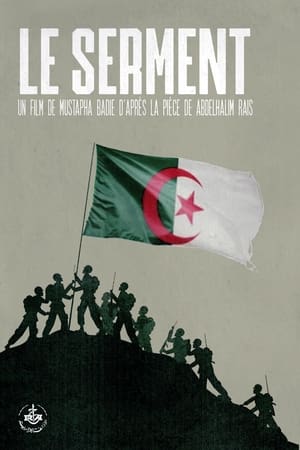
Le Serment
The Oath, a TV film produced by Algerian television in 1963 following the end of the war of independence, tells the story of young Algerians who joined the resistance after the bloody repressions of May 1945 in Constantinois by the French colonial army .
1963

Cléo from 5 to 7
Agnès Varda eloquently captures Paris in the sixties with this real-time portrait of a singer set adrift in the city as she awaits test results of a biopsy. A chronicle of the minutes of one woman’s life, Cléo from 5 to 7 is a spirited mix of vivid vérité and melodrama, featuring a score by Michel Legrand and cameos by Jean-Luc Godard and Anna Karina.
1962

Jamila, the Algerian
Djamila, a young Algerian woman living with her brother Hadi and her uncle Mustafa in the Casbah district of Algiers under the French occupation of Algeria, sees the full extent of injustice, tyranny and cruelty on his compatriots by French soldiers. Jamila's nationalist spirit will be strengthened when French forces invade her university to arrest her classmate Amina who commits suicide by ingesting poison. Shortly after the prominent Algerian guerrilla leader Youssef takes refuge with her, she realizes that her uncle Mustafa is part of this network of anti-colonial rebel fighters. Her uncle linked her to the National Liberation Front (FLN). A series of events illustrate Jamila's participation in resistance operations against the occupier before she was finally captured and tortured. Finally, despite the efforts of her French lawyer, Jamila is sentenced to death...
1958