Watch Time, Ago! (2017) Online Free
"Time, forward!" - two orchestral suites by George Sviridov, published for the first time in 1968 (first suite) and in 1977 (second suite). The suites were created on the basis of music for the film "Time, Forward!" By Mikhail Schweitzer (based on the novel of the same name by Valentin Kataev, shot in 1965, released in 1966), dedicated to the construction of the Magnitogorsk Metallurgical Combine. From the first suite, the most famous part is "Time, forward!". Subsequently, it was used in a number of films, in television and radio programs, documentary films about the first five-year plans, industrialization, and post-war reconstruction. Sergei Oskolkov composed his suite: "Time, back!" The film is dedicated to the 100th anniversary of the revolution in Russia.
Cast
Sergey Oskolkov
More Like This
Mismantler
A dark, stream of consciousness fever dream, gathering all that is decrepit in this world, and reflecting it all back to those who have reduced the Earth to what it is.
2025
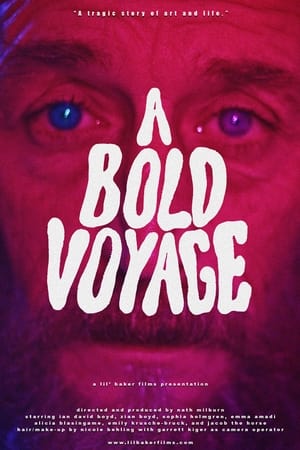
A Bold Voyage
A tragic story of a musician taking a bold voyage in the pursuit of creation, ambition, and need. Letting life choose for him, as part of the art itself and coming to terms with his decisions.
2024
Wilderness
A cinematic meeting point between nature and technology, Doug Aitken’s unearthly short is enfolded in evocative hymns whose voices are eerily AI-generated. Glimmering phone screens might have replaced the starry Milky Way, yet the famous Venice Beach still hums with the vibrancy of human activities.
2022
Last Love
The plot begins with them and ends with humanity. This author wanted to show continuity: the first love and the supposed last is an indivisible whole of one eternal Love.
2017
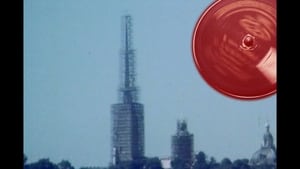
The Lone
The loneliness of man before nature. Loneliness in the urban environment. Loneliness as a way of life. Alone in front of myself - The film is dedicated to the artists of "Silver age" or "Fin de Siecle". This dedication applies primarily to Kazimir Malevich, and Edvard Munch.
2017

Hypnosis Display
Exploring impressionistic, emotional and sensory environments found within the vast natural and urban landscapes of America. Neither image nor sound takes precedence: the two interact and combine preserving a raw sense of the discovery that field recordings and in-camera edited film rushes often yield.
2014
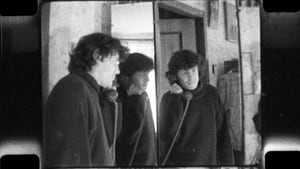
Conversation
To the idly meditating musician received a call from his distant friend with a proposal to write a song about the untimely departed Lady Diana.
2010
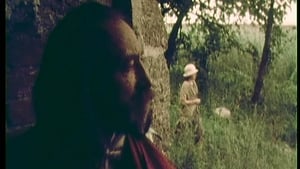
The Birth of Music
The film is an allegory in which the attempt is made to show the inner process of movement of the composer's soul at the time of the birth of music.
2010

Memory Vague
Created entirely from YouTube videos and edited in Windows Movie Maker, Lopatin recomposes outmoded video graphic landscapes via repetition and abuse.
2009
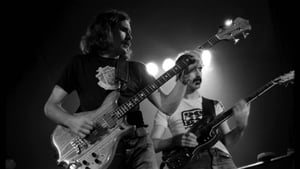
Classic Albums: Frank Zappa - Apostrophe (') Over-Nite Sensation
This episode focuses on Zappa's early 70s albums, Overnight Sensation (1973) and Apostrophy (') (1974). Together they encapsulate Zappa's extraordinary musical diversity and were also the 2 most commercially successful albums that he released in his prolific career. Included are interviews, musical demonstrations, rare archive & home movie footage, plus live performances to tell the story behind the conception and recording of these groundbreaking albums. Extras include additional interviews and demonstrations not included in the broadcast version, 2 full performances from the Roxy in 1973 and Saturday Night Live in 1976, and new full live performance done specially for these Classic Albums.
2007
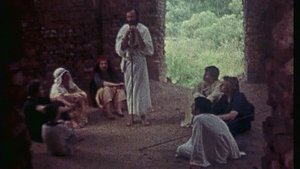
The Granny's Apocrypha
Saw and imagined in the children's fantasy the story of grandmother of Christ and the Apostles a little girl. Today few people remember that just a few decades ago in the village houses next to the icons you could still see the popular prints on religious themes. They finally disappeared from use only in the 60-ies of the last century. Of course, their creators were not professional painters or connoisseurs of theology. Drew, as best they could, she felt, not knowing neither rules nor laws. Simple uneducated people, nuggets, sought to glorify God with their creativity, that resonates in the hearts of those of peasants or artisans as they are.
2001

Puppets & Demons
An anthology of surreal films by Patrick McGuinn featuring Vincent, a puppet who is obsessed with Twinkies and pasta.
1997
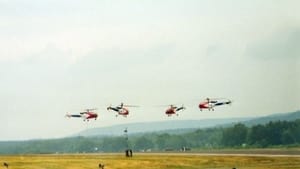
Helicopter String Quartet
One morning, the late Karlheinz Stockhausen awoke from a dream that told him to take to the sky. Stockhausen envisioned four helicopters swirling in the clouds, with each of a quartet’s members tucked inside his own chopper, communicating through headsets, stringing away in sync to the rotor-blade motors. He immediately set forth to make that dream a reality. In 1995, Dutch film director Scheffer followed Stockhausen in the days leading up to the premiere performance of his Helicopter String Quartet in Amsterdam. The resulting film offers a rare glimpse of Stockhausen as he patiently dictates every agonizingly detailed measure to the Arditti Quartet.
1996
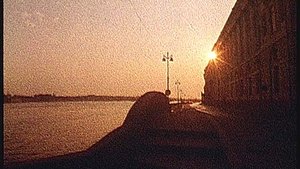
Phantoms of White Nights
Black people, red dwarfs, idols on bronze steeds, shadow of geniuses and heroes. This is not story about Hades from an ancient history textbook. This is Sankt-Petersburg In mystical literary tradition such as he is. A pomposity, an open space and - deathness. There is no gleam in the sky, Neva looked like poured by a lead, a crude air presses and can not pass through lungs, which are already struck by bacillus Kochii, and there are around ominous frights, threatening to punish for an unknown offence. And even white nights are bad. It looks as if you can meet phantom of a Poet which was tortured at thirtieth years of any of the last centuries. Be careful with monuments. They fond of walk along town quays (as told us Poushkin - he brings luck!). And do not trust this Neva prospectus. City - phantom, evolved from a bog which is refuge of evil spirits. Brilliant St.-Petersburg.
1991

Plague Mass
A conceptual live concert by Diamanda Galás, "Plague Mass" continues the themes of the suffering and misery of the infected found in her "Masque of the Red Death" trilogy.
1991
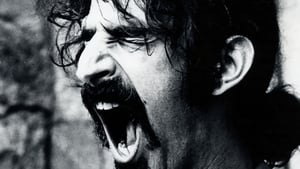
Frank Zappa: Does Humor Belong in Music?
Frank Zappa and his band in a digitally recorded live performance at "The Pier" in New York, NY on August 26, 1984.
1985

Magick Lantern Cycle
Cinematic magician, legendary provocateur, and author of Hollywood Babylon, Kenneth Anger was a unique figure in post-war American culture. His iconic short films are characterised by a mystical-symbolic visual language and phantasmagorical-sensual opulence that underscores the medium’s transgressive potential. Anger’s work fundamentally shaped the aesthetics of 1960s and 1970s subcultures, the visual lexicon of pop and music videos and queer iconography. These nine films form the basis of Anger’s reputation as one of the most influential pioneers of avant-garde film and video art. Fireworks, 1947, 14 min Puce Moment, 1949, 6 min Rabbit's Moon, 1950/1971, 16 min Eaux d'Artifice, 1953, 13 min Inauguration of the Pleasure Dome, 1954, 37 min Scorpio Rising, 1964, 28 min Kustom Kar Kommandos, 1965, 3 min Invocation of My Demon Brother, 1969, 11 min Lucifer Rising, 1981, 27 min
1974
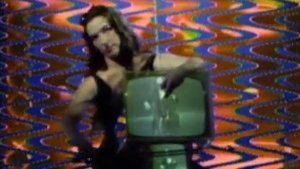
Global Groove
Global Groove was a collaborative piece by Nam June Paik and John Godfrey. Paik, amongst other artists who shared the same vision in the 1960s, saw the potential in the television beyond it being a one-sided medium to present programs and commercials. Instead, he saw it more as a place to facilitate a free flow of information exchange. He wanted to strip away the limitations from copyright system and network restrictions and bring in a new TV culture where information could be accessed inexpensively and conveniently. The full length of the piece ran 28 minutes and was first broadcasted in January 30, 1974 on WNET.
1973

Oh Yoko!
Animation by japanese artist Keiichi Tanaami for John Lennon's song "Oh Yoko!" -- the song was released in 1971, and the animation made in 1973. Keiichi Tanaami (田名網 敬一, Tanaami Keiichi, born in 1936 in Tokyo) was one of the leading pop artists of postwar Japan, and was active as multi-genre artist since the 1960s as a graphic designer, illustrator, video artist and fine artist until his death in 2024.
1973
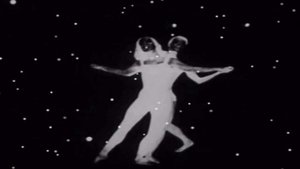
The Very Eye of Night
Dancers, shown in photographic negative, perform a series of ballet moves, solos, pas de deux, larger groupings. The dancers glide and rotate untroubled by gravity against a slowly changing starfield background. Their movements are accompanied by music scored for a small ensemble of woodwind and percussion.
1958