Watch The Scientist, The Imposter and Stalin: How to Feed the People (2018) Online Free
The documentary tells two very different human fates in the 1920s Soviet Union. Nikolai Vavilov was a botanical genius, Trofim Lyssenko was an agronomist who made great promises and fake inventions. Each of them tried to solve the country's nutritional problem, but only one succeeded.
Cast
Marina Vlady
More Like This

Mr. Nobody Against Putin
As Russia launches its full-scale invasion of Ukraine, primary schools across Russia’s hinterlands are transformed into recruitment stages for the war. Facing the ethical dilemma of working in a system defined by propaganda and violence, a brave teacher goes undercover to film what’s really happening in his own school.
2025

Emergency
Based on true events that unfolded in 1975, the film chronicles incidents that took place under the leadership of Indira Gandhi, one of the most powerful women in Indian history.
2025
Vichy in the Colonies
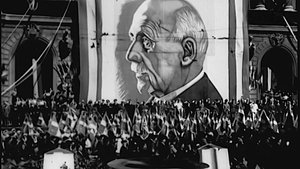
After the defeat of 1940, and faced with the unexpected collapse of French power, all eyes turned to a horizon of both hope and uncertainty: the colonies. France had suddenly become an empire without a metropolis, reduced to two-thirds of its former size. Pétain saw the colonies as a "consoling myth" after the defeat, while de Gaulle considered them essential strategic locations for the Resistance. The two clashed in a propaganda war.
2023
Eurodonbas
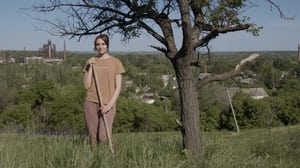
Throughout time, Eastern Ukraine (such as Donbas) has been referred to as a 'Russian world', but this is indeed not the case. The history of Donbas was re-written during the Soviet era. Although the Soviet Union edited out and withheld all references to the European background of this region from history books in schools and universities. There were, in fact, numerous French, Belgian, German, British, Polish, Swiss, Dutch, and even American settlements and more than 100 wide-scale enterprises in the region. Therefore, this film reveals the pro-European industrialization of Ukrainian Donbas at the turn of the 19th century. It aims to emphasize the European roots of Ukraine long before the official integration process of Ukraine into the EU in 2022.
2022
The Village Detective: A Song Cycle
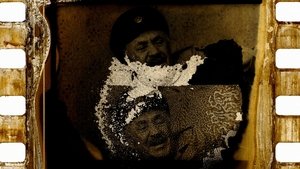
Atlantic Ocean, off the coast of Iceland, July 9, 2016. The surprising discovery of a canister —containing four reels of The Village Detective (Деревенский детектив), a 1969 Soviet film—, caught in the nets of an Icelandic trawler, is the first step in a fascinating journey through the artistic life of film and stage actor Mikhail Ivanovich Zharov (1899-1981), icon and star of an entire era of Russian cinema.
2021
Human By Chance?
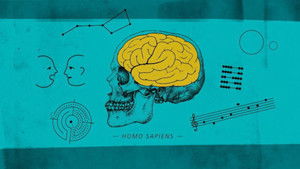
If we compare ourselves with our genetically closest living relatives, the chimpanzees, we have few physical advantages. We are far weaker, cannot move nearly as fast, and do not have the same climbing capabilities. Instead, humans excel in areas such as architecture, religion, science, language, writing, art, culture, and ideas. These achievements are due to our larger brain that contain billions of neurons. It was the rapid growth of our brain, originating about 2 million years ago, that allowed us to be the predominant species of the world. What caused this rapid growth of our cerebral cortex? Researchers worldwide have asked this question for many years, but now there finally seems to be an answer.
2020
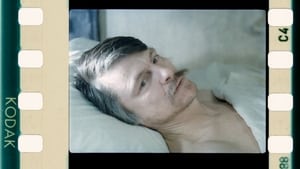
Andrey Tarkovsky. A Cinema Prayer
An account of the life and work of Russian filmmaker Andrey Tarkovsky (1932-86) in his own words: his memories, his vision of art and his reflections on the fate of the artist and the meaning of human existence; through extremely rare audio recordings that allow a complete understanding of his inner life and the mysterious world existing behind his complex cinematic imagery.
2019
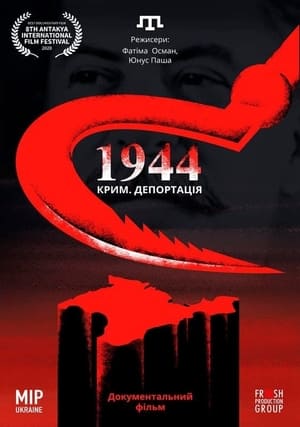
1944. Deportation
In 1944 Crimean Tatars has suffered a long road in exile. It was accompanied by famine, illness and loss. In the first years of exile, almost half of deported Crimean Tatars died. But those, who survived, dreamed of only one thing - to return to Crimea. The documentary 1944 tells about the tragedy of all Crimean Tatars through several separate life stories. They are cherished by each Crimean Tatar family and must be remembered by all generations to come.
2019
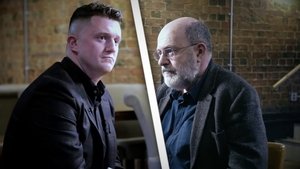
Panodrama
Tommy Robinson goes on the offensive by documenting how his own “hit piece” on his character was being constructed by the taxpayer-funded BBC for their popular investigative news special “Panorama.” In the film he manages to capture footage of the blackmailing of his former employees to invent stories, along with an organization—known as “Hope not Hate”—on set with the BBC, intimidating ex-employees of Robinson during interviews. The host of “Panorama” at the time of filming is caught on camera casually using racist and homophobic slurs during a £220 champagne lunch with the same ex-employee they had planned to coach for a fake interview in which the BBC would possibly edit in which to make it appear as, “a gender, a sexual thing against Tommy Robinson,” according to the host. Within 24 hours of releasing the film, social media giant Facebook made a public statement of their own and removed Tommy Robinson’s accounts permanently.
2019
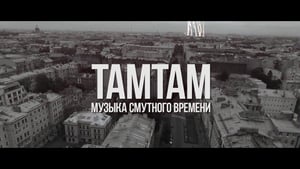
TaMtAm - Music of the time of troubles
Documentary film about the first St. Petersburg music club TaMtAm. It existed since 1991 upon 1996 and was held by Vsevolod Gakkel, ex-cellist of "Аквариум". The concept was modelled on cult NY club CBGB-OMFUG. Despite its controversial history this is the place where a new generation of Russian punk music was discovered.
2017

The Occupation of the American Mind
Over the past few years, Israel's ongoing military occupation of Palestinian territory and repeated invasions of the Gaza strip have triggered a fierce backlash against Israeli policies virtually everywhere in the world—except the United States. This documentary takes an eye-opening look at this critical exception, zeroing in on pro-Israel public relations efforts within the U.S.
2016

Lions for Lambs
Three stories told simultaneously in ninety minutes of real time: a Republican Senator who's a presidential hopeful gives an hour-long interview to a skeptical television reporter, detailing a strategy for victory in Afghanistan; two special forces ambushed on an Afghani ridge await rescue as Taliban forces close in; a poli-sci professor at a California college invites a student to re-engage.
2007

Hostile Waters
Based on true events, an American submarine collides into a Soviet sub of the coast of America and an ensuing standoff occurs that could lead to total annihilation.
1997
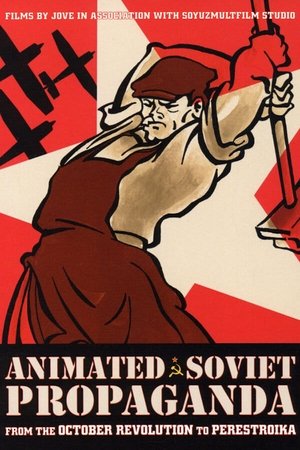
Animated Soviet Propaganda
A landmark four disc Box Set - Unearthed from Moscow's legendary Soyuzmultfilm Studios, the 41 films in ANIMATED SOVIET PROPAGANDA span sixty years of Soviet history (1924 - 1984), and have never been available before in the U.S.
1997
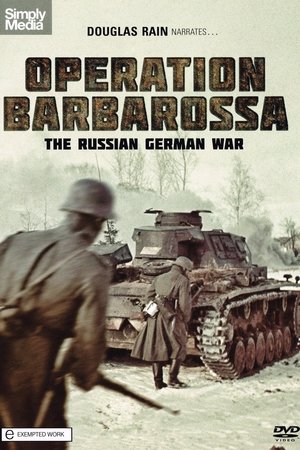
The Russian German War
This is a rare look at one of the worst horror stories in the long infamous history of warfare. This series features captured German and Russian film footage, much of which has never been seen before. For decades the Cold War prevented us from looking closely at what really happened between the Russians and the Germans on the Eastern Front during World War II. More than a struggle between nations, it pitted maniacal tyrant against maniacal tyrant, evil ideology against evil ideology. The lives of tens of millions of human beings were consumed by its raging hatreds and appalling indignities. One in every ten Russians died. One in every four Poles died. Whole divisions of Italians, Romanians, Hungarians disappeared with barely a trace. An average of 17,800 people died on every single day and this, the war on the Russian German Front, lasted for 1,400 days. This series features captured German and Russian film footage, much of which has never been seen before.
1995
Invasion
Docu-drama surrounding the events leading to the Soviet Union's invasion of Czechoslovakia in 1968.
1980

Railway Station
Warsaw's Central Railway Station. 'Someone has fallen asleep, someone's waiting for somebody else. Maybe they'll come, maybe they won't. The film is about people looking for something.
1980
Et Vint La Liberté
A historical epic that chronicles the Guineans’ long struggle against French colonialism and for their country’s independence.
1969
The Lost Apple
An anti-Communist propaganda film produced by the United States Information Agency for the indoctrination of the children separated by Operation Peter Pan into the United States. The short film follows the life of Roberto and two other young children inside the Florida City Camp that was one of the main offloading sites for children.
1962
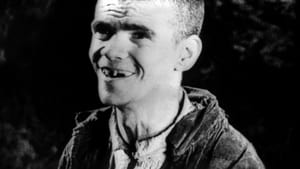
Land Without Bread
An exploration —manipulated and staged— of life in Las Hurdes, in the province of Cáceres, in Extremadura, Spain, as it was in 1932. Insalubrity, misery and lack of opportunities provoke the emigration of young people and the solitude of those who remain in the desolation of one of the poorest and least developed Spanish regions at that time.
1933