Watch The Memories of Angels (2008) Online Free
Documentary, poetry and essay rolled into one, this compilation of stockshots and clips sourced from NFB productions of the '50s and '60s offers a singular lesson in Montreal history - its famous figures, symbolic places, and ordinary citizens. Without commentary, the film moves from the red light district to Jean Drapeau, the Jacques-Cartier market, department stores downtown, textile factories, and the construction of Place Ville-Marie. We meet Geneviève Bujold, Oscar Peterson, Monique Mercure, and Igor Stravinsky. We hear Raymond Lévesque, Jean Drapeau, and René Lecavalier.
Cast
Paul Anka, Geneviève Bujold, Oscar Peterson, Igor Stravinsky, Carol-Lynne Traynor
More Like This
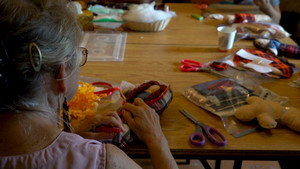
Healing Dolls
The testimonies of the Mashteuiatsh Puakuteu women's committee punctuate this intimate short film about mourning and healing. Throughout the doll-making workshops, the women share their doubts and hopes and build a space filled with strength and solidarity.
2026

Balance
Anna, a twelve-year-old Ukrainian gymnast, has fled her war-torn country and recently settled in Montreal with her mother, younger brother, and grandmother. Confronted by the past, the challenges of exile, and a deep need for belonging, she seeks to rebuild her identity and regain her balance. Through her child’s perspective, the documentary explores the reality of life after war, questioning what endures and what is missing, even when one has found refuge.
2024
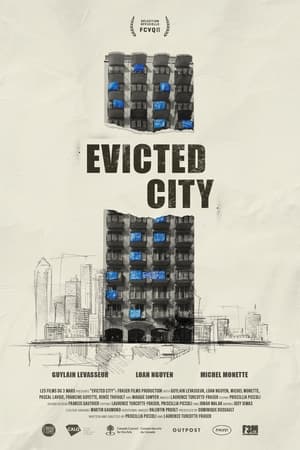
Evicted City
Montreal — one of the few remaining affordable cities in North America — is now in the midst of an unprecedented housing crisis. An intimate portrait of socio-political resistance, this multilayered film explores the human impact of real estate speculation on the cities of tomorrow.
2023
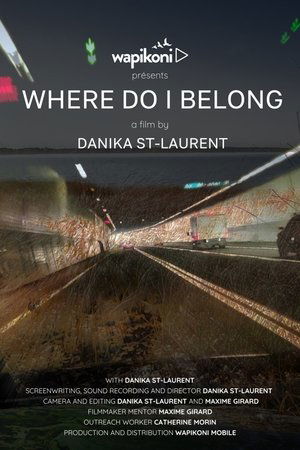
Where do I Belong
In a continuation of her first film We Are Not Speaking the Same Language, Danika explains what it feels like to be displaced Indigenous urban.
2022

SAQ : 100 ans d’histoire
To mark the 100th anniversary of the Société des alcools du Québec, Francis Reddy tells the exhilarating story of alcohol in Quebec from prohibition to promotion. With the help of historian Laurent Turcot and local producers, Reddy explores the unique relationship Quebecers have with alcohol and its place in their lifestyles over the years.
2021
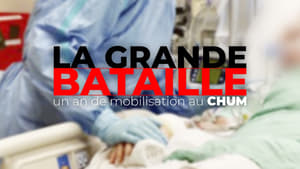
La grande bataille : un an de mobilisation au CHUM
In 2020, with the COVID-19 pandemic raging at historic proportions in the background, the Centre hospitalier de l’Université de Montréal (CHUM) decided it was its duty to posterity to document the crisis. The communications team took out the mics and cameras to capture what went on inside the hospital walls for one full year.
2021
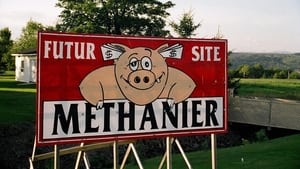
La bataille de Rabaska
2018
Les Hiboux, ça change des vies!
2018
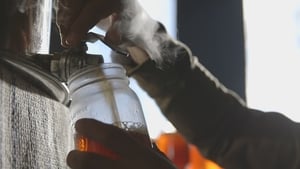
Le goût d'un pays
Focused on an inspiring and touching dialogue between Gilles Vigneault and Fred Pellerin, the documentary tells the story of Quebec by digging deep into an ancestral tradition etched into our cultural DNA: the production of maple syrup.
2016
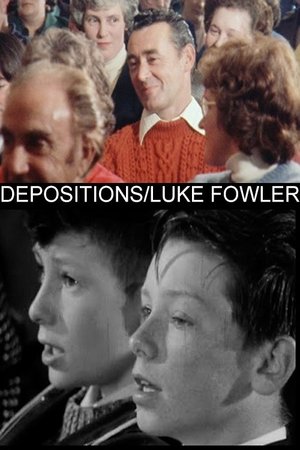
Depositions
The quietly insistent and critical DEPOSITIONS attempts to restore some dignity to images of the communities of the Scottish highlands taken from patronizing BBC documentaries and news features from the 70’s and 80’s. DEPOSITIONS repurposes footage from the archives of the BBC and sound from the School of Scottish Studies, it is a film about differences and dichotomies: science and superstition, near and far, community and the individual.
2014
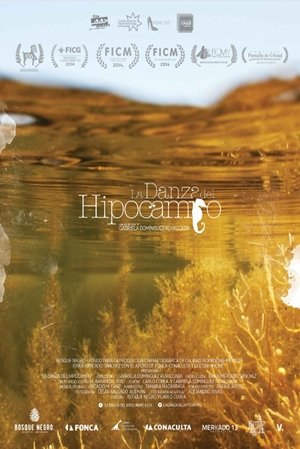
The Dance of Memory
Memory mechanisms are mysterious: we only see the stories we choose in order to construct our own reality. Every mark is a message in time, the invocation of an absence. To travel in the memory is to walk in time, zigzagging, a long road permeated by a dark, indecipherable logic… if we could choose seven moments to sum up our entire life, which ones would they be? The Dance of the Memory is a documentary-essay that guides us in that autobiographical search, where image and memory intertwine. It mixes archive material with an aesthetic and subjective tone.
2014
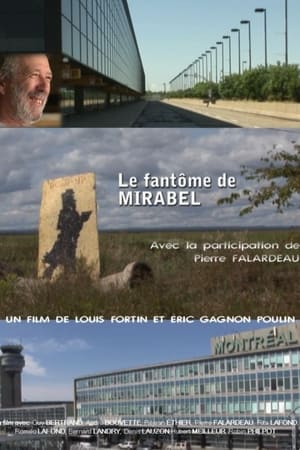
Le fantôme de Mirabel
2011
La dérive douce d’un enfant de Petit-Goâve
2009
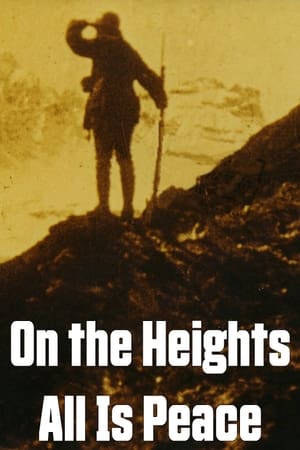
On the Heights All Is Peace
Found footage anti-war film comprising film documents of the Austro-Hungarian and Italian army on the Alpine front, and from first generation picture material by war-film pioneer Luca Comerio.
1998
Black Hole Radio
Black Hole Radio is an installation that consists of taped confessions of callers of the New York City Phone Confession Line and video images. The Phone Confession Line is based on anonymous callers ringing to confess on things they had done or thought like adultery, theft, murder or regrets. Thereafter anybody could call and listen to the confessions. Although making a confession was free, listening to a confession costs money. After Cohen got his hands on the confessions, he used them as an audio heartbeat to accompany video-images of every day life in New York City he had taken over the years. This installation is a portrait of the city with its dark secrets, hushed voices and nocturnal images. In this way Cohen tries to bring across an experience to the viewer that relies on absence, waiting and the effort to hear something in the dark.
1992
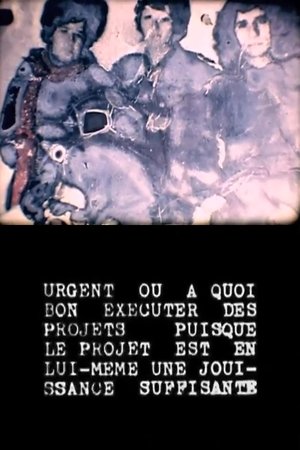
Urgent ou à quoi bon exécuter des projets puisque le projet est en lui-même une jouissance suffisante
Gérard Courant applies the Lettrist editing techniques of Isidore Isou to footage of late 70's pop culture. Courant posits that his cinema offers an aggressive détournement to the French mainstream, reifying a Duchampian view of film: "I believe in impossible movies and works without meaning... I believe in the anti-movie. I believe in the non-movie. I believe in Urgent... My first full length movie that is so anti-everything that I sometimes wonder if it really does exist!"
1977
Under a Bridge
In this tape, Ko Nakajima and Video Earth Tokyo interview a homeless man. The subject is initially angry and frustrated, but gradually opens up and shares stories about his life. Under A Bridge was later broadcast on cable television.
1974
Tout le temps, tout le temps, tout le temps...?
1969
Ville-Marie
Today it is the city of Montreal, but 3 centuries ago the tiny band of missionary founders called it Ville-Marie, the holy city of Mary. This film goes back to its beginning and those who felt called to plant an oasis of Christianity in the North American wilderness. In an imaginative, at times almost surrealistic, way the film recalls the highborn company from France, and shows what survives of Ville-Marie in the Montreal of today.
1965
Nanook of the North
This pioneering documentary film depicts the lives of the indigenous Inuit people of Canada's northern Quebec region. Although the production contains some fictional elements, it vividly shows how its resourceful subjects survive in such a harsh climate, revealing how they construct their igloo homes and find food by hunting and fishing. The film also captures the beautiful, if unforgiving, frozen landscape of the Great White North, far removed from conventional civilization.
1922