Watch The Day Israel Attacked America (2014) Online Free
Al Jazeera investigates the shocking truth behind a deadly Israeli attack on a US naval vessel during the 1967 Arab-Israeli Six-Day War. The unprovoked action against the surveillance vessel USS Liberty, in which 34 were killed and 171 wounded, is recounted by those who were there and those who investigated it. Was it a case of mistaken identity?
More Like This

Severed
Severed tells the story of Mohamad Saleh, an 18-year-old from Gaza who has lived through five major assaults on the Gaza Strip. In those attacks, he lost his home, family members, his best friends, and, at the age of 12, his leg. Now living in exile in Egypt, Mohamad struggles to piece together the shattered fragments of his life. Through his eyes, the pain and trauma endured by thousands in Gaza are laid bare, alongside their remarkable strength, resilience, and determination to live.
2025

Life and Death in Gaza
A film made by four Palestinians living through extraordinary times. Filming from the first days of the war, Khalid, Aya, Adam and Aseel document their own lives as they endure bombing raids, multiple evacuations, family separations and reunions, deaths, and even the birth of a new life amidst the chaos.
2024
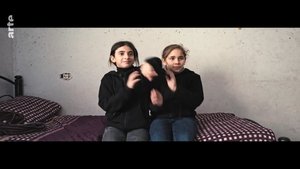
Aufwachsen im Westjordanland - Gefangen im Zorn
Two 10-year-old girls, one Palestinian and one Israeli, recount their daily lives under bombardment in the West Bank. Two poignant perspectives on the same conflict.
2024

The Killing Roads
The Killing Roads is a gripping documentary that exposes the terror unleashed on October 7, 2023, when Hamas launched coordinated attacks across the roads of southern Israel. Through raw, unfiltered stories from victims, survivors, and first responders, the film reveals the unimaginable violence that turned Israel’s peaceful roads into scenes of horror.
2024
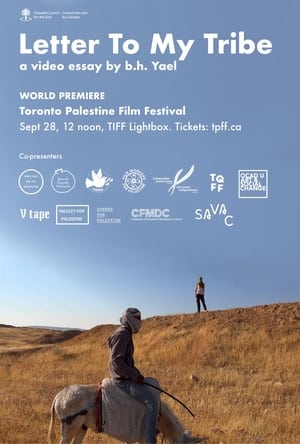
Letter to My Tribe
Letter to My Tribe started with a question: Why don’t more Jews and Israelis speak out about Palestine? Over many years my mother, who represents a more messianic perspective, and I have had numerous arguments, some recorded, some not. These form the backbone of this video essay in which Israelis and Jews, journalists, activists and a rabbi are interviewed, and in which documentation of actions on the ground, in the West Bank, are woven with more personal family histories and journeys to Iraq and to Poland.
2024

A State of Rage
In the West Bank, children grow up amidst a harsh and unforgiving reality. Daily life for Palestinians in Jenin Refugee Camp is shaped by the Israeli occupation, and the violence and oppression that comes with it. On the hills near Nablus, a Jewish settler family navigate the personal sacrifices and grief that come with their decision to live in an illegal settlement. They are resolute in their belief to remove Palestinians and settle the land. Children and their parents from both these areas search for their place in a world defined by violence and polarization.
2024

Trauma in Nahost - Der 7. Oktober und seine Folgen
October 7, 2023: Hamas terrorists attack Israel, murder and take hostages. Israel reacts with severity. The goal: the destruction of Hamas. But with the war in Gaza, Israel is awakening the great trauma of the Palestinians: the expulsion of 1948. How can the lack of empathy on both sides be explained?
2024
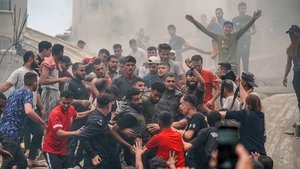
Israel and Gaza: Into the Abyss
This deeply affecting documentary follows a small number of Israelis and Gazans through the most dramatic and tragic year of their lives. Using personal and previously unseen footage, it tells the story of the war in Gaza and the October 7 attacks through deeply emotional stories from both sides of the conflict. In Gaza, the film follows three individuals from reaction to the October 7th attacks to the start of the bombing by the Israeli military and to the loss of family members that all three suffer. In Israel, we witness footage of the Israeli characters, as they and their family members are attacked by Hamas on October 7th and then follow their stories through the year.
2024
Blutiges Erbe – Das Ende der Osmanen
After the end of the First World War, another place besides Versailles stood for the reorganization of the world: not far from the Paris Palace lies the city of Sèvres. It was there that the victorious powers of France, Great Britain and the USA sealed the fate of an empire: the Ottoman Empire was to be broken up forever. The consequences of the Treaty of Sèvres can still be felt today in the form of terror.
2021
Sebastia
Sebastia, a small archaeological town, sits on top of a hill Northwest of Nablus, Palestine surrounded by Shavei Shomron, an illegal Israeli settlement and confiscated agricultural fields of olive groves and apricot trees. This ancient site was excavated multiple times over the last century by colonial archaeologists funded by Zionist individuals and institutions. The first excavation of 1908 led by Harvard University took advantage of Sebastia locals including women, men, and children as cheap labor digging their own land for the sake of biblical archaeology. Each excavation extracted soil and artifacts from the ground, taking what they considered valuable to their home institutions and leaving pottery shards and rubble on the surface. Today, what’s left of the archaeological monuments is contested by the nearby settlement as well as the Israeli military. The Roman Forum is a battlefield, but the locals are incredibly resilient.
2020
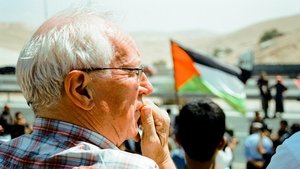
This Is Not a Movie: Robert Fisk and the Politics of Truth
For more than forty years, British journalist Robert Fisk has reported on some of the most violent conflicts in the world, from Northern Ireland to the Middle East, always with his feet on the ground and a notebook in hand, travelling into landscapes devastated by war, ferreting out the facts and sending reports to the media he works for with the ambition of catching the interest of an audience of millions.
2019
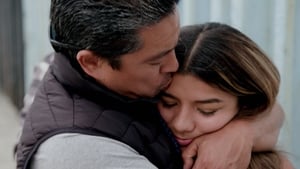
Walls of Silence
Mexico─United States border bar, “Trump Wall” is full of displaced migrants’ grief. Gaston who came to America as a teenager, is expelled from the States at his 40s and meets his family at the Wall. Bassam and Rami, becomes a dad who lost their daughter by each other. This film describes the people who lost their family by the wall and includes the views of refugees, human rights. Actor Jung Woo Sung participated in narration of the film.
2019
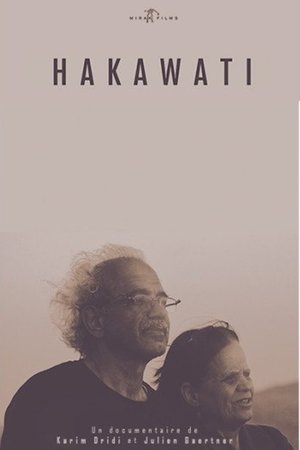
Hakawati, the Last storytellers
Despite their children's reluctance, Radi and Mounira, a 65-year-old puppeteer couple, set off on tour between Israel and Palestine in their outdated van. They are exhausted from having to set up and take down the stage, from performing three shows in a row in front of hundreds of wild children under a burning sky. Lost in Jericho, frightened by the bombs falling near Majd Al Shams, destabilized by the Bedouin children of the Negev unable to determine their own identity, they no longer know if their mission is still relevant. Safeguarding the identity of their people through their shows, but at what cost? A quest for Palestinian identity.
2019
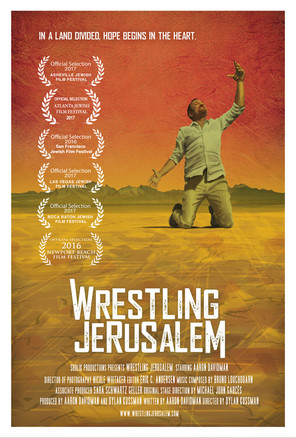
Wrestling Jerusalem
Writer-actor Aaron Davidman embodies seventeen different characters in and around the sacred city of Jerusalem as he takes us on an eye-opening journey into the heart of the Israeli-Palestinian story. Exploring universal questions of identity and human connection, the film is about one man's effort to embrace a multiplicity of conflicting viewpoints, chronicling a brave exploration of the complex humanity at the heart of one of the world's most troubling conflicts.
2016
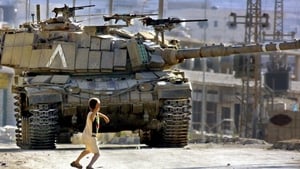
The Occupation of the American Mind
Over the past few years, Israel's ongoing military occupation of Palestinian territory and repeated invasions of the Gaza strip have triggered a fierce backlash against Israeli policies virtually everywhere in the world—except the United States. This documentary takes an eye-opening look at this critical exception, zeroing in on pro-Israel public relations efforts within the U.S.
2016

Love During Wartime
"There can only be an unhappy ending to this", people say when they hear about Palestinian Osama and his Israeli wife Jasmin’s love. Their home countries separate them through racist laws and lack of security. They choose exile, but soon rosy dreams turn into despair in an inhospitable Europe. Will their love survive?
2010
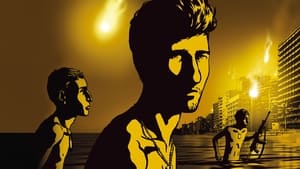
Waltz with Bashir
An Israeli film director interviews fellow veterans of the 1982 invasion of Lebanon to reconstruct his own memories of his term of service in that conflict.
2008
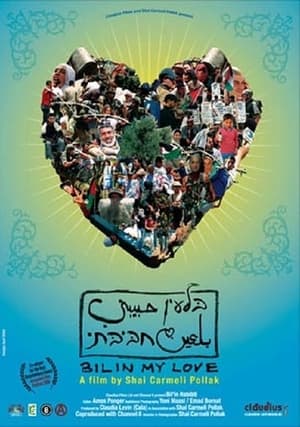
Bil'in Habibti
The Israeli filmmaker Shai Corneli Polak records the building of the 'security wall' through Palestinian territory at the village of Bil'in. The villagers protest mostly peacefully, while the Israeli army doesn't react peacefully. By now the Israeli High Court has ruled that the building of the wall was illegal.
2006
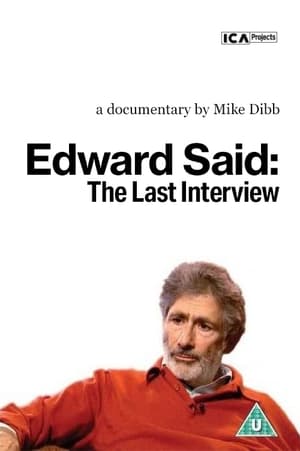
Edward Said: The Last Interview
Edward Said, Professor of English & Comparative Literature at Columbia University, was a prominent literary critic of the late 20th century and a leading spokesperson for the Palestinian cause in the US. Born to a Palestinian family in Al-Quds (Jerusalem) in 1935, he and his family were dispossessed in 1948 and settled in Cairo. Educated in the US, he lived in New York for many years. Said was a member of the Palestine National Council. After resigning from the PNC in 1991, Said wrote critically about the post-Oslo peace process, the political failures of Yasser Arafat and the PLO. Said was diagnosed with leukemia in 1991 and struggled with the disease while continuing to write and teach. He stopped giving interviews but made an exception less than a year before his death in 2003, speaking about his illness, work, Palestine, politics, life, and education. The last interview is the final testament of this passionately committed intellectual.
2004
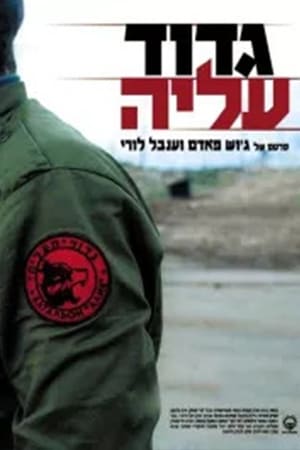
Gdud A'liyah
The long lasting Palestinian-Israeli conflict has created appaling phenomenons that have horrified the Israeli society. the "politically conscience-refusals" or those individual soldiers refusing to fight in the occupied territories, are one of those phenomenons. In opposition to them stand a thousand immigrants from the former Soviet Union, ex-military men from the Red Army, who yearn to be recruited into the IDF and fight for Israel, but who are denied the right to serve in the army. Through the stories of Oleg and Alex, immigrants and the battalion's charismatic commanders, the story of the Russkii Battalion is told. It is a story of contrasts between the hardships of the daily struggles they face as new immigrants against the pride and the sense of belonging they find in the battalion. The Russkii Battalion is a film about a militaristic social bubble, in a country that is in constant war.