Watch Stasi: A State Against Its People (2021) Online Free
After the fall of the Berlin Wall, thousands of documents were hastily shredded by the dreaded GDR political police. 16,000 bags filled with six million pieces of paper were found. Thanks to the meticulous work of technology, the destinies of men and women who had been spied on and recorded without their knowledge could be reconstructed.
Cast
Véronique Augereau, Walter Ulbricht, Karl Alich, Günther Grässler, Helmut Müller-Enbergs, Erich Mielke, Bernd Roth, Günter Pelzl, Manfred Springer, Christian Booß, Erich Honecker, Tatjana Sterneberg
More Like This

Red Shadow over the White House
As the 2024 elections approach, Russian interference in American politics – through spies or agents of influence – is a troubling reality. Vladimir Putin is counting on Donald Trump’s victory to weaken support for Ukraine. Why does Trump almost always support Russia? Is he compromised? During his presidency, did he betray the United States in favor of the Kremlin? And why has the Republican Party shifted its stance toward Russia? Answering these questions means shedding light on a labyrinthine espionage and manipulation operation. Still ongoing, it began forty years ago, during the final years of the Cold War. Back then, Trump was merely a real estate developer, and Putin was a young KGB agent. This operation contains many dark areas, but some hold pieces of the puzzle. A former KGB leader, infiltrated “illegals,” a former Trump advisor, and former senior officials from the CIA and FBI, as well as a former prosecutor, provide testimony. . . . [taken from Nilaya Productions]
2024
Intercept: A Century of Signals Intelligence
A thought provoking documentary feature film providing a comprehensive exploration of the evolution of signals intelligence over the past century. Whether you're intrigued by the secretive world of intelligence agencies or concerned about the implications of digital surveillance, this film will leave you with a deeper understanding of the role signals intelligence plays in society.
2023
La Tragédie des Brigades Internationales
2016

Castro: The World's Most Watched Man
Fidel Castro employed a vast spy network that helped him remain in power.
2015

Pif, Behind the gimmicks
Taking stock of the extraordinary adventure of "Pif Gadget", a French publishing phenomenon of the 1970s-80s and even of the whole history of children's press. For the comic-strip magazine with the iconic dog, created in 1969 by the French Communist Party, often reached a million copies. With editions available for all of Europe (including Germany, under the title Yps), and on both sides of the Iron Curtain.
2015

Cannibal Island
A disturbing chapter in Russian history is explored in this documentary. In 1933, Joseph Stalin sent 6000 "unwanted" citizens of Moscow and Leningrad to a desolate Siberian island - with no food or clothes to speak of. Decades later this documentary returns to the island.
2009
Alexej Čepička – Z vojína generálem
2009
The Long Road Through Balkan History
Bosnian Croat writer Miljenko Jergović and Serbian writer Marko Vidojković replace one another by the steering wheel of Yugo, a symbol of their common past while driving on the Brotherhood and Unity Highway that stretched across five of six republics of Yugoslavia.
2009

Charlie Marx and the Chocolate Factory
Charlie Marx and the Chocolate Factory started as an investigation of the link between politics and chocolate, at the Karl Marx Confectionary Factory in Kiev, Ukraine. Since access to the factory was denied, the project had to be re-considered, re-invented or re-enacted. Mostly made of archival footage and re-enacted performances based on the company's website, the film merges what was left of the initial idea with what has been collected and realized instead. It borrows from the genres of video art, 'Man on the street' interview, direct address, corporate film, essay, and music video, without legitimately belonging to any of them. The film unravels as a reflection on its own failure, and yet keeps on investigating what has always been at stake: the shift from public to private property (and from analog to digital technology), dialectics of permanence and change, language as a mirror of ideology, and post-Soviet oligarchy culture.
2009
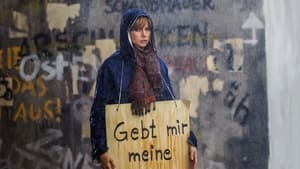
Die Frau vom Checkpoint Charlie
Based on a true story, Miguel Alexandre's two-part drama focuses on an East German woman and the fight for her children. Spring 1982: Sara Bender, living with her daughters Silvia and Sabine in the East German town of Erfurt, wants to marry her colleague Peter, but shortly before the wedding, her father is killed in a road accident. As the funeral takes place in West Germany, she isn't allowed to got there, so she starts planning to leave her communist home country forever. Trying to flee via Romania, she is caught by the secret service. After years in jail, Sara is ransomed by the West German government, but without her daughters. To draw the world's attention on her desperate situation, she starts demonstrating at the Berlin border crossing Checkpoint Charlie
2007
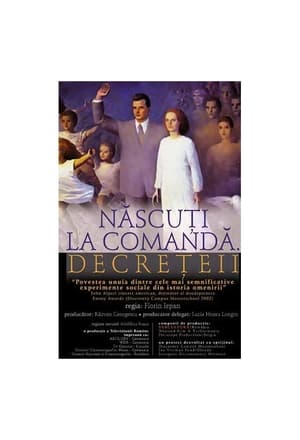
Children of the Decree
Procreation is the social duty of all fertile women, was the political thinking during the 1960s and 1970s in Romania. In 1966, Ceaucescu issued Decree 770, in which he forbade abortion for all women unless they were over forty or were already taking care of four children. All forms of contraception were totally banned. The New Romanian Man was born. By 1969, the country had a million babies more than the previous average. Romanian society was rapidly changing. By using very interesting archival footage and excerpts from old fiction films and by interviewing famous personalities from that time – gynecologists or mothers who were part of the new society - the director revives this period of tremendous oppression of personal freedom. Many deaths were caused by the mere fact that women, including wives of secret Romanian agents, famous TV presenters, and actresses, had to undergo illegal abortions. Many women were jailed for having them.
2005
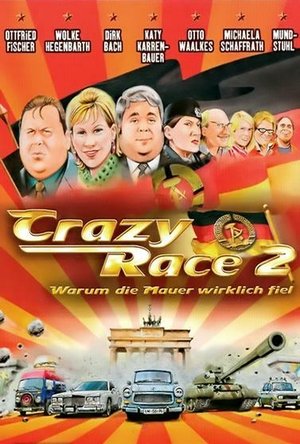
Crazy Race 2 - Warum die Mauer wirklich fiel
In 1989, Jenny Ecker, an 18-year-old daughter of an entrepreneur, flees from Hildesheim to the east - out of love. The teenager has fallen hopelessly in love with an East Berliner. Jenny’s parents are foaming from wrath and offer a reward: One-hundred thousand, later even a million, deutschmarks for whoever brings them their daughter back. The prospect of so much money gets east and west into quite a disarray – and in the end, the Wall really falls.
2004
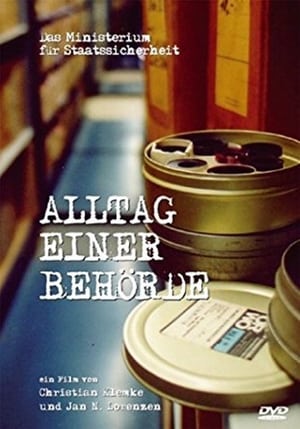
The Ministry for State Security - Everyday life at a public authority
Former heads, senior officers and the rector of the MfS law school explain how the ministry functioned. The interviewees see themselves as legitimate actors with a clear mandate and political enemy image. They provide an insight into the techniques and routines of secret service work, psychological tricks during interrogations and the management of “unofficial collaborators”. What they all have in common is that they are not aware of any moral guilt. The directors contrast their footage of prisons and archives with the statements of former Stasi employees in an attempt to expose their evasions and efforts at suppression.
2002
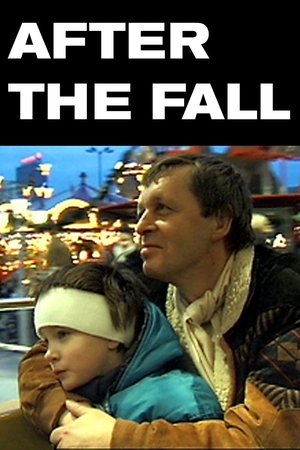
After the Fall
A documentary exploring the aftermath of the Berlin Wall's fall, the film features interviews in English and German with long-time residents and foreign visitors/residents from both sides of the former divide.
2000

Cycling the Frame
In 1988, Tilda Swinton toured round the Berlin Wall on a bicycle - starting and ending at the Brandenburg Gate - accompanied by filmmaker Cynthia Beatt. As Swinton travels through fields and historic neighborhoods, past lakes and massive concrete apartment buildings, the Wall is a constant presence.
1988
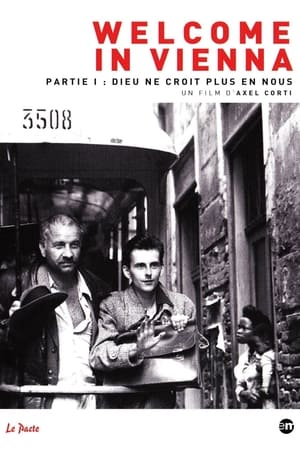
God Does Not Believe in Us Anymore
After his father is murdered by the Nazis in 1938, a young Viennese Jew named Ferry Tobler flees to Prague, where he joins forces with another expatriate and a sympathetic Czech relief worker. Together with other Jewish refugees, the three make their way to Paris, and, after spending time in a French prison camp, eventually escape to Marseille, from where they hope to sail to a safe port.
1982

Fischzüge
A ship from the GDR fishing fleet is on its way home. The work is done, the hold full of fish. Captain Nipmerow could be satisfied with that, but he has a completely different problem to deal with - a matter about which he also owes the shipping company a statement.
1975
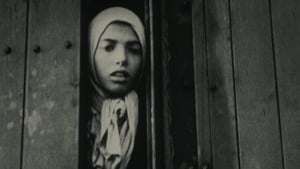
Night and Fog
Filmmaker Alain Resnais documents the atrocities behind the walls of Hitler's concentration camps.
1956
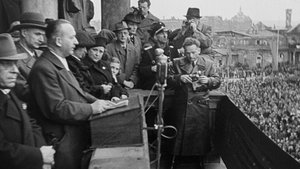
Unity SPD – KPD
Documentary about the merging of the Communist Party of Germany and the Socialist Unity Party of Germany in the Soviet occupation zone, a merger that would lead to the creation of the Socialist Unity Party that would rule the soon-to-be-created East Germany until 1989.
1946
Junge Deutsche im Mai
Every year, the most beautiful, best and proudest representatives of German youth meet in Dresden to take to the streets together.