Watch Sophie Pacini & Martha Argerich: New Year's Impressions from Vienna (2022) Online Free
Martha Argerich, is considered as one of the greatest pianists of our time. Sophie Pacini, on the other hand, has been praised by critics and loved by her fans for her 'effectful, but never affected piano playing'. An intimate and lightning personal and artistic friendship connects Sophie Pacini with Martha Argerich, who has now become her personal musical mentor. The two female pianists play at the Konzerthaus Wien with festive splendor on four hands with works by Mozart and Liszt.
Cast
Martha Argerich
More Like This
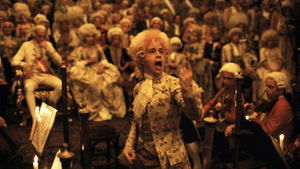
Amadeus
Disciplined Italian composer Antonio Salieri becomes consumed by jealousy and resentment towards the hedonistic and remarkably talented young Salzburger composer Wolfgang Amadeus Mozart.
1984
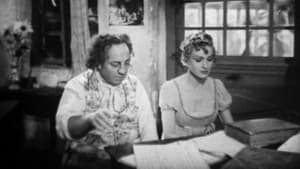
The Life and Loves of Beethoven
Lyrical biography of the classical composer, depicted as a romantic hero, an accursed artist.
1937

The Thousand Colours of the Morning
The story of young composer, Johannes Brahms, and his relationship with, Robert and Clara Schumann, the famous music couple that aided in his rise to fame.
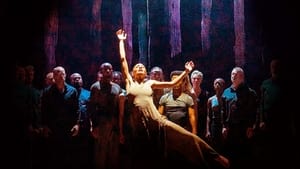
Mozart's Requiem
Witness an epic, heart-rending journey of the soul, as Opera North, Phoenix Dance Theatre, Jazzart Dance Theatre and Cape Town Opera combine for a powerful performance. Filmed at Leeds Grand Theatre, this unforgettable contemporary dance staging of Mozart’s great choral lament is choreographed by Dane Hurst and conducted by Garry Walker. Featuring soloists Ellie Laugharne, Ann Taylor, Mongezi Mosoaka and Simon Shibambu alongside the Chorus and Orchestra of Opera North.
2023
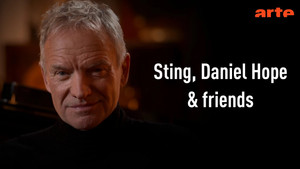
Sting, Daniel Hope & Freunde in Berlin Mit Golda Schultz, Bruce Liu u.v.m.
In a special Christmas edition, violinist Daniel Hope and guests perform a varied and atmospheric repertoire including traditional Christmas songs in new arrangements, classical works and the hit song "Fields of Gold". Daniel Hope's guests are British musician, composer, and living-legend, Sting, Canadian pianist Bruce Liu, winner of the 18th International Chopin Piano Competition, South African soprano Golda Schultz, Argentinian-British guitarist Dominic Miller, Brazilian pianit Sylvia Thereza, the up-and-coming Leonkoro Quartet, cellist Nicola Mosca and percussionist Michael Metzler.
2022
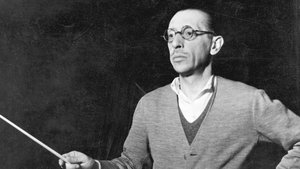
Les Grands Rivaux en musique - Schönberg vs Stravinsky
A look back at the violent conflict between the two leading figures of musical modernity, Arnold Schönberg and Igor Stravinsky, in the first decades of the 20th century. Although Arnold Schönberg and Igor Stravinsky both had a decisive influence on the fourth art, their creations remained diametrically opposed. While the Austrian developed the dodecaphonic method, placing the twelve notes of the chromatic scale at the heart of the composition technique to the detriment of tonality, his Russian rival based his practice on stylistic eclecticism. Their supporters formed two opposing camps, and the two composers - one the father of the Second Viennese School, the other of Neoclassicism - became, in the wake of their successes, the figureheads of a conflict that marked the history of music by its duration and intensity.
2020

Le Robot Solitaire
Robots live alongside mankind in a not too distant future, but are they really living?
2020
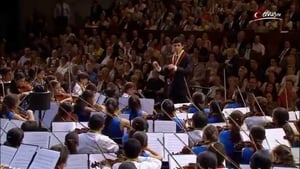
El Sistema at the Salzburg Festival
2014
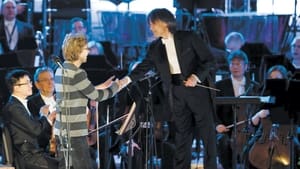
Fred Pellerin : La tuque en mousse de nombril
The Montreal Symphonic Orchestra (MSO) and Kent Nagano share the stage with Fred Pellerin, a colorful character whose imagination seduces as much as it surprises. He tells Christmas in his own way, through his stories featuring the protagonists of the small village of Saint-Élie-de-Caxton. An unprecedented encounter of the symphonic world and the universe of this artist of words. Concert recorded on December 16 and 17, 2011 at the Maison symphonique de Montréal.
2011
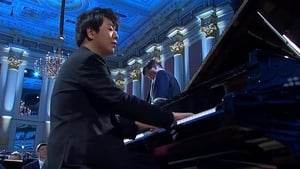
Lang Lang - Live in Vienna
Filmed live in Vienna's legendary Musikverein concert hall, this release represents Lang Lang's second live recorded recital to date after the best-selling "Live at Carnegie Hall" in 2004, which marked his international breakthrough as a recording artist.
2010
Bauçà
Changing colors according to the music.
2009
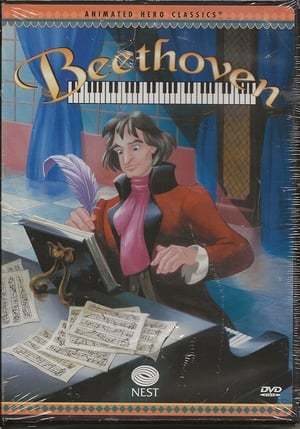
Animated Hero Classics: Beethoven
Even as a young boy, Beethoven marched to the beat of a different drummer. Trained in the traditional music methods by his father, Beethoven was an accomplished pianist by the age of 12. But he yearned to try new sounds and persevered until audiences heard his music. By his early twenties, this persistent young man performed for Joseph Haydn, who compared him to the great Mozart. Sadly, Beethoven began to lose his hearing, but he threw himself even more deeply into his music, composing "Fur Elise," "Sonata Pathetique" and the dramatic "Fifth Symphony" years later, audience members heard what he could not and leapt to their feet in ecstatic appreciation for such passionate music. His creativity gave the world then, as it does today, music that stirs the soul. The video begins in 1827 with 30,000 people paying tribute to the great Beethoven in Vienna, Austria. Then the video switches to his life as a child...
2005
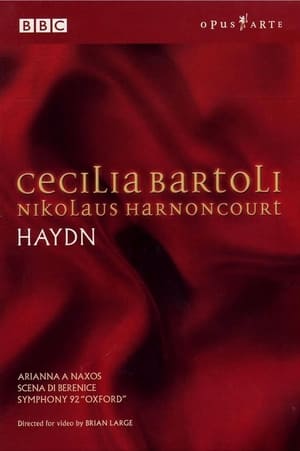
Cecilia Bartoli Sings Haydn
From the Styriarte Festival in Graz Austria, the acclaimed mezzo-soprano Cecilia Bartoli and Maestro Nikolaus Harnoncourt with his orchestra Concentus Musicu Wien, present a concert on Haydn arias and Symphony No.92, the "Oxford". The singing virtuosity of "Scena di Berenice" is sublime as is the performance of The "Oxford" Symphony from the ensemble renown for its specialty in early music and playing on period instruments. A unique concert.
2001
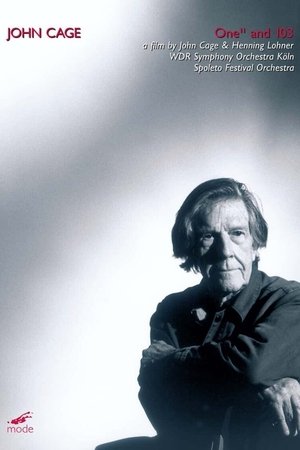
One 11 and 103
Avant-garde composer John Cage is famous for his experimental pieces and "chance music" but temporarily branched into video in 1992 with this art film about meaningless activity. The work is composed of two segments that are supposed to be played simultaneously: "One 11" contains the artistic statement, and "103" is a 17-part orchestral piece. Also included is a revealing documentary about Cage and director Henning Lohner.
1992
Bratři Karamazovi
1990
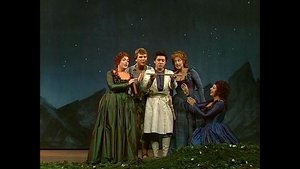
The Magic Flute
The Queen of the Night enlists a handsome prince named Tamino to rescue her beautiful kidnapped daughter, Princess Pamina. Aided by the lovelorn bird hunter Papageno and a magical flute that holds the power to change the hearts of men, young Tamino embarks on a quest for true love, leading to the evil Sarastro's temple where Pamina is held captive.
1983
Die Zauberflöte
Wolfgang Amadeus Mozart's Magic Flute is undoubtedly one of the most multi-layered, profound, complicated, and therefore also most difficult to stage works in the entire opera repertoire. In terms of genre, it can only be understood if it is seen as a mixture of four things: a philosophically profound drama of ideas with countless encryptions, a naïve fairy tale, a bawdy comedy, and a crude Punch and Judy show. It is based on the intersection of the traditions of Baroque magic opera, Italian buffa, and Viennese Singspiel, where all manner of wonders are conceivable and permissible. Peter Ustinov's production appeals to all those who love a primarily fairy-tale-like interpretation; the atmosphere is traditional and conventional. An outstanding ensemble of singers has been assembled.
1971
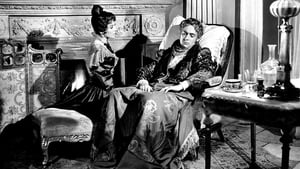
House of Ricordi
The film covers a hundred years in the lives of the Ricordi family, the Milan publishing house of the title, and the various composers and other historic personalities, whose careers intersected with the growth of the Ricordi house. It beautifully draws the parallel between the great music of the composers, the historic and social upheavals of their times, as well as the "smaller stories" of the successive generations of Ricordi.
1954
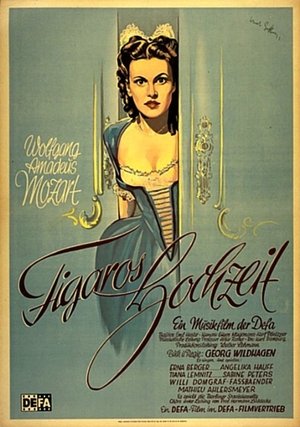
Marriage of Figaro
Shortly after WWII, the DEFA Studios produced a series of operas and operettas which belonged to the classical German musical heritage. This enchanting film, the very first opera production of DEFA, stands out because of its lavish decor and costumes, its outstanding actors and their masterful voices of that time.
1949
Kamenný orchestr
1949