Watch Shepherds of the Earth (2022) Online Free
The region of Lake Turkana, located in Kenya and Ethiopia, is considered to be “the Cradle of Humankind”. Among other finds, primate fossils from millions of years ago have been discovered in the region. But what about the region’s modern inhabitants and their relationship to their environment? Iiris Härmä, whose previous work includes the award-winning Leaving Africa, had the chance of joining Helsinki University’s researchers, Álvaro Fernández-Llamazares and Mar Cabeza, on their pre-pandemic trip to study the Daasanach people’s relationship to their environment through traditional animal tales. The researchers hope that storytelling would help to bridge the gap between people’s everyday lives and conservation efforts.
Cast
Álvaro Fernández-Llamazares, Mar Cabeza
More Like This
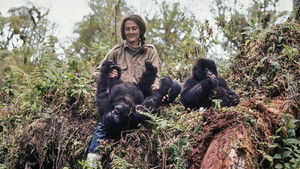
Dian Fossey: Ihr Leben für die Gorillas
She was the first to study gorillas in their natural environment: the high mountains of Rwanda, where she settled in 1967. For nearly twenty years, Dian Fossey lived with the gorillas, observed their behavior, and changed the way people viewed them. Her relentless fight against poaching prevented the species from becoming extinct. But in December 1985, the primatologist was murdered, and the mystery surrounding her death remains unsolved. Former colleagues, scientists, and biographers shed light on the impact of her work, but also on the darker sides of her personality and her uncompromising commitment.
2025
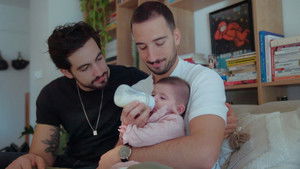
Paternité : une métamorphose décryptée
Becoming a father is an extraordinary adventure in a man's life, but it is also a real physiological metamorphosis that science is only just beginning to reveal. Researchers from multiple disciplines are lifting the veil on these changes taking place in men who are in contact with young children, and their discoveries are astonishing. By tracing the thread of evolution, the film reveals that these deep, long-ignored bonds between men and children are very ancient. And that they are just waiting for the right context to fully express themselves.
2025

13 novembre, nos vies en éclats
On November 13, 2015, the attacks in Paris and Saint-Denis, carried out by three Islamist commandos and claimed by ISIS, were the deadliest in France since the end of World War II. In the months that followed, the November 13 Program was launched by the CNRS and Inserm to study the construction of individual and collective memory around an event that profoundly marked French society. Today, the testimonies of 27 volunteers—among some 1,000 people—who participated in the study form a mosaic of experiences that shows how trauma extends beyond the immediate circle to permeate the national collective memory.
2025
An Inconvenient Study
In 2016, journalist Del Bigtree issued a challenge to the head of infectious disease at one of the most prestigious medical institutions in the world: conduct the most thorough vaxxed vs. unvaxxed study that has ever been done. The expert took up the challenge and ran the study to prove Del wrong. That study never saw the light of day... until now.
2025
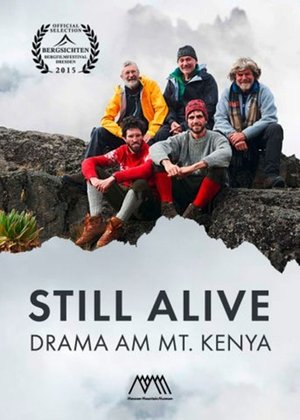
Still Alive – The Drama on Mount Kenya
Still Alive - The Drama on Mount Kenya is a gripping docudrama that recounts a legendary rescue operation on Mount Kenya in Africa in 1970.
2025
All the Little Things
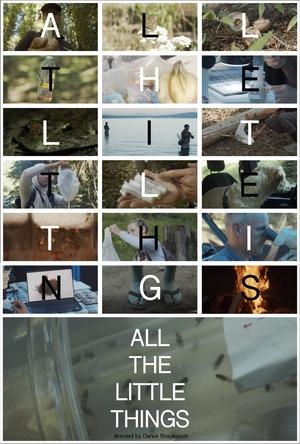
An accomplished molecular biologist moves out of the lab in a quest to make an encyclopedia documenting all the fruit fly species in North America.
2024

Ethiopiques Magnetic Suite
Dazzled by the surrealist movement, Francis Falceto decided at the age of 17 to live an extraordinary life. In the 1980s, co-created l'Oreille est Hardie and Le Confort Moderne in Poitiers, leaving his mark on French underground culture. A record he discovered by chance opened another important chapter in his life: Ethiopian music, of which he became a great champion. "Ethiopiques Magnetic Suite" is the portrait of a discreet and essential man, a plunge into the counterculture, an invitation to live his his life.
2024
Umoja - Wo nur Frauen das Sagen haben
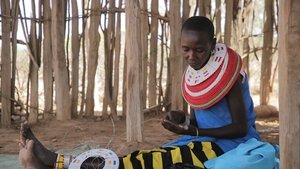
380 kilometers from Nairobi, in the Samburu territory, lies a unique village: Umoja. Defended by a thorn fence, access is strictly forbidden to men. Created in 1991, it offers refuge to women repudiated by their husbands or victims of domestic violence. A nerve center for the community, its school is open to children from other villages, provided their families undertake not to subject them to genital mutilation or early marriage. As the new school year approaches, Jane, co-founder of the community, and Rose, teacher, meet little Samella's parents.
2023

Oxente, Bixiga!
Nordeste is a fiction, sang Belchior in São Paulo. If the paulista and the northeastern are inventions elevated along a path, they are also the shapers of cities carried in the body of everyone who comes and everyone who goes. The documentary looks at the presence of many northeasters, in this region called Bixiga, known for its Italian presence, claimed in its black and indigenous memory.
2021
The Imperial Lullaby
The armies of Fascist Italy conquered Addis Ababa, capital of Abyssinia, in May 1936, thus culminating the African colonial adventure of the ruthless dictator Benito Mussolini, by then lord of Libya, Eritrea and Somalia; a bloody and tragic story told through the naive drawings of Pietro Dall'Igna, an Italian schoolboy born in 1925.
2020
Masai Mara: The Big Hunt
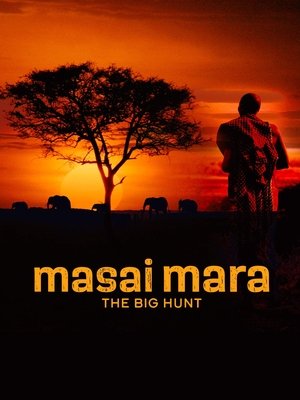
See the great migration as never before! The Mara River, nature’s best laid trap for migratory animals, is the stage for a grandiose spectacle. When food supply in the Serengeti dwindles, the Masai Mara is a paradise for predators. As the black wildebeests, gazelles, zebras and antelopes make their yearly trip from the south of the Serengeti to the north, nature’s best laid trap, the Mara River in Kenya is waiting ahead. Captivating shots filmed under water show how crocodiles prepare for the Big Hunt while other predators lurk on the banks awaiting their bounty.
2018
Sidney & Friends
When his family tries to kill him, Sidney, who is intersex, flees to Nairobi where he meets a group of transgender friends. Together, they fight discrimination and discover life, love and self-worth.
2017
The Donkey that Carried the Cloud on its Back
In the Indian Ocean, off the coast of Kenya, there is an island. On this island there is a stone town; its stone buildings stand as skeletons of the splendor of its yesteryears. High tide, low tide, Full moon, new moon. Lamu is an island frozen in time. Now Africa’s largest port is being constructed. In order to evolve, what part of ourselves do we keep and what part do we leave behind?
2015
Walter Mittelholzer - Eine Schweizer Pioniergeschichte
2015
Kenya 3D: Animal Kingdom
A journey in the most spectacular wildlife sanctuary on Earth. Join two young Maasai warriors and discover the breathtaking diversity of the region's natural fauna, including the Big Five - lions, elephants, Cape buffalo, leopards and black rhinos - as well as giraffe, hippos, cheetahs, and many more.
2013
A Blooming Business
A documentary about people in Kenya who are imprisoned by the global flower industry. The dilemmas of the industry become painfully clear and a dark world of oppression, sexual abuse and terrible working conditions unfolds. There is only one conclusion possible: the smell of the imported rose is not sweet, but bitter.
2009
A Walk to Beautiful
"A Walk to Beautiful" tells the story of five women in Ethiopia suffering from devastating childbirth injuries. Rejected by their husbands and ostracized by their communities, these women are left to spend the rest of their lives in loneliness and shame. The trials they endure and their attempts to rebuild their lives tell a universal story of hope, courage, and transformation.
2007
Dukas Dilemma
2002

Benito Mussolini: Anatomy of a Dictator
1962
Under the water
A daily life in Korogocho, Kenya, one of the world’s poorest slums.