Watch Raï Story: From Cheikha Rimitti to Cheba Djenet (2004) Online Free
Raï Story is a musical journey in search of the Raï legend, Cheikha Remitti, in Oran, Algeria, where the Raï musical tradition began. In 1923, the first Raï singers performed behind screens during ceremonies to protect their identity. It was only when the music of singer Cheikha Remitti began to gain popularity among the general public that Raï music was made public, in the 1940s. Cheikha Remitti, who lives between Paris and Oran, is nowhere to be found, the filmmakers then decide to meet producers, musicians, singers like Cheba Dalila or Cheba Djenet, for whom Remitti created a wake. The opportunity, through these unique stories, illustrated with archive images, to retrace the important place of women in this musical tradition and the transformation of Raï music from the 1960s to 2000.
Cast
Cheikha Remitti, Cheba Djenet, Cheba Dalila, Chaba Fadela, Chaba Zahouania, Cheb Hasni, Cheb Khaled, Cheb Mami, Raïna Raï, Messaoud Bellemou, Mohamed Lamine, Belkacem Bouteldja
More Like This

Selena y Los Dinos: A Family's Legacy
Never-before-seen footage and intimate interviews celebrate the life and legacy of iconic Mexican American singer Selena Quintanilla and her family band.
2025

Vitaa, je m’appelle Charlotte
2024

Taylor Swift, la première puissance américaine
2024

Der Taylor-Swift-Effekt
2024
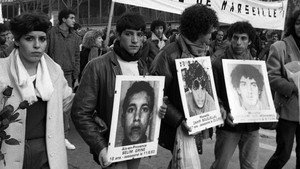
1983, The Marchers for Equality
In the 1980s, young people of North African descent born in France and a priest from the Lyon suburbs organized the "March of the Beurs." Launched on October 15, 1983, by seventeen people from the La Cayolle neighborhood in Marseille following a racist crime, the march concluded two months later—on December 3—on the streets of Paris, with 100,000 participants. This movement demanded equal rights. Was their cry heard?
2023
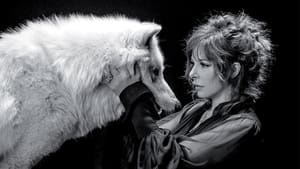
Mylène Farmer : Les Clips L'Intégrale (1999-2020)
2021
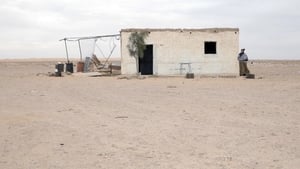
143 Sahara Street
Alone in a small white house on the edge of national road 1, the Trans-Saharan road, which connects Algiers to Tamanrasset crossing the immensity of the desert, Malika, 74, one day opened her door to the director Hassen Ferhani, who came there to scout with his friend Chawki Amari, journalist at El Watan and author of the story Nationale 1 which relates his journey on this north-south axis of more than 2000 km. The Malika of Amari's novel, which Ferhani admits to having first perceived as a "literary fantasy", suddenly takes on an unsuspected human depth in this environment naturally hostile to man. She lends herself to the film project as she welcomes her clients, with an economy of gestures and words, an impression reinforced by the mystery that surrounds her and the rare elements of her biography which suggest that she is not from the region, that she left the fertile north of Algeria to settle in the desert where she lives with a dog and a cat.
2021

Lady Gaga - Encore
Gaga has travelled through time with her ever changing sound, reinventing herself for every album, award ceremony and red carpet. With a strong fan base behind her, she continues to reign as one of the biggest pop stars of the industry.
2020
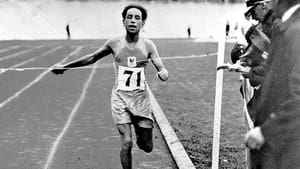
El Ouafi Boughera, The marathon runner of history
On August 5, 1928, after 2 hours and 32 minutes of racing, the 71st rooster wearing the bib entered the Olympic stadium in Amsterdam. Ahmed El Ouafi Bouguéra wins the gold medal and becomes the first Olympic champion from the African continent. He achieved his feat under the tricolor flag. The start of his real marathon is underway. The history of sport extends to the history of Algeria and France. This documentary retraces the different stages of the life of this great champion, not only the history of sport but also the great story. Archival photographs and interviews mingle with the painted paintings. The series thus once again gives voice to this forgotten hero, one of the great heroes of immigration who defended France for more than a century.
2018
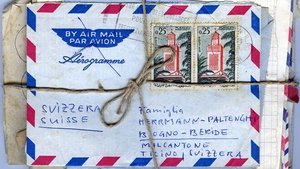
CHoosing at Twenty
Between 1954-1962, one hundred to three hundred young French people refused to participate in the Algerian war. These rebels, soldiers or conscripts were non-violent or anti-colonialists. Some took refuge in Switzerland where Swiss citizens came to their aid, while in France they were condemned as traitors to the country. In 1962, a few months after Independence, Villi Hermann went to a region devastated by war near the Algerian-Moroccan border, to help rebuild a school. In 2016 he returned to Algeria and reunited with his former students. He also met French refractories, now living in France or Switzerland.
2017

The Revolution Of El Harrachi
The artistic journey of Dahmane El Harrachi, born in 1925 in Algiers, bears the mark of his experience. An attentive and vigilant observer of the environment of immigrant workers, Dahmane has always avoided falling into the ambient miserabilism. From the Algerian Chaâbi, he has kept certain melodic lines and a clear propensity for sayings drawn from the oral poetic tradition. El Harrachi uses simple language, understandable by all popular sectors of the Maghreb, which partly explains its wide success. In 1949, he went to France and it was in cafes, springboard places where people come to breathe the air of the country, that he performed regularly. Elegant, with his beautiful atmosphere, the “bluesman” of the suburbs seduces, upsets and stirs consciences. Discovered late by the new generation, the creator of Ya Rayah met a tragic end, on August 31, 1980, in a car accident, on the Algiers coast which he sublimated above all else.
2014

Ilse DeLange - Live In Ahoy
Tracklisting: 01. Broken Girl 02. We're Alright 03. World Of Hurt 04. Livin'on Love 05. I Still Cry 06. When We Don't Talk 07. Flying Blind 08. Sister Golden Hair 09. I'd Be Yours 10. Heavenless 11. Fall 12. Have A Little Faith 13. Stuck In The Middle 14. Love Won't Hide 15. Pirate Of Your Soul 16. Puzzle Me 17. Sharp Dressed Men 18. The Other Side 19. Miracle 20. The Great Escape 21. I'm Not So Tough 22. I Love You 23. So Incredible Extra's: *** Music Video’s - So incredible - Miracle - Puzzle me *** Backstage Footage
2009

Dreamgirls
A trio of female soul singers cross over to the pop charts in the early 1960s, facing their own personal struggles along the way.
2006
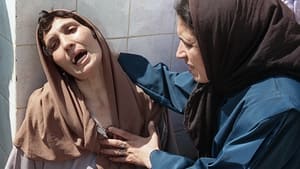
Algérie 1988-2000 : Autopsie d'une tragédie
2005

Selena
In this biographical drama, Selena Quintanilla is born into a musical Mexican-American family in Texas. Her father, Abraham, realizes that his young daughter is talented and begins performing with her at small venues. She finds success and falls for her guitarist, Chris Perez, who draws the ire of her father. Seeking mainstream stardom, Selena begins recording an English-language album which, tragically, she would never complete.
1997
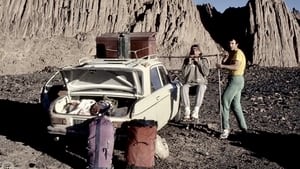
Oversand
Oversand is one of the first films about free climbing, the third film in a series of three with "Overdon" and "Over-Ice". Directed by Jean-Paul Janssen, the film was shot in 35mm in Algeria, in the Sahara Desert, in the Tamanrasset region, on the walls of the majestic peaks of the Atakor massif, central sub-region of Hoggar, mountainous heart of Hoggar, a volcanic plateau of almost circular shape, whose average altitude is 2000 meters, and which culminates at Mount Tahat (2918m), the highest point in Algeria. The Atakor is distinguished by its spectacular volcanic peaks, its needles, and its rugged landscapes, resulting from the erosion of ancient volcanic chimneys, which make it the most emblematic summits of the Hoggar, such as the Assekrem, the Ilamane, or the Tizouyag, where climbers Patrick Edlinger, Patrick Bérhault, Bernard Gorgeon, Hugues Jaillet, Jacques Perrier, Stéphane Troussier and Odette Schoënleb evolve under the watchful eye of the Tuareg caravans.
1981
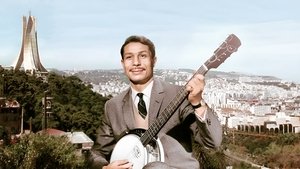
Saha Dahmane
Film about Dahmane El Harrachi, musician, singer and composer of the famous song "Ya Rayah", a cult song covered by Rachid Taha, which will enjoy international success. Virtuoso of the banjo, the work of Dahmane El Harrachi did not initially respond to the canons of the purists of Algiers Chaâbi song. However, he will end up establishing himself alongside great masters of the genre, El Hadj M'hamed El Anka, Boudjemaâ El Ankis, El Hachemi Guerouabi, Amar Ezzahi... He plays his own role in this film shot with his musician friends, just before his tragic death in 1980 in a car accident on the Corniche of Algiers.
1980

Algeria, Year Zero
Documentary on the beginnings of Algerian independence filmed during the summer of 1962 in Algiers. The film was banned in France and Algeria but won the Grand Prize at the Leipzig International Film Festival in 1965. Out of friendship, the production company Images de France sent an operator, Bruno Muel, who later declared: "For those who were called to Algeria (for me, 1956-58), participating in a film on independence was a victory over horror, lies and absurdity. It was also the beginning of my commitment to the cinema."
1965
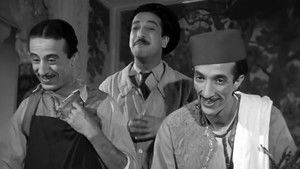
The Unexpected Party
This musical comedy produced in 1953 for the General Government of Algeria, features the comic trio composed of Rouiched, Mohamed Touri and Sid Ali Fernandel, accompanied by the orchestra of the master of the Algiers Chaâbi El Hadj M'hamed El Anka, the singer Fadhéla Dziria, Mustapha Skandrani on the piano. Some scenes were filmed at the Summer Palace (the current Palace of the Algerian Presidency, called the People's Palace). André Zwobada, the director, will play an important role after the independence of Algeria in 1962, in the production and preservation of the first Algerian newsreels.
1953
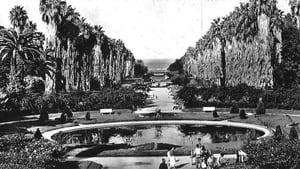
Alger Et Ses Environs
The film, shot in 1938, is part of a series entitled “The true face of Algeria”. The film highlights the proximity of Algiers to Paris and promotes air travel. The commentary supporting the images highlights the urban dynamism (“Every day, a new skyscraper replaces a wasteland”) and the comparison with Paris (“Algiers is often nicknamed the Paris of North Africa because of its elegance become proverbial). Contemporary architectural achievements are described as the sign of “grandiose modernism”: “we love the new, the bold”. But the point does not forget the buildings illustrating “the Moorish, classic and attractive style”. The description of the Casbah also attempts to understand the architectural organization but also the diversity and even the atmosphere.
1945