Watch Psychiatry in Russia (1955) Online Free
In 1955, Albert Maysles traveled by motorcycle throughout Russia. During this trip, he shot what was to become his first film, 'Psychiatry in Russia', an unprecedented view into Soviet mental healthcare. Originally televised by the David Garroway Show on NBC-TV in 1956.
More Like This
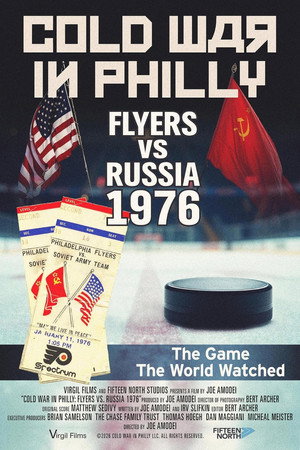
Cold War in Philly
In 1976 with the Cold War raging, the Philadelphia Flyers took to the ice to play the unbeaten Russian Red Army team. What happened that day went down in sports history.
2026

Astrakan 79
1979. Flicking through pictures from a Soviet magazine, 15-year-old Martim dreams of building a new society. His radical communist parents send him to study at Astrakan for one year. In her new film, Catarina Mourão captures with tremendous precision the moment a middle-aged man passes his story on to his son, thus shedding the taboo of his ineffable experience.
2024
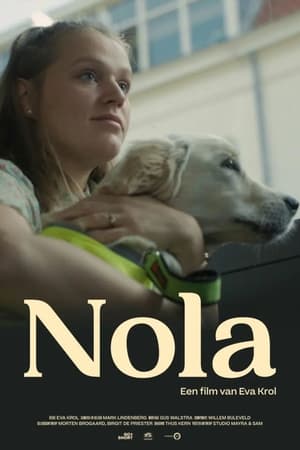
Nola
In the documentary Nola, we follow the 24 year old Daniëlle and her psychosocial assistance dog. Daniëlle has been struggling with her anxiety disorder for years and has tried many forms of therapy to no avail. Therefore, assistance dog Nola is her last hope for recovery.
2023

On the Edge - Health System in Crisis
Things are busy at the Paris hospital where young psychiatrist Jamal and his colleagues work. The place is run down, the staff are exhausted, budgets are constantly being slashed. You know the story, but you’ve rarely seen it conveyed as engagingly as in ‘On the Edge’, which employs a handheld camera and meaningful, artistic interventions to observe the daily routine at the psychiatric ward. The deeply sympathetic Jamal is an everyday hero with an exemplary, humanistic disposition, for whom the most important prerequisites for mental health – and for a healthy society in general – are good relationships with other people. He puts his philosophy into practice by listening patiently, giving good advice and organising theatre exercises based on Molière. Realism and idealism, however, are in balance for the young doctor, at least as long as the institutional framework holds up.
2023
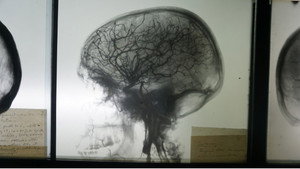
Uma Conversa em Família
The history of prefrontal leucotomy, a brain intervention created by Portuguese neurosurgeon and scientist António Egas Moniz, Nobel Prize winner in Medicine.
2021

Master and Tatyana
Lithuanian photographer, the legend of Soviet Sixties' generation Vitas Luckus tragically passed away in 1987. Yet the life and times of the talented rebel still impassion and lead us to a journey questioning why, at all times, we are wary of those who are really free.
2015
The Spy Who Went Into the Cold
A documentary about Kim Philby, a British member of MI6 who was in reality a spy and defected to the U.S.S.R.
2013
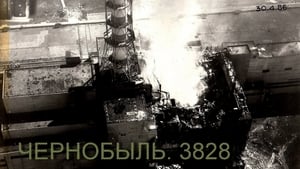
Chernobyl.3828
Military people call such places "FRONTLINE", liquidators who worked at the Chernobyl nuclear station called it "ROOF COATING". It was the most contaminated, and therefore the most dangerous, place in the zone. The remains of the roof coating of the 4th reactor. The operation on decontaminating the roof lasted more than five months. We will tell about only two days. About the most important two days in the life of an explorer - dosimetrist Valeriy Starodumov. He participated in this operation until it was over. He himself came out to the roof and led people there. He himself planted the "victory banner" at the level of 75 meters, as the signal for the zone: the roof coating has been decontaminated! Now, 25 years later, Valeriy Starodumov comes back to the zone. Now Chernobyl is a tourist object. But not for him...
2011
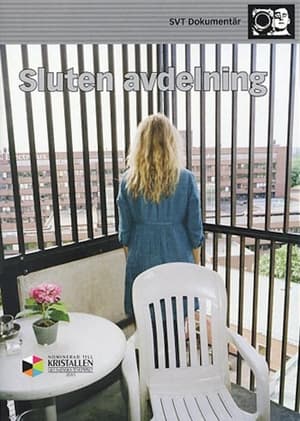
Sluten Avdelning
Maud Nycander has over one and a half years, filmed a psychiatric emergency ward at St. Göran's Hospital in Stockholm.
2010
Flys and Angels
Ilya Kabakov is considered one of the most important contemporary artists worldwide. Born and raised in the Ukraine in the period between Stalin and Gorbatschow he left the country in the 80s. In his Installations and his numerous paintings Kabakov creates a world of its own, which leaves the heaviness of socialist and post-socialist life far behind. The film links Ilya Kabakovs artistic spaces with insights into Russian everyday life, which itself sometimes appears like an installation by the artist.
2009
Ascension
Definitively proving that all the "B" Science Fiction of the 1950s and 1960s do not hold a candle to the 'real thing,' Pavel Medvedev's surreal 45 minute documentary Ascension is certainly one to look for. Composed entirely out of archival footage, much of it from the Soviet science and space archives, delicately scored and building to an undeniable mood of surreal (perhaps even ominous) energy, it charts (and re-purposed) the progress of man into to the unknown area of space exploration with a flair for creating art out film that was shot by scientists and engineers as a mundane record.
2009
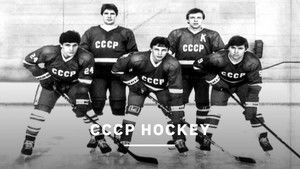
CCCP Hockey
The Soviet hockey players Fetisov, Kasatonov, Krutov, Larionov and Makarov were "The Super Five". It is a tale of sacrifice and ruthless demands, and of the revolt against the system that was set in motion by Larionov and Fetisov, and aimed primarily at Viktor Tichonov.
2004
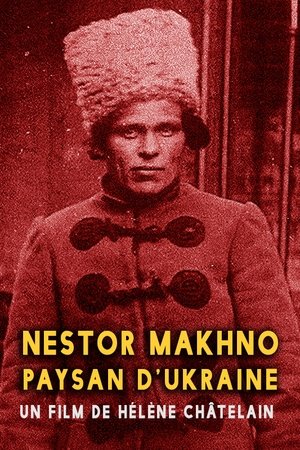
Nestor Makhno
With breathless pace, Hélène Chatelain ("the woman" in "La Jetée") reconstructs the life of Nestor Makhno from his writings, Soviet propaganda films, reactions of workers today and the memory he has left in the hearts & minds of his people in Gouliaïpolié, in the east of the Ukraine.
1996
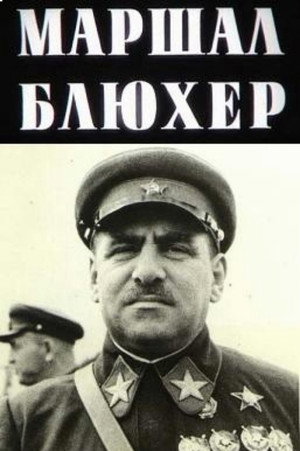
Marshal Blucher: A Portrait Against the Background of an Epoch
The story of Marshal Vasily Konstantinovich, a dedicated Red Army commander who was killed in Stalin's "purges." The film attempts to study the fate of the country through his biography, and unlock the riddle of the show trials of the thirties.
1988
L'albero storpio
1982

Matriculation
The final oral exam in history and social studies at one of Warsaw's high schools. The film illustrates the theatre of social life in Soviet Poland where one says different things on the stage and another behind the scenes.
1979
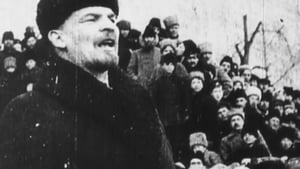
Tsar to Lenin
A documentary film account of the Russian Revolution, based on archival footage.
1937
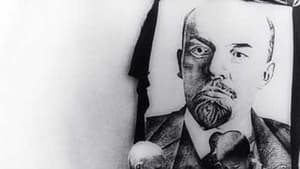
Kino Eye
This documentary promoting the joys of life in a Soviet village centers on the activities of the Young Pioneers. These children are constantly busy, pasting propaganda posters on walls, distributing hand bills, exhorting all to "buy from the cooperative" as opposed to the Public Sector, promoting temperance, and helping poor widows. Experimental portions of the film, projected in reverse, feature the un-slaughtering of a bull and the un-baking of bread.
1924
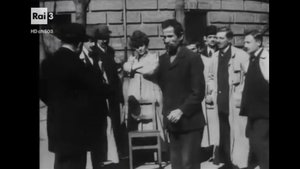
Neuropathology
Signed by neurology professor Camillo Negro and cinematographer Roberto Omegna for the Società Anonima Ambrosio of Turin, Neuropathology is one of the first and most significant scientific documentaries in the history of cinema. Premiering in Italy on February 17, 1908, this film meticulously records a series of clinical cases of patients with various pathologies of the nervous system observed at the Cottolengo Hospital and neuropathological clinics in Turin between 1906 and 1908. The material includes studies of convulsions, spasms, ocular paralysis, ataxia, epileptic seizures, and other neurological disorders, presented with a didactic and scientific objective for physicians and neurology students.
1908
Sainte-Anne, hôpital psychiatrique
Documentary made with the patients of wards 15 and 17 of the Sainte-Anne psychiatric hospital in Paris in 2008-2009.