Watch Wolsong: Vanishing Town (2019) Online Free
More Like This
Radioactive: The Women of Three Mile Island
In this thrilling documentary, indomitable women fight back against the nuclear industry to expose one of the biggest cover-ups in US history: the 1979 Three Mile Island meltdown and its aftermath. The film reveals the never-before-told stories of four intrepid homemakers who take their case all the way to the Supreme Court, and a young female journalist who's caught in the radioactive crossfire.
2024
I'm So Sorry
In a quiet forest, a sign warns of radiation hazard. “Is this the past or the future?” muses the masked figure who appears like a kind of ghost in nuclear disaster areas. At a time when nuclear power may be re-emerging as an alternative to fossil fuels, this calmly observed and compelling tour takes us to places that may serve as a warning.
2021
The Atom: A Love Affair
With a wealth of fantastic archive footage and a series of revealing interviews with those who had first-hand experience, filmmaker Vicki Lesley tells the turbulent story of the West’s love-hate relationship with a nuclear power over the past seventy years. Capturing both the tantalising promise and the repeated disappointments of this singular technology, the film reveals how the post-war, romantic fantasy of an Atom-powered future developed into the stormy, on-off relationship still playing out today. A tale of scientific passion and political intrigue all wrapped up in the packaging of a sentimental screen melodrama.
2019
Ryeohaeng
A group of women climbs a summer mountain situated in South Korea. They are refugees who have settled into South Korean society after fleeing from North Korea. For them, climbing the mountains has been an unavoidable journey for survival - a matter of life and death.
2019

Atomic: History Of The A-Bomb
The smallest of sparks can lead to the largest of explosions. Such is the case of the Atomic Bomb and the minds who have conceived of the deadliest force the world has ever known. This new documentary Atomic: The History of the A-Bomb follows this weapon of mass destruction from inception to detonation.
2019
Atomic Homefront
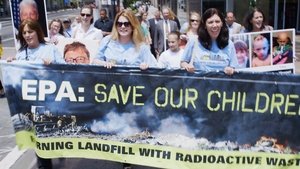
Revealing St. Louis, Missouri's atomic past as a uranium processing center for the atomic bomb and the governmental and corporate negligence that lead to the illegal dumping of Manhattan Project radioactive waste throughout North County neighborhoods.
2017
Azure Dust - Inside Chernobyl's Exclusion Zone
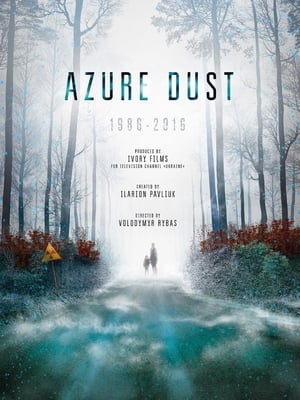
The story about Chornobyl area, all around the world we know of the disaster in 1986. The film may be called a guide to the Exclusion Zone. Thanks to the unique footage from the place of the tragedy, that the crew succeeded to capture, the viewers will have a chance for a full immersion into the atmosphere of the events and, along with the heroes of the film, feel the dreadful and amazing air that reigns where one of the major anthropogenic disasters took place.
2016

A Lullaby Under the Nuclear Sky
Personal documentary from director Kana Tomoko, who has covered environmental issues and people suffering misfortune in films like Beautiful Islands. This film documents the pregnancy she discovered immediately after the March 11, 2011 earthquake and follows her experiences until the baby's birth. In the aftermath of the Tohoku earthquake and tsunami, Kana was 4 kilometers from the Fukushima Daiichi Nuclear Power Plant documenting the people who were forced to evacuate because of the nuclear power plant accident. Then, she discovers that she is pregnant. Her first pregnancy at the age of forty takes her by surprise, and she worries about the impact of radiation on her unborn child.
2016
My Love, Don't Cross That River
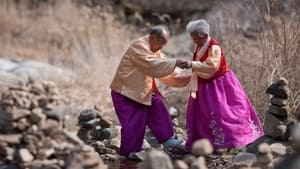
There lives a couple known as "100-year-old lovebirds". They're like fairy tale characters: the husband is strong like a woodman, and the wife is full of charms like a princess. They dearly love each other, wear Korean traditional clothes together, and still fall asleep hand in hand. However, death, quietly and like a thief, sits between them. This film starts from that moment, and follows the last moments of 76 years of their marriage.
2014

Centrales nucléaire : démantèlement impossible
2013
Die Mächtigste Bombe der Welt
2011
The Making of Fallout: New Vegas
This 8-part documentary includes behind the scenes interviews, concept art, and promotional trailers for the game.
2010
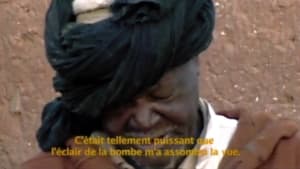
Gerboise Bleue
"Gerboise bleue", the first French atomic test carried out on February 13, 1960 in the Algerian Sahara, is the starting point of France's nuclear power. These are powerful radioactive aerial shots carried out in areas belonging to the French army. Underground tests will follow, even after the independence of Algeria. From 1960 to 1978, 30,000 people were exposed in the Sahara. The French army was recognized recognized nine irradiations. No complaint against the army or the Atomic Energy Commission has resulted. Three requests for a commission of inquiry were rejected by the National Defense Commission. For the first time, the last survivors bear witness to their fight for the recognition of their illnesses, and revealed to themselves in what conditions the shootings took place. The director goes to the zero point of "Gerboise Bleue", forbidden access for 47 years by the Algerian authorities
2009

The New American Century
"Historically accurate, narratively captivating, The New American Century is one of the best films about the facts behind the 9/11 attacks". Webster G. Tarpley "The New American Century is a stunning film. It should be seen as widely as possible, in cinemas, bars, clubs, at meetings and, of course, through the internet. I'm sure the film will continue to be a source of debate and political education for many years." Ken Loach. Massimo Mazzucco’s Inganno Globale (soon in English as "Global Deceit") presented all the major inconsistencies in the 9/11 official version, i.e. World Trade Center’s demolition, no Boeing at the Pentagon, etc., that lent credibility to the accusation by the so-called "9/11 Truth Movement" of the attacks having been an inside job. The New American Century presents the historical, philosophical, economical and political background, some of which is practically unknown to the general public, that seems to support such accusation by the 9/11 Truth Movement.
2008
Chernobyl Reclaimed: An Animal Takeover
What would happen if the world were suddenly without people - if humans vanished off the face of the earth? How would nature react - and how swiftly? On the edge of Europe, the deserted village of Chernobyl reveals the surprising answer after an unplanned experiment. Chernobyl was abandoned by people after the worst nuclear disaster in history (April 26, 1986). A level 7 meltdown resulted in a severe release of radioactivity following a massive explosion that destroyed the reactor. More than 20 years later, Chernobyl has been taken over by a remarkable collection of wildlife and descendents of pets that were left in the city when its residents fled the nuclear fallout. Unexpectedly in the aftermath of this disaster, Chernobyl has become a sanctuary for plants, birds, and animals, including some species thought to be on the brink of extinction.
2007

Climate of Hope
Documentary created to demystify climate change and nuclear energy. While the threat of climate change is now widely accepted in the community, the potential for a host of nuclear power stations in Australia has raised questions about the best strategy for the country to move to a low-carbon economy. This animated documentary takes viewers on a tour through the science of climate change and the nuclear fuel chain and the remarkable energy revolution that is under way.
2007
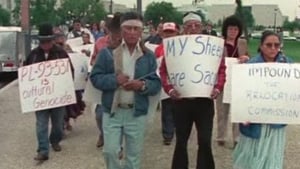
Broken Rainbow
Documentary chronicling the government relocation of 10,000 Navajo Indians in Arizona.
1985

Seabrook 1977
In April 1977, the small coastal town of Seabrook, New Hampshire became an international symbol in the battle over atomic energy. Concerned about the dangers of potential radioactive accidents, over 2,000 members of the Clamshell Alliance, a coalition of environmental groups, attempted to block construction of a nuclear power plant. 1,414 people were arrested in that civil disobedience protest and jailed en masse in National Guard armories for two weeks.
1978
Planning for Public Shelter Entry
The film features a meeting led by Dave Taylor, the shelter manager, discussing the protocols and responsibilities for staff members involved in managing a public shelter. Key participants, including operations deputy Harvey Johnson and health leader Mrs. Carter, outline their roles in ensuring a smooth entry for occupants during an emergency. The meeting emphasizes the importance of organization, communication, and the distribution of supplies. Staff members are encouraged to familiarize themselves with each other's duties and prepare for potential scenarios, including managing newcomers and ensuring safety and sanitation within the shelter.
1963
Inside The Atom
This short documentary offers a look at Canada’s Chalk River Project in the late 1940s. While humanity pondered the ultimate threat or promise of atomic energy, Chalk River scientists worked on the first set of experiments that attempted to apply atomic energy to medical and biological uses. Inside the Atom examines this frontier of science and assesses its value in terms of human progress.
1948