Watch Tins for India (1941) Online Free
Documenting the production of kerosene tins and their reuse in rural India, this early short by Bimal Roy observes industrial labor and everyday life with a restrained, humanist perspective.
More Like This
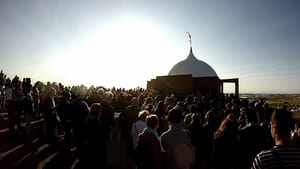
The Search for the Meaning
"The Search for the Meaning" is a collective experience, carried out with the audiovisual contribution of countless people who record their testimonies and spiritual experiences in 19 countries, to show a new spirituality that is being born...
2019

The Unreserved
The Unreserved is an inquiry into the lives of passengers who use the Unreserved Compartment, the cheapest way to travel across India on the Indian Railways system. The film portrays the passengers’ aspirations, efforts and opinions through conversations and personal stories.
2017
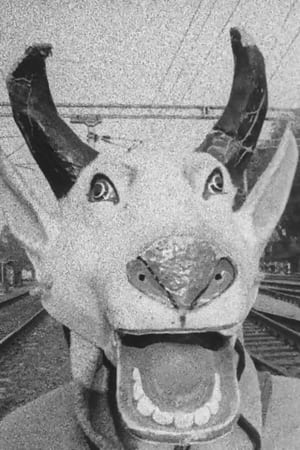
The Kali of Emergency
During social and political turmoil, what is the manifestation of divine intervention? How do the gods and goddesses act in the volatility of the contemporary world? If they walk on earth as men and women, how do they endure the chaos of modernity? Centering on the terrible and majestic incarnations of Goddess Kali and her celestial avatars, this film is a metaphysical contemplation in times of perpetual emergencies. Avikunthak’s remarkable sense of forms finds expression in the extraordinary combination of performance and essayistic cinematic practices.
2017
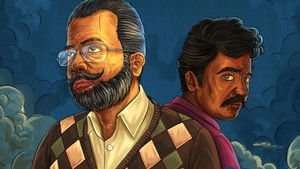
The Karma Killings
"The Karma Killings," is a modern-day crime thriller mixed in with Indian mythology and class warfare. The documentary delves into India's most infamous serial killings and its impact on a nation. Told through the people directly involved, the film unravels the complexities of the case and goes beyond the sensational headlines to present a suspenseful and scary mystery. And has a huge twist - one of the killers maybe innocent?
2016

Ho Chi Minh Kim Chi
The sights and sounds of a kimchi factory in Vietnam.
2016

Fascinating India
"Fascinating India" spreads an impressive panorama of India’s historical and contemporary world. The film presents the most important cities, royal residences and temple precincts. It follows the trail of different religious denominations, which have influenced India up to the present day. Simon Busch and Alexander Sass travelled for months through the north of the Indian subcontinent to discover what is hidden under India’s exotic and enigmatic surface, and to show what is rarely revealed to foreigners. The film deals with daily life in India. In Varanasi, people burn their dead to ashes. At the Kumbh Mela, the biggest religious gathering of the world, 35 million pilgrims bathe in holy River Ganges. This is the first time India is presented in such an alluring and engaging fashion on screen.
2014
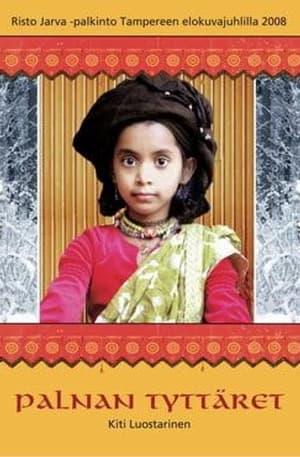
Palna's Daughters
A film about memory, identity and the overwhelming power of love. One-year-old Devi was found starving at a railway station in Delhi. The police took her to Palna, an orphanage, where she lived for a year. When Devi learned to talk she often wanted to talk about Amma, her first mother. In the film, the 6-year-old Devi journeys to her own past, as her family adopts another daughter from Palna, a baby sister for Devi.
2007
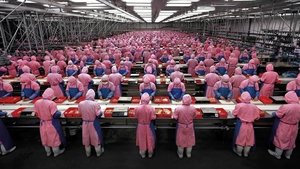
Manufactured Landscapes
MANUFACTURED LANDSCAPES is the striking new documentary on the world and work of renowned artist Edward Burtynsky. Internationally acclaimed for his large-scale photographs of “manufactured landscapes”—quarries, recycling yards, factories, mines and dams—Burtynsky creates stunningly beautiful art from civilization’s materials and debris.
2006
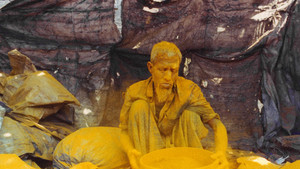
Megacities
Megacities is a documentary about the slums of five different metropolitan cities.
1998
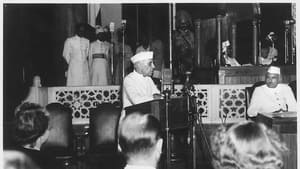
Nehru
Divided into three parts — The Awakening, The Struggle, and Freedom — this is a biographical film on Pandit Jawaharlal Nehru, the first Prime Minister of independent India. Relying on Nehru's writings and speeches, the film traces the evolution of Nehru from his birth through his life. It also deals with the effect of history on Nehru and in turn his impact on the world.
1984
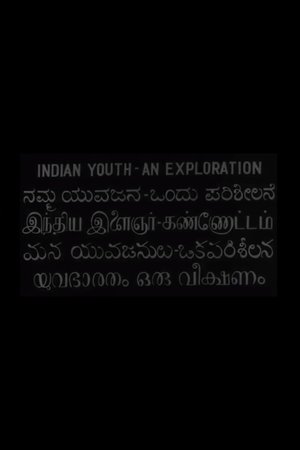
Indian Youth: An Exploration
A documentary on the life of the youth in post-Independence India.
1968
Music of India
Short documentary on classical Indian music.
1966

Six Years of Freedom
This documentary highlights the achievements of India in the political, economic, and international fields since she attained Independence. The framing of her Constitution, the integration of the States and the general elections, the rehabilitation of displaced persons, the river valley projects, and the setting up of a chain of National Laboratories are some of the achievements shown here.
1953

Ladakh
A stunning trek from the vale of Kashmir, via Sind Valley and Kargil and Lamayaru Monastry.
1943
Atlas
The concept of machine-made knit was known as early as the 1850s, but it was only during the 1920s that the quality of the material had improved. When the plant known as "Atlas" was introduced in 1931, the shop windows drew a lot of attention, and Aho & Soldan was ordered to make a promotional film. In this well-paced film, we see the jersey production step by step.
1931
Jute
The film show the day to day running of the Titaghur Jute company, which is in Bengal on the banks of the river Hooghly. Opening shot 360 degree pan of industrial buildings. 7000 Indian workers are employed, mostly women and children. There parks for the children to play. We follow the process from jute to cloth women working at looms in the factory (very dark), shots of power plant. Schools and workers accommodations. Shots of trains and boats, loading.
1923
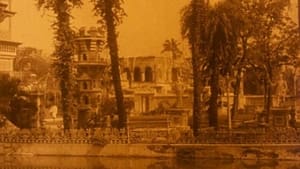
Picturesque India or, In and About Calcutta
Botanical gardens in Bombay plus the highly decorative Jain Temple in Calcutta.
1913
Seil und Tau Fabrikation in Howrah bei Kalkutta
A short film showing the industrial process of jute works in India.
1909
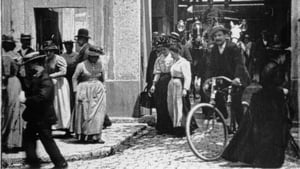
Workers Leaving the Lumière Factory
Working men and women leave through the main gate of the Lumière factory in Lyon, France. Filmed on 22 March 1895, it is often referred to as the first real motion picture ever made, although Louis Le Prince's 1888 Roundhay Garden Scene pre-dated it by seven years. Three separate versions of this film exist, which differ from one another in numerous ways. The first version features a carriage drawn by one horse, while in the second version the carriage is drawn by two horses, and there is no carriage at all in the third version. The clothing style is also different between the three versions, demonstrating the different seasons in which each was filmed. This film was made in the 35 mm format with an aspect ratio of 1.33:1, and at a speed of 16 frames per second. At that rate, the 17 meters of film length provided a duration of 46 seconds, holding a total of 800 frames.
1895

Mai
As the months pass through her, Mai gives us a glimpse into old age that explores between being abandoned and being belonged, passing the time and living the time.