Watch The Navigators: Pathfinders of the Pacific (1983) Online Free
In hand-built, double-hulled canoes sixty feet long, the ancestors of today's Polynesians sailed vast distances using only the waves, the stars, and the flights of birds to navigate. Anthropologist Sanford Low visits the Caroline Islands of Micronesia to meet Mau Piailug, the last navigator initiated on his island and one of few men still practicing this once-essential art. He demonstrates his skill by sailing a replica canoe 2500 miles from Hawaii to Tahiti with no modern navigational instruments.
More Like This
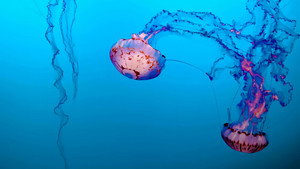
Jellyfish, The new Rulers of the Ocean
Jellyfish blooms are making headlines around the world. This is due to the damage they cause to tourism, fishing and our health. How can these creatures, which are over 98% water and have no shell, skeleton or brain, expand so rapidly? Although this is a normal stage in the life cycle of these gelatinous animals, we have to admit that blooms have become much more frequent and massive in recent decades. We're even witnessing jellyfish populations appearing in more and more regions where fish have been replaced by them, such as off the coast of Namibia, in the Black Sea, in the Sea of Japan and in certain areas of the Baltic Sea. What causes this? Why has the role of jellyfish in the ocean been underestimated, even though they outlived the dinosaurs? Are jellyfish on their way to dominating the oceans as they once did? What if they were to be the only ones left?
2026
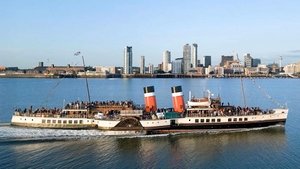
Ships, seas, power - beginning of globalization
People have always wanted to reach the horizon and go beyond it. It wasn't and isn't just about discovering for the sake of discovering. Exotic goods, wealth and power were the driving forces of these people. The steamship ultimately brought the breakthrough for global mobility and trade. In the past, as now, shipping is the engine of globalization.
2025

Dalangpanan
Despite being only a five-minute boat ride away from Cebu City, at the foot of the country’s record-breaking new expressway, Shell Island is an unfamiliar name to many Cebuanos today. “Dalangpanan” sheds light on the island, following a day in the life of one of its residents to uncover the stories and struggles of living on a forgotten, desolate land amidst progressive, bustling cities. Through the voices of the Shell locals, audiences learn why and how they ended up settling there, and what their future could possibly be. The documentary’s title, which literally translates to “refuge” in Cebuano, is a nod to what the island might mean to those living on it—a home, a source of hope, or even more.
2024
L'énigme des éléphants d'Andaman
2023
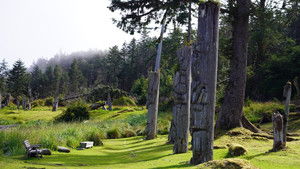
The Haida in Canada
Haida Gwaii, an archipelago off the west coast of Canada, is home to Skil Jaadee and her family. They live in harmony with nature and have made it their mission to save their language and preserve their history.
2022
Cuba, A Paradise on the Brink
Will Cubans be able to safeguard their heritage of pristine Nature and preserved ecological treasures under this new era, as they are facing the combined pressure of money and tourism? What policies can be implemented to maintain the island’s spectacular wilderness?
2017
Jumbo: The Plane That Changed the World
Documentary about the development of the Boeing 747 jumbo jet. The 747 was a game changer, the airliner that revolutionised mass, cheap air travel. But the first wide-bodied plane was originally intended as a stopgap to Boeing's now-abandoned supersonic jet. This is the remarkable untold story of the jumbo, a billion-dollar gamble that pushed 1960s technology to the limits to create one of the world's most recognisable planes.
2014
Sailing the Treasure Ship
Navigating the Indian Ocean in a reconstruction of a 1,200-year-old Arab ship, held together by 100km of rope and 127,000 hand-sewn stitches. The Jewel will sail more than five thousand kilometres across the Indian Ocean and do battle with the Monsoon – but for sailors it can spell danger and even death. It took a year to build: the Jewel of Muscat – a reconstruction of a 1200 year old Arab ship, based on an ancient shipwreck. Built from more than 18 tonnes of wood, the ship is held together entirely by 100 km of rope in over 127,000 hand-sewn stitches. Now the Jewel will sail more than five thousand kilometres across the Indian Ocean and do battle with the Monsoon – the mighty rain soaked wind that turns the arid land it touches green. But for sailors it can spell danger and even death.
2010
Morning Light
Fifteen young sailors... six months of intense training... one chance at the brass ring. This documentary tells the story of a group of intrepid and determined young men and women, on the cusp of adulthood, as they embark on life's first great adventure. Racing a high-performance 52-foot sloop the crew of "Morning Light" matches wits and skills in a dramatic 2300 mile showdown.
2008
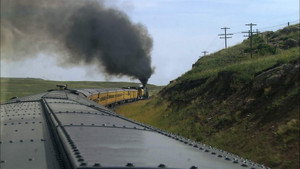
Hear That Train a Comin'
Meet the crew of the Union Pacific Challenger No. 3985, the largest and most powerful steam engine in the world. This colorful documentary is a behind-the-scenes look at the conductors, engineers and mechanics who keep this fickle train running, an engaging history of steam power, and a scenic tour the Great Plains -- from Cheyenne, Wyo., through Denver and across Nebraska to the Omaha headquarters of the Union Pacific.
2006
An Island Invaded
Five Guamanians interviewed in the early 2000s recall the Japanese bombing of Guam on 7 December 1941, and the years of food shortages, abuses, and other hardships that followed. They describe their childhood lives before, during, and after the island's occupation by Japanese soldiers.
2004
Jak se žije převozníkům podle Romana Vávry
1997
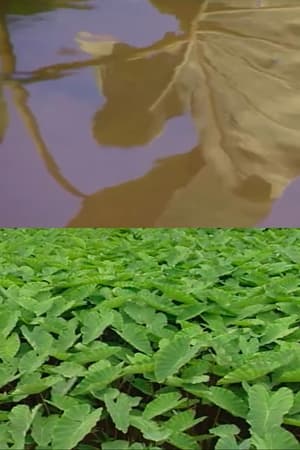
Back to the Roots
Kalo (taro) production on each of the major islands of Hawai'i circa 1994. Meet the amazing people who love and continue to cultivate taro on lo'i that in some cases has been in the family for generations and centuries! Young, old, and family growers on Maui, Moloka'i, Hawai'i, O'ahu, and Kaua'i islands. Includes history/culture of kalo, Issues related to land and water, uses of kalo, and prospects for the future.
1994

Ridin' the Dog
The world-famous Greyhound bus is almost as old as the Wild West. It is a symbol of North America, of progress, and of nostalgia. Reporter Studs Terkel travelled 2,000 miles across the United States by Greyhound. From Seattle to Chicago, he observes his fellow-passengers. He meets a number of travelers who appear to be very interesting people: a Native American boxer on his way to his birthplace in Montana, a bar owner who was a bank robber in a former 'career', a 99 year old woman who is still running a busy hotel, and, of course, a pedigree cowboy. The spectator of this film listens to their personal stories, watches the beautiful scenery, and is treated to famous feature film fragments in which the Greyhound bus plays a part. Seven states and two time zones later, he is back in his cinema seat.
1989

Singlehanders
Follow two Canadians, Bob Lush and Mike Birch, aboard their yachts during the 1980 Observer Singlehanded Transatlantic Race. More than a record of this prestigious international sailing event, the resulting film is the starting point for an epic of challenge and determination.
1982
Samoa i Sisipo
An overview of the people, lifestyle, and traditions of Samoa, as well tourism and other economic changes on the Samoan islands.
1972

Call Me Captain
The Norfolk Broads tourist film promotes the pleasures of boating.
1961
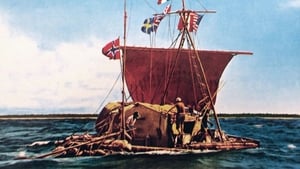
Kon-Tiki
"Kon-Tiki" was the name of a wooden raft used by six Scandinavian scientists, led by Thor Heyerdahl, to make a 101-day journey from South America to the Polynesian Islands. The purpose of the expedition was to prove Heyerdal's theory that the Polynesian Islands were populated from the east- specifically Peru- rather than from the west (Asia) as had been the theory for hundreds of years. Heyerdahl made a study of the winds and tides in the Pacific, and by simulating conditions as closely as possible to those he theorized the Peruvians encountered, set out on the voyage.
1950
Seas the Day: The Sailing Movie
Seas the Day: The Sailing Movie is a genre-defying documentary that blends real-world adventure with deeply human storytelling. It transcends typical sailing documentaries by blending docu-fiction with a narrative inspired by Joseph Campbell’s classic The Hero's Journey. Directed by Ryan Luskin, an anthropologist and teacher, the film follows his family's quest across sixteen countries, learning life skills from diverse cultures.
Sea Spiders
A look at the everyday life of Tahitian natives.
1932