Watch The Danger Zone (1989) Online Free
Loading Cinehub...
Produced by the International Dairy-Deli Association, this food safety training video centers on Alice, a new employee who learns how different areas of a deli operates and the importance of maintaining a clean environment to avoid "the Danger Zone" with the help of her co-worker Cathy and well-dressed teleporting man who goes by many names.
More Like This

Traquer l'invisible - Nos chercheurs face à la menace mondiale des virus et des bactéries
2025
The Place Once Known as Earth and We, Homo Sapiens
A daring exploration of the intersection of religion, patriarchy, and gender oppression in India, unearthing how rituals, customs, and cultural double standards—often sanctified in the name of faith—perpetuate misogyny across generations.
2025

Sous le bio, la malbouffe
Sales of organic products have increased tenfold in 20 years. In 2020, the market will have exceeded 13 billion euros in sales. The heavyweights of the food industry are surfing on this consumer craze for healthy food by offering more and more "green" products. But organic does not necessarily mean nutritionally balanced.
2021
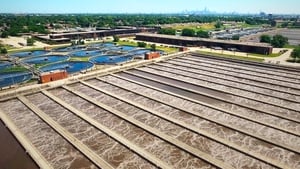
Brave Blue World: Racing to Solve Our Water Crisis
From reuse to energy generation, new innovations across five continents are explored in this documentary about building a future for sustainable water.
2019
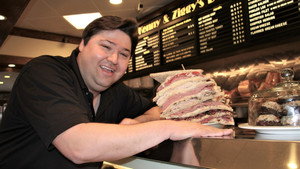
Deli Man
Every story needs a brave and trustworthy guide, and Deli Man's is the effusive and charming Ziggy Gruber, a third-generation delicatessen man - his uncle and great-uncle owned Berger's in the diamond district, and the Woodrow Deli on Long Island. His grandfather owned the famous Rialto Delicatessen on Broadway, and Ziggy was stuffing cabbages atop of a crate when he was eight. Now he is owner and maven (as well as a Yiddish-speaking French trained chef) of one of the country's top delis, Kenny and Ziggy's in Houston – yes, Texas…Shalom y'all. Of course the story of deli isn't Ziggy's alone. Deli Man has visited meccas like the Carnegie, Katz's, 2nd Avenue Deli, Nate ‘n Al, and Canter's, as well as interviewed some of the great connoisseurs of deli, including Jerry Stiller, Alan Dershowitz, Freddie Klein, Dennis Howard, Jay Parker (Ben's Best), Fyvush Finkel, and Larry King.
2015

Beef
BEEF is a comedic spin on a real person courtroom show. Set in a NY deli, BEEF revolves around Lou, his family, and the cases he settles. People march in with a "beef" for Lou to solve with old-school advice, simple justice, or a fine cut of meat.
2014
Ash Wednesday
In early 1980s Manhattan, a pair of Irish-American brothers become embroiled in a conflict with the Irish Mob.
2002
Cadillac Desert: Water and the Transformation of Nature
Documentary on water usage, money, politics, the transformation of nature, and the growth of the American west, shown on PBS as a four-part miniseries.
1997
Get With a Safe Food Attitude
Discusses safe food handling for mothers-to-be. Topics covered include shopping, food storage, food preparation, cooking, serving food on the go, leftovers/reheating, safe bottle-feeding, diaper changing, etc.
1995
Surviving Edged Weapons
In an intense action-filled 85 minutes, you will learn to defend yourself against the mounting threat of “knife culture” offenders.
1988

Water and the Dream of the Engineers
Documentary where rich social history frames a spirited debate on the development of water infrastructure throughout the USA.
1983
Safety and the Supervisor
Using a case study, the film examines the causes and effects of an industrial accident, highlighting the role of the supervisor and identifying his responsibility as interpreted by the Health and Safety at Work Act. The lessons are then applied to other industries and commercial offices. Intended for safety supervisors.
1978
Chlorine and the Firefighter
This 1974 film is dedicated by the Chlorine Institute to the public interest. It is specifically intended to assist firefighters and other emergency services. The techniques demonstrated are appropriate for emergency use; different circumstances might require modified or additional procedure. The information is drawn from sources believed to be reliable. The Institute, its members any organizations cooperating in the development of this film, jointly or severally, cannot be responsible for how the information is used and must make this legal disclaimer. This is a 1960s era, color movie about Chlorine and emergency workers… specifically, firefighters. The film is intended to show firefighters what chlorine is, what a chlorine emergency might involve, how a company can plan ahead and how an emergency can be handled safely.
1974
Lifesaving and Water Safety: Snorkeling Skills and Rescue Techniques
The film provides a comprehensive guide on snorkeling skills and rescue techniques, emphasizing the importance of proper equipment such as masks, snorkels, and fins. It discusses how to choose the right mask for comfort and fit, the proper use of snorkels, and techniques for clearing water from both masks and snorkels. The film also covers essential skills for entering the water safely, practicing buddy systems during snorkeling, and techniques for locating and rescuing submerged victims. It highlights the need for training and emphasizes that while these skills are crucial for rescue, they do not replace the need for a full certified course in skin diving.
1972
Safety in the Shop: Power Tools
The film emphasizes the importance of safety when using power tools in a workshop. It outlines key safety practices, such as using guards, securing materials, and wearing protective gear like safety glasses. The film also covers specific tool usage tips, including the correct handling of cutting machines, drills, grinders, and lathes, stressing that safety precautions should never be neglected. Proper maintenance and awareness of tool settings are crucial to prevent accidents.
1970
Sanitation: Why All The Fuss?
The film "Sanitation: Why All The Fuss?" emphasizes the critical importance of sanitation in food handling for public health. It explains how bacteria, which can multiply rapidly and cause illness, are often transferred by people, pests, and contaminated tools. To prevent foodborne illnesses, food handlers must adhere to strict hygiene practices, including frequent handwashing, maintaining proper food temperatures, and ensuring cleanliness in food preparation areas. The film highlights that while heating food kills bacteria, it does not eliminate toxins that may have already formed, making prompt refrigeration essential.
1969
The Fire Triangle
"The Fire Triangle" presents different types of fires (electrical, chemical, etc.) and firefighting techniques, while exploring the "triangle" conception of fire, consisting of heat, fuel and oxygen. Shot in Los Angeles with the cooperation of the LAFD, it dates to 1962.
1962
Make Mine Service
Training and Customer Service information film sponsored by the Marketing Retail Sales Department of the Standard Oil Company. Features product placement for brands like Atlas and Chevron.
1952
The Good Housewife in Her Kitchen
Short public information film showing housewives' efficient and hygienic methods of food storage.
1950
Malchen, die Unschuld vom Lande
Produced by a division of social services, the film follows a country girl's journey to learn more about hygiene and health after she's rejected from by her boyfriend who thinks her uncultivated.
1921