Watch Storm (1943) Online Free
A look at how the weather bureau tries to warn farmers and businessmen about approaching large storms. Although some precautions can be taken to lessen their impact, storms have to run their course, and there is really not much we can do about them.
Cast
John Nesbitt
More Like This
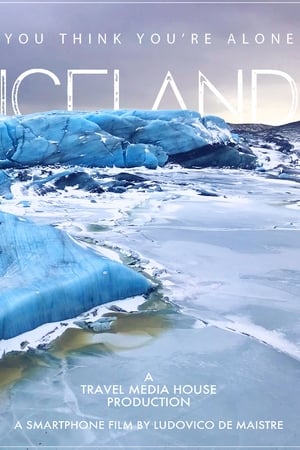
Iceland You Think You're Alone
Iceland is one of the wildest places on earth. You could be caught up in the midst of snowstorms and blizzards, but you are never alone... Although tourists from all over the world have started a silent invasion, nature keeps on winning.
2018
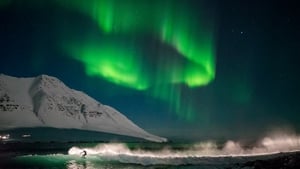
Under an Arctic Sky
Six fearless surfers travel to the north coast of Iceland to ride waves unlike anything they've ever experienced, captured with high-tech cameras.
2017

The Weirdest Weather in the Universe
Horizon visits state-of-the-art laboratories and uses CGI to recreate the science-fiction-worthy weather experienced on other planets.
2016
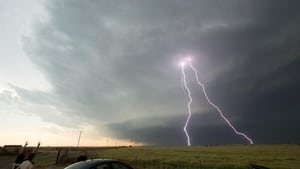
National Geographic: Inside the Mega Twister
The tornado that struck El Reno, Oklahoma, on May 31, 2013, defined superlatives. It was the largest twister ever recorded on Earth.
2015
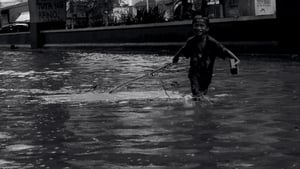
Storm Children
The Philippines is visited by an average of 20~28 strong typhoons and storms every year. It is the most storm-battered country in the world. Last year, Typhoon Haiyan, considered the strongest storm in history, struck the Philipines, leaving in its path apocalyptic devastation.
2014
The 11th Hour
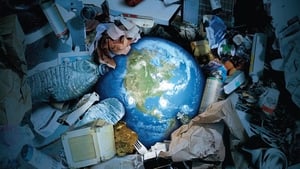
A look at the state of the global environment including visionary and practical solutions for restoring the planet's ecosystems. Featuring ongoing dialogues of experts from all over the world, including former Soviet Prime Minister Mikhail Gorbachev, renowned scientist Stephen Hawking, former head of the CIA R. James Woolse
2007

The Great Global Warming Swindle
This film tries to blow the whistle on what it calls the biggest swindle in modern history: 'Man Made Global Warming'. Watch this film and make up your own mind.
2007
Det var en gång en skog...
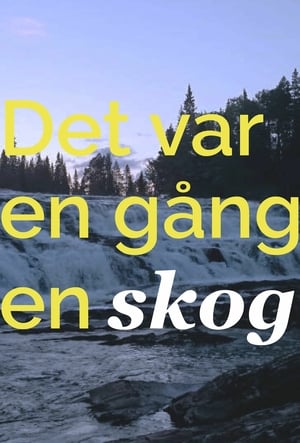
On January 8, 2005, the storm Gudrun pulled over southern Sweden and large parts of the Småland forest blew down. How do you cope when your food disappears overnight? Anders and Lisbeth Ericsson, who run a smaller farm, were hit hard by the storm. 70% of their 250 ha were blown down. This put them in a difficult economic and emotional crisis. They realize that it is important to find new solutions in order to live on now that the conditions have changed so completely. Johan Forsman and his father Jan have a large farm with 1500 ha of forest. For them, it is not just a financial loss, the extensive work to take care of the broken forest feels endless. It is difficult to get enough people to work. Some of the assistance is taken from other parts of the world, including Finnish forest workers. The problem is that the Finns only speak Finnish, and a little Russian…
2005
Stormchasers
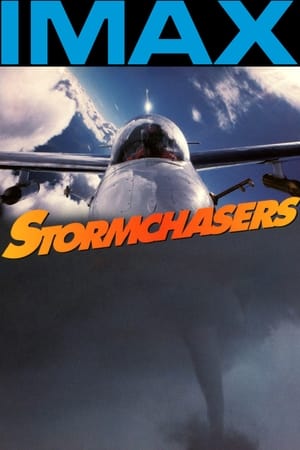
Track monsoons, hurricanes, blizzards, and tornadoes. Take a journey around the planet to experience our most extreme storms and to witness the dramatic--and often perilous--efforts of scientists in the pursuit of understanding weather.Join meteorologists in the cockpit of a P-3 weather plane as they penetrate the eye of a hurricane; and in the tense, decisive moments on the road as they focus their radar on an approaching tornado, traveling to the heart of severe storms to learn what makes weather systems tick. Experience the bumpy ride into the sudden and spectacular calm of a hurricane’s eye, or the commando-like raid to the very brink of a killer tornado, and experience one of the elemental joys of doing science: that of confronting nature head-on to divine its awesome secrets.
1995
The Hurricane of '38
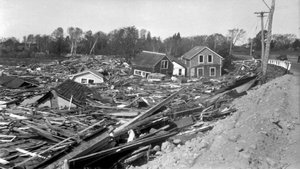
In September of 1938, a great storm rose up on the coast of West Africa and began making its way across the Atlantic Ocean. The National Weather Bureau learned about it from merchant ships at sea and predicted it would blow itself out at Cape Hatteras, North Carolina, as such storms usually did. Within 24 hours, the storm ripped into the New England shore with enough fury to set off seismographs in Sitka, Alaska. Traveling at a shocking 60 miles per hour -- three times faster than most tropical storms -- it was astonishingly swift and powerful, with peak wind gusts up to 186 mph. Over 600 people were killed, most by drowning. Another hundred were never found. Property damage was estimated at $400 million -- over 8,000 homes were destroyed, 6,000 boats wrecked or damaged.
1993
Wake of '38
Personal experiences of Northwest Ohio residents during the January 1978 blizzard that disrupted daily activities. Stories include the helicopter rescue of an expectant mother, effects on emergency services, and methods people used to survive without electricity and heat.
1978
Countdown to Survival: Tornado
Commissioned by the U.S. Government Defense Civil Preparedness Agency, the film describes the elements of a modern tornado warning system as was developed at the Texas Tornado Warning Conferences in 1953 and included radar detection of tornadoes, a spotter network, and improved communications between the U.S. Weather Bureau, spotters, and public officials to better disseminate warnings to the public. In the 1960s TV changed the way tornado safety and preparedness information was disseminated and this film is likely a product of that development. This film opens with vignettes of people in a small town somewhere in America’s suburban midwest. It then goes on to display the moments before and after the onset of a tornado and informs the audience of appropriate safety response measures.
1976
Your Chance to Live: Heat Wave
The film highlights the dangers of extreme heat and the importance of staying hydrated and cool. It portrays a conversation between two friends, one of whom insists on playing basketball despite the oppressive heat. The narrative emphasizes that heat-related illnesses can be avoided by recognizing the body's signals and taking necessary precautions, such as drinking water and staying indoors. The film concludes with a report of record-breaking temperatures, underscoring the seriousness of heat exposure.
1973
Proměny vzdušného moře
1952

Tennis in Rhythm
A "Passing Parade" MGM short featuring tennis star Alice Marble
1947
Forgotten Treasure
This John Nesbitt's Passing Parade series short highlights the film preservation efforts of the Museum of Modern Art in New York. Several scenes from early newsreels are shown.
1943
This Is the Bowery
In this somewhat whitewashed documentary on Manhattan's Bowery a newcomer to the area takes his first step toward redemption after a meal, bed, and inspiring talk.
1941

Trifles of Importance
Part of John Nesbitt's Passing Parade series, this short shows how three seemingly unimportant things can affect people. The first is how the number 7 affects a student accused of theft charges. The second segment shows that a person's doodles can reveal personality traits. The final segment shows why certain items are on men's suits, such as lapels.
1940
Zyklonenbildung auf der Wetterkarte
Short documentary about cyclones.
1938
Donner, Blitz und Regen
Short film about light and weather phenomena
1930