Watch Shusenjo: The Main Battleground of the Comfort Women Issue (2019) Online Free
A Japanese-American director digs deep into the controversial 'comfort women' issue to settle the debate on whether the women were paid prostitutes or sex slaves, and reveals the motivations and intentions of the main actors pushing to revise history in Japan.
Cast
Shinzo Abe, Park Geun-hye, Barack Obama
More Like This
Bullets And Blueberries
The Holocaust began with the indiscriminate mass shootings by the Einsatzgruppen in the bloodlands of Eastern Europe and was perfected in the gas chambers at Auschwitz. “Bullets And Blueberries” explores the motives, methods and madness of the perpetrators, using never-before-seen images captured by the killers themselves — images that fully capture the banality of evil.
2025

Bucha
The story of a refugee from Kazakhstan who in the spring of 2022 saved hundreds of Ukrainians in Bucha and other cities and towns occupied by Russian troops.
2024

Soundtrack to a Coup d'Etat
Jazz and decolonization are intertwined in a powerful narrative that recounts one of the tensest episodes of the Cold War.
2024

The Origin of Miracles
A documentary film covering the life of President Syngman Rhee and the contributions he made to the Republic of Korea, spanning his childhood, focusing on his independence movement, the founding of the nation, the process of leading to victory in the Korean War, and the process of laying the foundation for Korea's industrialization.
2023

Assassination
In Japanese-occupied Korea, three freedom fighters are assigned a mission to assassinate a genocidal military leader and his top collaborator. But the plan goes completely awry amidst double-crossings, counter-assassinations, and a shocking revelation about one of the assassins' past.
2015
Labyrinth of Lies
A young prosecutor in postwar West Germany investigates a massive conspiracy to cover up the Nazi pasts of prominent public figures.
2014

The Serbian Lawyer
Ten years after fleeing the regime in Serbia, Marko finds himself defending some of the very people that he fought against while he lived there, including the notorious Radovan Karadzic.
2014
Doctors of the Dark Side
Doctors of the Dark Side is the first feature length documentary about the pivotal role of physicians and psychologists in detainee torture. The stories of four detainees and the doctors involved in their abuse demonstrate how US Army and CIA doctors implemented the Enhanced Interrogation Techniques and covered up signs of torture at Guantanamo and Abu Ghraib. Interviews with medical, legal and intelligence experts and evidence from declassified government memos document what has been called the greatest scandal in American medical ethics. Based on four years of research by Producer/Director Martha Davis, written by Oscar winning Mark Jonathan Harris, and filmed in HD by Emmy winning DP Lisa Rinzler, the film shows how the torture of detainees could not continue without the assistance of the doctors.
2011
My Enemy's Enemy
Reveals an alternate history of the post-war world. This is a version of history where, in contrast to what we are all told, fascist ideology prevailed. The story of Klaus Barbie, Nazi torturer, American spy, tool of repressive right-wing regimes, is symbolic of the real relationship that the "Western" governments had with fascism and makes us see the world as it is today - and the politicians that inhabit it - in a different way.
2007
Sinking of the Lusitania: Terror at Sea
The story of the sinking of the Lusitania in 1915 after she was torpedoed off the Irish coast. The story is told from the perspective of Prof. Holbourn (a passenger), the German U-boat and its captain and crew, and other passengers, crew and Admiralty staff
2007
The Devil Came on Horseback
While serving with the African Union, former Marine Capt. Brian Steidle documents the brutal ethnic cleansing occuring in Darfur. Determined that the Western public should know about the atrocities he is witnessing, Steidle contacts New York Times reporter Nicholas Kristof, who publishes some of Steidle's photographic evidence.
2007
The Collaborator
During the conflict in the former Yugoslavia many soldiers were convinced to kill fellow citizens including friends and relatives in the name of patriotism. The Kolaborator follows the story of Goran, 24, a promising young soccer player who is forced to become a soldier. Goran goes from being a talented athlete to an executioner virtually overnight. Following orders, Goran lines up civilians, shoots them and drags them into mass graves. Justifying his role as a protector of his people, Goran becomes increasingly detached from the task until his soccer coach and life-long friend, Asim, is led in front of him. As a familiar face stands defeated before him, Goran must reconsider his actions and choose between his own life and that of his dear friend.
2007

Grbavica: The Land of My Dreams
A woman and her daughter struggle to make their way through the aftermath of the Balkan war.
2006

Kizu: The Untold Story of Unit 731
Documentary about Japan's Unit 731 of World War II.
2004

Conspiracy
At the Wannsee Conference on January 20, 1942, senior Nazi officials meet to determine the manner in which the so-called "Final Solution to the Jewish Question" can be best implemented.
2001

The Murmuring
Every Wednesday at noon, women who were kidnapped for sexual purpose by the Japanese army during its imperialism and their supporters demonstrate against Japanese government to request official apology and indemnity for their crimes. This documentary portrays sexually abused old women's suppressed story of overcoming of their shame and forced silence.
1995
The Last Emperor
A dramatic history of Pu Yi, the last of the Emperors of China, from his lofty birth and brief reign in the Forbidden City, the object of worship by half a billion people; through his abdication, his decline and dissolute lifestyle; his exploitation by the invading Japanese, and finally to his obscure existence as just another peasant worker in the People's Republic.
1987
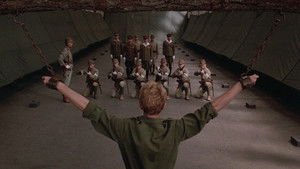
Merry Christmas, Mr. Lawrence
Island of Java, 1942, during World War II. British Major Jack Celliers arrives at a Japanese prison camp, run by the strict Captain Yonoi. Colonel John Lawrence, who has a profound knowledge of Japanese culture, and Sergeant Hara, brutal and simpleton, will witness the struggle of wills between two men from very different backgrounds who are tragically destined to clash.
1983
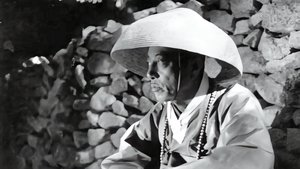
Ah! Baekbeom Kim Ku
Kim Chang-su, who participated in the Donghak Movement, escapes to Manchuria after being chased by the Japanese army, finally making his way home. Angered by the assassination of Empress Myeong-seong, he murders a Japanese lieutenant and is sent to jail. He escapes from prison turns his focus on the democratic movement by teaching civilians and organizing Sinminheo (a democratic organization), even changing his name to 'Kim Gu.' After he is imprisoned again, he gets out on parole and goes to China, where he participates in establishing a provisional government from which he can direct the anti-Japanese struggle. Kim Gu goes on to play a part in Yun Bong-gil's deeds in Shanghai, the events at Hongkou Park, the encounter with Jiang Jish, and the establishment of the Korean National Army, and leads the struggle for Korea's independence with warm fraternal love and clear national spirit. When Korea is liberated in August 15, 1945, he returns back to his native land.
1960
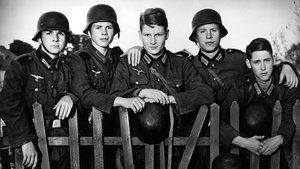
The Bridge
A group of German boys are ordered to protect a small bridge in their home village during the waning months of the second world war. Truckloads of defeated, cynical Wehrmacht soldiers flee the approaching American troops, but the boys, full of enthusiasm for the "blood and honor" Nazi ideology, stay to defend the useless bridge. The film is based on a West German anti-war novel of the same name, written by Gregor Dorfmeister.
1959