Watch Shark Beach with Chris Hemsworth (2021) Online Free
Chris Hemsworth has a real passion for sharks. The Hollywood star talks to experts to find out more about the apex predators of the oceans.
Cast
Chris Hemsworth, Valerie Taylor, Mick Fanning
More Like This
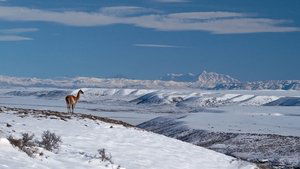
Unfenced
Amidst harsh winter conditions, Patagonia Park Argentina’s rewilding team works to dismantle deadly fences – enabling guanacos to continue their ancestral migrations unimpeded. This effort is part of their remarkable mission to restore the Patagonian steppe. This short wildlife documentary is a journey into the heart of Patagonia Park, Argentina, where the spectacle of winter migrations unfolds against the backdrop of ongoing rewilding efforts.
2024

Grotte Chauvet - Dans les pas des artistes de la Préhistoire
2024
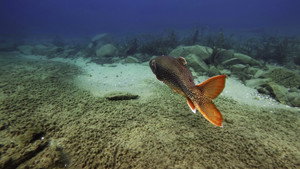
All Too Clear
This immersive documentary uses underwater drones to investigate the impact of invasive quagga mussels on the Great Lakes ecosystem, illustrating significant ecological changes. The filmmakers spent over 150 days capturing underwater footage, resulting in a comprehensive exploration of freshwater wildlife and environments. Blending scientific inquiry with natural history, the film offers a unique perspective on this pressing ecological issue.
2024

Artemis - The Lost Temple
The location of the sanctuary of Artemis at Amarynthos has long remained one of the last great archaeological enigmas of Ancient Greece. This vast Artemision is mentioned in several ancient texts, which even go so far as to specify the distance that separates the sanctuary from the ancient city of Eretria. But despite the efforts of numerous scientific expeditions since the end of the 19th century, no trace of the sanctuary or its temple has ever been found. In the 1960s, a young archaeologist - Denis Knoepfler - set out in search of the lost temple of Artemis. His investigations soon led him into the hinterland of the island of Euboea, well beyond the limits of previous expeditions. It would take five decades of searching, unshakeable faith and moving tons of earth to finally unravel the mystery. In 2017, a tenacious Swiss-Greek team of archaeologists formally identified the sanctuary of Artemis, where Denis Knoepfler had predicted it lay buried.
2023
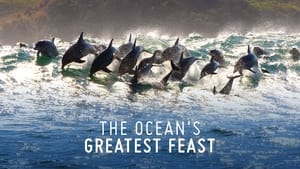
The Ocean’s Greatest Feast
The story of South Africa’s sardine run is brought vividly to life on camera.
2022
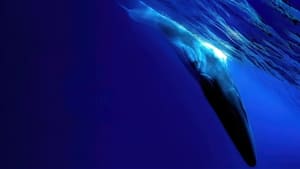
The Loneliest Whale: The Search for 52
THE LONELIEST WHALE is a cinematic quest to find the “52 Hertz Whale,” which scientists believe has spent its entire life in solitude calling out at a frequency that is different from any other whale. As the film embarks on this engrossing journey, audiences will explore what this whale’s lonely plight can teach us — not just about our changing relationship to the oceans, but to each other. Executive Produced with Leonardo DiCaprio and Adrian Grenier.
2021
Breaking Boundaries: The Science of Our Planet
David Attenborough and scientist Johan Rockström examine Earth's biodiversity collapse and how this crisis can still be averted.
2021
Perpetual Planet: Heroes of the Oceans
Oceanographer Sylvia Earle and a cast of marine scientists tell the story of the incredible work being done to protect our oceans fragile ecosystem.
2021

WWF : à quoi joue le panda ?
2021
Mississippi River Sharks
Sharks attack a fish rodeo on the Mississippi River, and it is up to a group of locals to stop them.
2017
Atlantis Rising
James Cameron and Simcha Jacobovici go on an adventure to find the lost city of Atlantis by using Greek philosopher Plato as a virtual treasure map.
2017
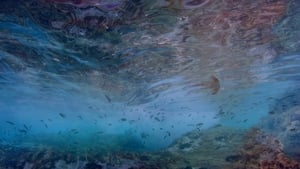
Life in the Blue
This films reveals the extraordinary variety of life found in the vast blue expanses of the open ocean. Here, all the action takes place in a 10 metre deep band of water, just under the surface. Many species use this section of water to migrate and hunt while others use ingenious ways to stay hidden where there appears to be no shelter.
2016
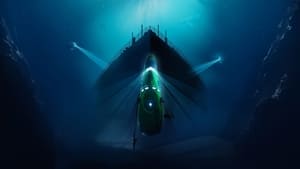
Deepsea Challenge 3D
Described as being a film about determination, danger and the ocean’s greatest depths, James Cameron's "Deepsea Challenge 3D" tells the story of Cameron’s journey to fulfill his boyhood dream of becoming an explorer. The movie offers a unique insight into Cameron's world as he makes that dream reality – and makes history – by becoming the first person to travel solo to the deepest point on the planet.
2014
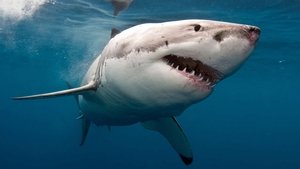
The Search for the Ocean's Super Predator
There's a mysterious predator lurking in the depths of Australia's wild Southern Ocean, a beast that savagely devoured a great white shark in front of cinematographer David Riggs 11 years ago. Riggs's obsession to find the killer leads him to an aquatic battle zone that's remained hidden until now. Here, killer whales, colossal squid and great white sharks face off in an underwater coliseum where only the fiercest creatures of the marine world survive.
2014
Wild Sharks
With the aid of modern technology, reveal the unknown behavior of some unusual species of shark: lemon sharks and their white-tip reef counterparts.
2013
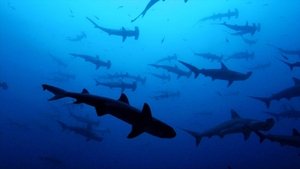
Sharkwater
Driven by passion fed from a life-long fascination with sharks, Rob Stewart debunks historical stereotypes and media depictions of sharks as bloodthirsty, man-eating monsters and reveals the reality of sharks as pillars in the evolution of the seas.
2006

Shark Attack in the Mediterranean
A prehistoric shark (named in the books "megalodon") lurks Mallorca, killing a couple of individuals. A professional diver begins the hunt.
2004
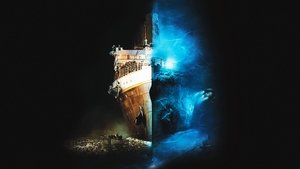
Ghosts of the Abyss
With a team of the world's foremost historic and marine experts as well as friend Bill Paxton, James Cameron embarks on an unscripted adventure back to the wreck of the Titanic where nearly 1,500 souls lost their lives almost a century ago.
2003

Code Name: Wolverine
Harry Gordini is on his way to Italy for a holiday with his family. On his way he accidentally picks up the wrong suitcase which holds in it hundreds of millions worth of new superdrug. Now the drugdealers want the drugs back and kidnap Harry's wife and son. But unfortunately Harry isn't just anyone, he's an ex-Navy SEAL and veteran of the Gulf war, code named "Wolverine". He successfully rescues his wife and kid from the drugdealers, but unfortunately their problems aren't yet over. Adolfo Jones, the head of the crime organisation, is still at large, and he's being helped by couple of dirty DEA-agents. Once again the drugdealer Jones is able to kidnap his son. So everything must come down to a final showdown between the "Wolverine" and Jones...
1996
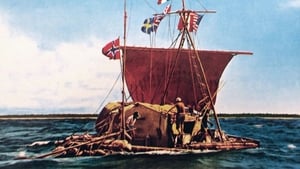
Kon-Tiki
"Kon-Tiki" was the name of a wooden raft used by six Scandinavian scientists, led by Thor Heyerdahl, to make a 101-day journey from South America to the Polynesian Islands. The purpose of the expedition was to prove Heyerdal's theory that the Polynesian Islands were populated from the east- specifically Peru- rather than from the west (Asia) as had been the theory for hundreds of years. Heyerdahl made a study of the winds and tides in the Pacific, and by simulating conditions as closely as possible to those he theorized the Peruvians encountered, set out on the voyage.
1950