Watch Seven Easy Pieces (2007) Online Free
For Seven Easy Pieces Marina Abramovic reenacted five seminal performance works by her peers, dating from the 1960's and 70's, and two of her own, interpreting them as one would a musical score. The project confronted the fact that little documentation exists from this critical early period and one often has to rely upon testimony from witnesses or photographs that show only portions of any given performance. The seven works were performed for seven hours each, over the course of seven consecutive days, November 9 –15, 2005 at the Guggenheim Museum, in New York City. Seven Easy Pieces examines the possibilities of representing and preserving an art form that is, by nature, ephemeral.
Cast
Marina Abramović, Olivera Katarina
More Like This
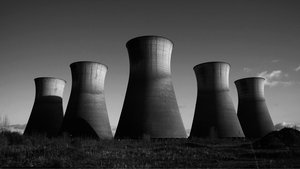
INFRASTRATA
Amongst the contemplative static shots of decaying architecture weaves an abstract narrative unveiling the life-cycle of a higher perception, too large to perceive. Shot at various sites across south-east England, INFRASTRATA is a study on the concept of super-organisms, and the relationship between structure and nature.
2024

Grid
A ritual of grids, reflections and chasms; a complete state of entropy; a space that devours itself; a vertigo that destroys the gravity of the Earth; a trap that captures us inside the voids of the screen of light: «That blank arena wherein converge at once the hundred spaces» (Hollis Frampton).
2021
Eruption
A documentary-art film, incorporating dance sequences alongside interviews with such luminaries as Rigoberta Menchú Tum, a K’iche’ Guatemalan human rights activist, feminist and Nobel Peace Prize laureate, and current Guatemalan president Bernardo Arévalo.
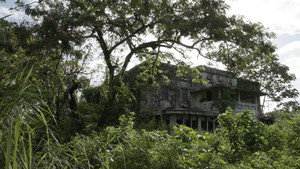
De let'en! - Da it'en!
A meditative depiction of a colonial villa in Mungo, Surinam, taken back by nature.
2026

Lurching
A body lurchs through the university.
2025
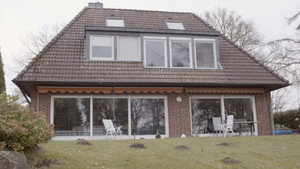
The Weight Of My Name
2-channel film installation 'Die Last meines Namens', wherein Heydt deals with an unpleasant part of his own family history. Heydt’s great-grandfather was a member of the NSDAP and mayor of the small town of Haselünne in Emsland for almost 10 years during the Third Reich. Based on interviews with his grandfather and research in various archives, Heydt develops a personal perspective on the subject. The film deals with how we construct identity from oral retellings, how we process family histories, and how we can find current and personal points of access to German remembrance culture. At the heart of the work are two conversations with his grandfather Heinrich Heydt, recorded at different points in the research process. In them, the grandfather describes his memories of his father, the time, and the two reflect on the subject and the results of the research.
2025
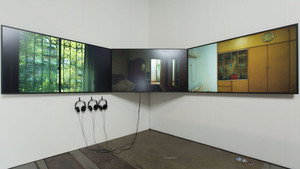
Flowers bloom prosperity, Clouds float with time
A three-screen video installation juxtaposing the Dutch sky, the artist's grandparents' apartment, and the cityscape of Changsha.
2025
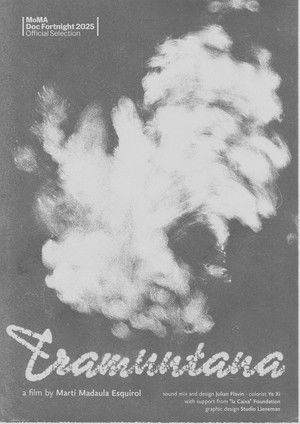
Tramuntana
In a remote area of northern Spain, the wind has a name: Tramuntana. Tramuntana takes what it wants—clothes, trees, boats, and the people of the landscape who live with the endless threat of being carried away by its force. This film is a lyrical portrait of this furious wind, woven from the stories passed down by local villagers.
2025
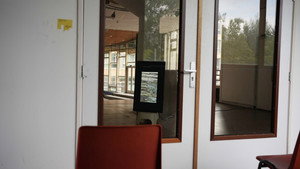
A puddle of water held in shape by my thoughts
"Water reflections are never static, its fluid form constantly plays with the light in new and totally unique ways. Trying to capture this process naturally leads to an imperfect representation. Embracing this, ‘a puddle of water held in shape by my thoughts’ plays with the materiality of the digital image with the border between digital grain and the movement of the water constantly blurring. This ongoing research project consists of clips recorded over the last two years. - During the Leaving Space exhibition (2024) the work was presented as an installation using an old LCD screen, a wash-stool and other spacial elements. The space where the screen was installed could only be observed from the outside through the glass doors but not entered.
2024
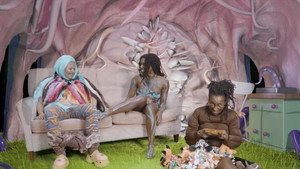
2044
Aida Ra Mana invites you to explore a sci-fi universe set in the year 2044. In this imagined future, the story revolves around three aliens whose deep friendship unfolds in a world dominated by military rule and stringent restrictions. Through this work, Aida Ra Mana poses profound questions about resilience and the human spirit. How do we create joy and humor when faced with pervasive limitations and diminished opportunities? What does it mean to nurture friendship and creativity in an environment where one must constantly conceal their magic and beliefs from an authoritarian regime? By blending elements of science fiction with poignant social commentary, Aida Ra Mana's universe serves as a mirror to our own society's challenges and a testament to the enduring power of joy and laughter in the face of adversity.
2024
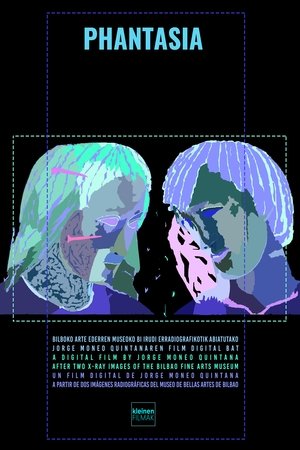
Phantasia
X-ray images were invented in 1895, the same year in which the Lumière brothers presented their respective invention in what today is considered to be the first cinema screening. Thus, both cinema and radiography fall within the scopic regime inaugurated by modernity. The use of X-rays on two sculptures from the Bilbao Fine Arts Museum generates images that reveal certain elements of them that would otherwise be invisible to our eyes. These images, despite being generally created for technical or scientific purposes, seem to produce a certain form of 'photogénie': they lend the radiographed objects a new appearance that lies somewhere between the material and the ethereal, endowing them with a vaporous and spectral quality. It is not by chance that physics and phantasmagoria share the term 'spectrum' in their vocabulary.
2024
Middelpolder
"Inspired by my countless walks in the Middelpolder, the video mirrors my text ‘Dream of a Dutch Sky’, unfolding the Dutch landscape through three different perspectives: the camera’s , the protagonist’s and the plane’s, capturing a wanderer’s stroll."
2023
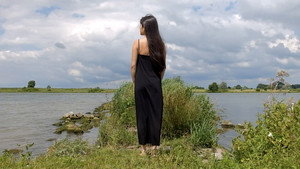
Rivers
"The river Lek reminded me of the river Xiang in my hometown Changsha. I had not been home for 3 years and one of the connections with home was the poems my dad wrote me every day via WeChat. The rivers seemed equally significant for the people in the Netherlands and in Changsha. They are both a romantic connection and an important symbol of daily trade and industry. In a Wechat session my father and I simultaneously read three pairs of poems we wrote for this occasion, he by the Xiang and I by the Lek. Giving the words to the waters that ultimately will meet somewhere in the ocean. The video shows fragments of the performance which took place at the same time in Changsha and Culemborg in June. The full-length documentation is presented as a dual-screen video installation. The three poems written by me can be found on the page "Writing"."
2023
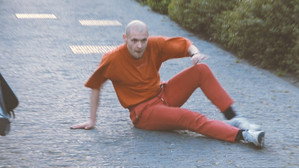
Homophobe
Performance documentation of Mees Joachim's 'Homophobe', a 10 minute live-reenactment of a scene from 'E Kolór Korrá' (2017). A juxtaposition performed as minimally as possible. A destructively interpretive dance, literally shattering bones whilst forcefully dropping on the ground. A pre-cursor to their 'The Scaphoid Fracture' (2017) performance.
2018

Afloat
'Afloat' is an experimental film that paints a portrait of Japanese performance artist: Ayumi Lanoire. The film opens as a telephone call between Ayumi and Person X, which meanders the audience through the various layers that make up her personas leading one to wonder whether she is in fact a myth or reality.
2017
First vlog!! #1
A short mock-vlog film explaining and defending the concepts behind the fictional 'Death To Straight White Men 2017' clothing brand. Edited in a way that mocked the trends of Youtube vlogging and apology-videos of the time, including sound effects and interjected fast-moving graphics. "After QnWF-société received an overwhelming amount of negative feedback following the launch of their 'Death To Straight White Men 2017' clothing brand, their CEO felt the need to create an apology video of sorts - explaining and defending the concepts behind their latest line of clothing."
2017
Death To Straight White Men 2017
Three commercials, presented as a short film, for fictional clothing brand 'Death To Straight White Men' by the QnWF-Sociétè. This fictional clothing brand and the ready-for-action poses and portraits of the three models were in many ways the foundation for 'E Kolór Korra' (2017).
2017
You're Leaving Amsterdam / Welcome To Amstelveen: Introduction
A short documentary film functioning as the introduction to the One Minutes x Inter-Architecture Department (Gerrit Rietveld Academy) short-film broadcast episode for Rietveld TV, as aired on SALTO. This broadcast was meant to give an artistic impression of a communal art-project developed by the Inter-Architecture Department for the municipality of Amstelveen, The Netherlands. This short documentary film introduces each duo placed and posing at their respective project-based locations, spread out over Amstelveen, through purposely awkward still-but-moving vignettes. The duo's are reintroduced several times in quick succession, with each consecutive appearance showing more of an awkward inter-personality, meant to evoke a certain liminal playfulness. An overpass, a bridge, a bridge-barrier, a docking port, the border between Amsterdam and Amstelveen, the edges of Amsterdamse Bos, an abandoned railroad.
2017
1/4 Visuals
A silent experimental film, originally made in accompaniment to Josephine Zwaan's '1/4' album release presentation in 2016. The film sees musician Josephine Zwaan persist through a test of endurance, with the foundation of the film being a one-take of her staring deeply into the lens of the camera, haphazardly overlayed and re-framed by graphical elements color-matched to the album's artwork.
2016
Objects of War
‘Objects of War’ is a series of testimonials on the Lebanese war. Each person chooses an object, ordinary or unusual, which serves as a starting point for his / her story. These testimonials while helping to create a collective memory, also show the impossibility of telling a single History of this war. Only fragments of this History are recounted here, held as truth by those expressing them. In ‘Objects of War’, the aim is not to reveal a truth but rather to gather and confront many diverse versions and discourses on the subject. ‘Objects of War’ started in 1999 assembling the testimonials of eleven persons. It was first shown in 2000 . It continued in 2003 with ‘Objects of War n°2’, recording seven additional testimonials. This time however, and since then, the recorded material is left unedited, shown in its integrity. The work of collecting and assembling these stories continued with ‘Objects of War n°3 & n°4’ in 2006 and ‘n°5 & 6’ in 2014.
2000