Watch Sénac, Jean. Algérien, Poète (2011) Online Free
Jean Sénac, born in Béni Saf in Algeria in 1926 and died in Algiers in 1973, is today considered one of the great French writers and poets and the only one of his reputation to have accompanied the Algerian revolution before November 1954. part of all the debates and got involved, very early and with immense enthusiasm, in a work of commitment which ended badly. His poetry, his sexual preferences and his political lyricism work against him: rejected as much by the Pieds Noirs as by the FLN activists then by the power in place in Algiers, Jean Sénac was assassinated in 1973 at his home in Algiers, in circumstances never clarified.
Cast
Jean Sénac, Éric Sarner
More Like This
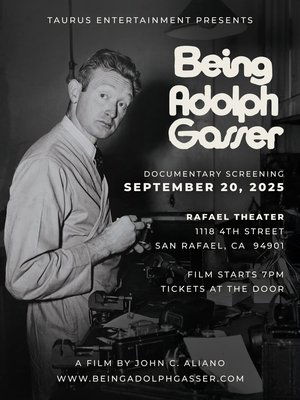
Being Adolph Gasser
Nearing the end of his life, Adolph Gasser looks back on a seventy-year career as a world-class camera repairman, WWII veteran, inventor, and best friend of nature photographer Ansel Adams, contributing developer of the first Nikon camera and a sales/rental/camera repair store owner who empowered other prominent Bay Area visual artists and inventors to succeed. As eminent domain, the internet and changing technologies threaten everything he has built, he struggles to find a way to keep moving forward. Inspired by his unique stories and abilities, filmmaker and professor John C. Aliano follows him over the course of several years and reflects on his own career trajectory.
2025
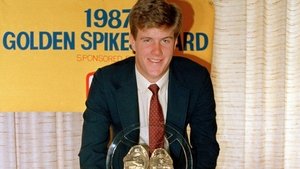
Southpaw: The Life and Legacy of Jim Abbott
Yankee Stadium has seen a plethora of legends over the franchise's storied history, but few have left a legacy as unique as Jim Abbott's. On September 4, 1993, the pitcher, who was born without a right hand, threw a no-hitter in front of the Yankee faithful. This astonishing achievement is merely one in a lifetime of perseverance, as Abbott continues to advocate for people with disabilities.
2024
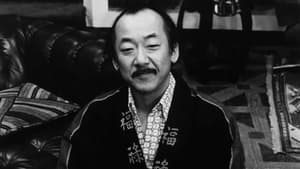
More Than Miyagi: The Pat Morita Story
The Oscar nominated actor best known for his role of Mr. Miyagi, left behind a painfully revealing autobiographical record of his much-too-brief time here on earth. Tracing his journey from being bed bound as a boy to the bright lights and discrimination in Hollywood. Deep inside that sweet, generous, multi-talented performer seethed an army of demons, that even alcohol and drugs couldn't mask.
2021
The Mysterious Life of Zita Johann
Profile of the actress Zita Johann
2020
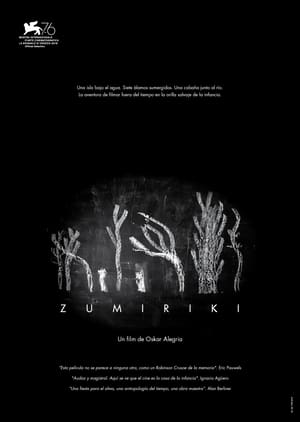
Zumiriki
Is it possible to travel twice to the same memory? The filmmaker built a cabin on an isolated riverbank, just opposite his childhood island, which had disappeared under the water after the construction of a dam. The goal was to go back to that place, which had become invisible. Only the trees of the island where he’d played stood firm in the middle of the water, like the masts of a broken toy boat, so the air was the only space left, the only vestige of the past to be conquered. This film is a diary of a castaway in memories: four months of a Walden experience in a lost paradise with two hens, a small vegetable garden and a clock that stopped forever at 11.36 and 23 seconds.
2019
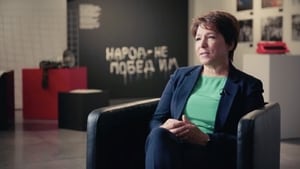
The Man Who Was Too Free
A documentary about Boris Nemtsov, a prominent figure of Russian political opposition and an outspoken critic of Vladimir Putin. Nemtsov was murdered in Moscow in February of 2015.
2017
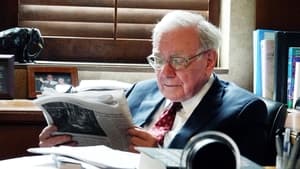
Becoming Warren Buffett
The story of the evolution of a boy from Nebraska who became one of the most respected men in the world, and the heroes who helped guide him along the way. By allowing access to his life and never-before-released home videos, Buffett offers a glimpse into his unique mind to help us understand what is truly important when money no longer has meaning.
2017
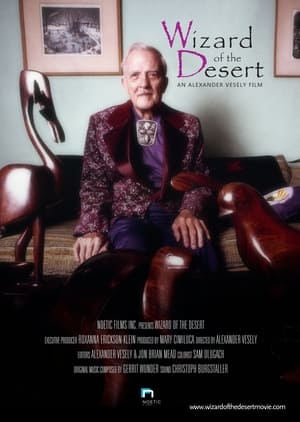
Wizard of the Desert: An Alexander Vesely Film
This documentary explores the personal life and incredible career work of Milton H. Erickson, M.D., founder of Modern Hypnotherapy. This unsung American genius was a pioneer in psychiatry using radical and unconventional hypnotic techniques to cure not only patients but to control his own debilitating pain and paralysis. The work of Milton H. Erickson, M.D., often referred to as “The Mozart of Communication,” shocked the scientific community with new and effective theories for therapeutic intervention, which even today defy scientific explanation. But it is his personal story that commands our initial attention. How does a child born in the silver mining community of Aurum, Nevada, and soon to be ghost town at 7,500 feet above sea level, survive all odds after being stricken with polio to grow into the man destined to become an evolutionary genius in the fields of hypnosis and psychotherapy?
2014
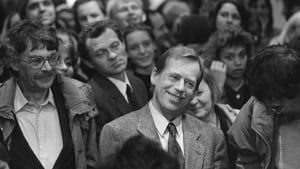
Václav Havel - Living in Freedom
Bohemian, playwright, and suddenly president at the end of 1989: Czech European Václav Havel played a decisive role in shaping the history of the continent in the second half of the 20th century. Andrea Sedláčková recounts Havel's almost novel-like life, drawing on a wealth of archival material. It is a story of dramatic highs and lows, and several defining moments in European history.
2014
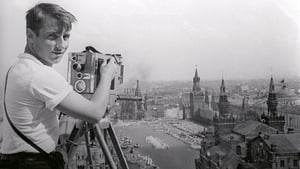
I Stop Time
Gunilla Bresky’s new film, “I stop time”, is a story from World War II that is unlike anything else. It is based on the Russian war photographer Vladislav Mikosha’s diaries and photographs. He was filming at the front, but he also visited Hollywood during the war and became a star when he showed his pictures from the front. As Mikosha’s Swedish voice in “I stop time” we have Jonas Karlsson. Gunilla Bresky has made several award-winning documentary films about World War II. The most recent, “Night Witches”, is about female Soviet bomber pilots.
2014
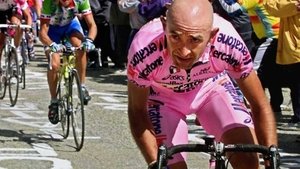
Pantani: The Accidental Death of a Cyclist
In 1998 Marco Pantani, the most flamboyant and popular cyclist of his era, won both the Tour de France and Giro d'Italia, a titanic feat of physical and mental endurance that no rider has repeated since. He was a hero to millions, the saviour of cycling following the doping scandals which threatened to destroy the sport. However, less than six years later, aged just 34, he died alone, in a cheap hotel room, from acute cocaine poisoning. He had been an addict for five years. This is the story of the tragic battles fought by the most important Italian cyclist of his generation; man verses mountain, athlete verses addiction, Marco Pantani verses himself.
2014
Menstrual Man
Some folks squirm at mention of a woman’s period…not Arunachalam Muruganantham. Considered a madman and pervert by his community, he ignores his detractors and makes his dream—low-cost sanitary pads made by and for rural Indian women—a reality. Using manually operated machines, Muruganantham’s microbusiness model is focused on something more important than profits: providing sustainable employment, hygiene and emancipation to women who would otherwise go without. He’s a man with a million-dollar idea—except money has nothing to do with it. His goal is to make a livelihood, not to accumulate wealth; to operate at a human scale, not a multinational one. Menstrual Man is the inspiring story of a hero who rises above poverty and a lack of education to become a superstar social entrepreneur in the business of breaking cultural taboos and re-inventing the economic pyramid. Muruganantham is leading a movement, not a company. And it’s spreading.
2013
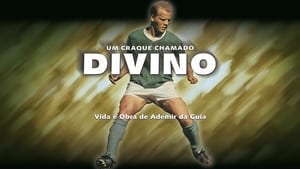
Um Craque Chamado Divino
A documentary about the life of Brazilian footballer Ademir de Guia (o Divino) who played his whole professional career for Palmeiras.
2006
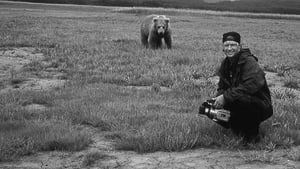
Grizzly Man
Follows the story of "Grizzly Man" Timothy Treadwell and what the thirteen summers in a National Park in Alaska were like in his attempt to protect the grizzly bears. The film is full of unique images and a look into the spirit of a man who sacrificed himself for nature.
2005
The Two Loves of Anthony Trollope
Documentary that gives background on Trollope's life from childhood, adolescence, adulthood and death.
2004

Katharine Hepburn: All About Me
In a rare interview, Katharine Hepburn shares her memories and memorabilia.
1993
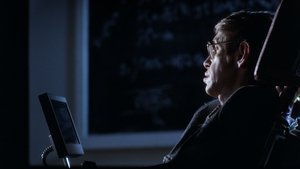
A Brief History of Time
This shows physicist Stephen Hawking's life as he deals with the ALS that renders him immobile and unable to speak without the use of a computer. Hawking's friends, family, classmates, and peers are interviewed not only about his theories but the man himself.
1991
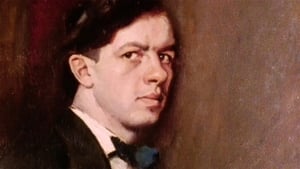
Thomas Hart Benton
Thomas Hart Benton's paintings were energetic and uncompromising. Today his works are in museums, but Benton hung them in saloons for ordinary people to appreciate.
1989
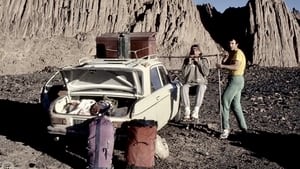
Oversand
Oversand is one of the first films about free climbing, the third film in a series of three with "Overdon" and "Over-Ice". Directed by Jean-Paul Janssen, the film was shot in 35mm in Algeria, in the Sahara Desert, in the Tamanrasset region, on the walls of the majestic peaks of the Atakor massif, central sub-region of Hoggar, mountainous heart of Hoggar, a volcanic plateau of almost circular shape, whose average altitude is 2000 meters, and which culminates at Mount Tahat (2918m), the highest point in Algeria. The Atakor is distinguished by its spectacular volcanic peaks, its needles, and its rugged landscapes, resulting from the erosion of ancient volcanic chimneys, which make it the most emblematic summits of the Hoggar, such as the Assekrem, the Ilamane, or the Tizouyag, where climbers Patrick Edlinger, Patrick Bérhault, Bernard Gorgeon, Hugues Jaillet, Jacques Perrier, Stéphane Troussier and Odette Schoënleb evolve under the watchful eye of the Tuareg caravans.
1981

Algeria, Year Zero
Documentary on the beginnings of Algerian independence filmed during the summer of 1962 in Algiers. The film was banned in France and Algeria but won the Grand Prize at the Leipzig International Film Festival in 1965. Out of friendship, the production company Images de France sent an operator, Bruno Muel, who later declared: "For those who were called to Algeria (for me, 1956-58), participating in a film on independence was a victory over horror, lies and absurdity. It was also the beginning of my commitment to the cinema."
1965