Watch Return to Life (1937) Online Free
In this propaganda film intended to raise money for republicans fighting in the Spanish Civil War, Henri Cartier-Bresson first presents the achievements of the Spanish Republic in the field of public health. He then shows how members of the public and organizations across the world were supporting the fighters.
Cast
Pierre Unik
More Like This
Agustina González. La zapatera que miraba a las estrellas
2023
La Era
2022
La Antorcha de los Éxitos: Cifesa (1932-1961)
The amazing story of Cifesa, a mythical film production company founded in Valencia by the Casanova family that managed to dominate the box office during the turbulent times of the Second Spanish Republic, the carnage of the Civil War and the hardships of the long post-war period and Franco's dictatorship — and survive until the sixties, when Spain was timidly beginning to change.
2022
Estos muros
In the mountains of Madrid, Spain, a railway track on an abandoned bridge and a poem erased from the wall of a ruined building reveal a deliberately silenced story: the system established by Franco's dictatorship after the civil war (1936-39) that allowed hundreds of companies to use thousands of convicted Republicans as slave labor.
2021
Cantata de la guerra civil
2021
La Tragédie des Brigades Internationales
2016
The Man Who Was There
The Spanish journalist Manuel Chaves Nogales (1897-1944) was always there where the news broke out: in the fratricidal Spain of 1936, in Bolshevik Russia, in Fascist Italy, in Nazi Germany, in occupied Paris or in the bombed London of World War II; because his job was to walk, see and tell stories, and thus fight against tyrants, at a time when it was necessary to take sides in order not to be left alone; but he, a man of integrity to the bitter end, never did so.
2013
Brigadistas
2007
Extranjeros de sí mismos
2000
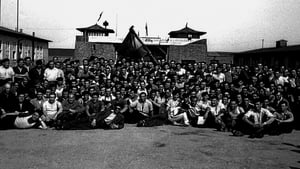
Francisco Boix: A Photographer in Hell
In 1939, just finished the Spanish Civil War, Spanish republican photographer Francesc Boix escapes from Spain; but is captured by the Nazis in 1940 and imprisoned in the Mauthausen concentration camp, in Austria, a year later. There, he works as a prisoner in the SS Photographic Service, hiding, between 1943 and 1945, around 20,000 negatives that later will be presented as evidence during several trials conducted against Nazi war criminals after World War II.
2000

Madrid
Hans, a German director, is in Madrid to film a television production about the capital and the Civil War, 50 years after it occurred. Accompanied by Lucía, his editor, and Goyo, his cinematographer, he films shots of the modern city, searching for spaces and people related to its past. At the same time, he views materials related to the past. In this search, Hans questions the point of his project, and disagrees with his producers until he discovers a project that he is passionate about.
1987

Caudillo
Caudillo is a documentary film by Spanish film director Basilio Martín Patino. It follows the military and political career of Francisco Franco and the most important moments of the Spanish Civil War. It uses footage from both sides of the war, music from the period and voice-over testimonies of various people.
1977

Long Live Death
At the end of the Spanish civil war, Fando, a boy of about ten, tries to make sense of war and his father's arrest. His mother is religious, sympathetic to the Fascists; his father is accused of being a Red. Fando discovers that his mother may have aided in his father's arrest. Sometimes we witness Fando imagining explanations for what's going on; sometimes we see him at play, alone or with his friend Thérèse. Oedipal fantasies and a lad's natural curiosity about sex and death mix with his search for his mother's nature and his father's fate. Will Fando survive the search?
1971
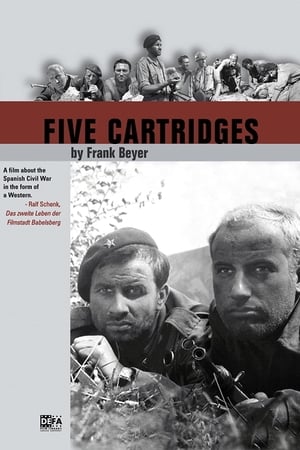
Five Cartridges
It is the year 1936 and the Spanish Civil War is raging. When the German commander of an international brigade is badly wounded he gives his five comrades a message which he divides up and secretes into in five cartridges. All five shells must reach the battalion in order for the message to be relayed. But Frenchman Pierre can’t bear the heat of the Sierra. When he leaves their hide-out to drink from a well he is hit by an enemy bullet.
1960
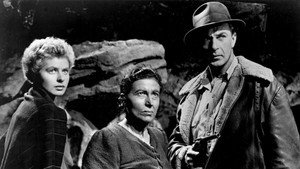
For Whom the Bell Tolls
Spain in the 1930s is the place to be for a man of action like Robert Jordan. There is a civil war going on and Jordan—who has joined up on the side that appeals most to idealists of that era—has been given a high-risk assignment up in the mountains. He awaits the right time to blow up a crucial bridge in order to halt the enemy's progress.
1943
Carmen and the Reds
Javier Navarro, a Falangist, is ordered to infiltrate Republican Madrid to deliver a message to a member of the Fifth Column.
1939
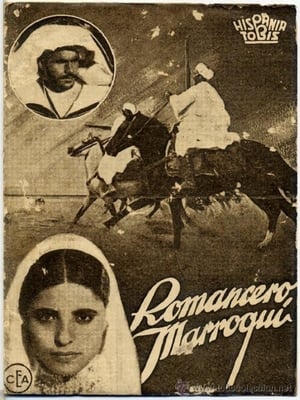
Romancero marroquí
The young farmer Aalami leaves his family to find work elsewhere. He gets to know the country and its people, customs and traditions at Küste in North Africa: Market life in Tetuan, the art of craftsmanship, the life of the Moors, dances and festivities in honour of the caliph, white mosques, the call of the muezzin of the minaret and the music of the shepherd flutes. Aalami also follows Franco's call and flies from Morocco to Spain to fight at Bürgerkrieg. In the end Aalami comes back to his wife and children.
1939
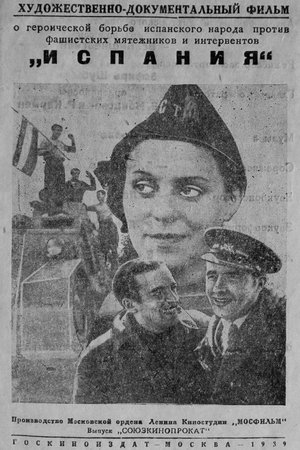
Spain
A feature-length documentary based on film reports from the Spanish civil war.
1939
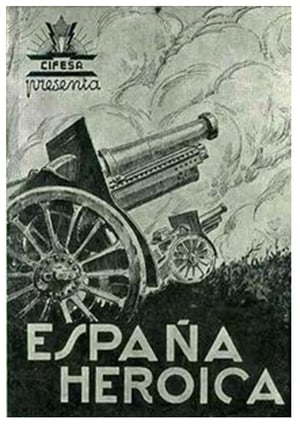
Heroic Spain
Documentary produced by Falange and edited in Berlin, in response to the international success of the Republican production "Spain 1936" (Le Chanois, 1937).
1938
Toma de Belchite y Teruel
1937