Watch Refugees in Their Own Land (2015) Online Free
Refugees in Their Own Land is an intimate portrait of a man and what belongs to him, an inner struggle forged by the forces of nature.
More Like This
Pinball
In this contemplative coming of age portrait, Yosef, a spirited athlete, is becoming more aware of his family history, after being displaced from their Iraqi homeland.
2026
Les survivants, l'impossible départ après la Shoah
2026

Staden brinner
When a group of Eritrean refugees arrive in the small town of Härnösand there is a growing sentiment against them from the locals. 17-year old Sara Westin decides to found an anti-racist group to combat these feelings but when Sara and her best friend are murdered by Sara's Eritrean ex-boyfriend the feelings in the city reach a boiling point.
2025

Aisha's Story
A Palestinian grain miller in a Jordanian refugee camp safeguards her culture and shares her people’s history through food prepared with love, longing, and sumud—the Palestinian spirit of steadfastness.
2025
Raha
A portrait of a queer HIV+ Iranian refugee in Quito.
2024
Limits of Europe
A prominent Czech journalist Saša Uhlová leaves her family and joins “cheap labour force” in Western Europe. Undercover, she works at an asparagus farm in Germany, tries her hand as a maid at a hotel in Ireland and takes care of the elderly in France. She experiences first-hand the struggles of Eastern European low-wage workers whose sacrifice and hard work allow for the Western society’s comfort. What is the real price that Europe pays for exploiting its own citizens? How do the lives of economic migrants, who have been forced to leave their children and elderly parents, look like? And why are privileged Europeans looking the other way?
2024

Homefront
A family with five children flees the war raging in their home village on the Russian border. They end up in Mshanets, a farming village on the other side of the country, remote and unknown. Here the family starts building a new home. At the same time, two documentary makers come to the village, looking for a story. In the Lymar family they find the ideal characters for their film. But one day, when the renovation of their house is almost finished, the family disappears. The filmmakers go in search of their characters and along the way they try to find an answer to the question: what does a person need to feel at home?
2024

Corps et âme
Aïcha is 59. She's been through some hard times. She decided to turn to helping others. Seeing firsthand the government's lack of support, she tries in her own way to remedy the lack of care for refugees. She dedicates the majority of her time to helping refugees in the greater Paris area, first as part of the "Solidarité Migrants Wilson" organization operating in the suburbs north of Paris, then in the nonprofit she founded, "la Team du Coeur", with the help of one of her daughters, her son-in-law, a Sudanese refugee himself, and a friend. Together, they offer on-street support and enter refugee camps daily to talk, provide material support and a listening ear.
2024

Longe de Cabul
2023
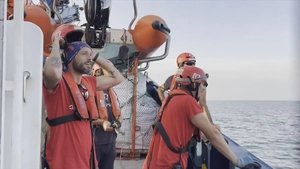
Aita Mari
The Stella Maris Berria is a tuna vessel destined for scrapping. However, Iñigo Mijangos and Iñigo Gutierrez, two members of the NGO Salvamento Marítimo Humanitario, have an unusual idea: to transform the fishing boat into a rescue boat to save refugees drowning in the Mediterranean Sea. That is how Aita Mari was born.
2021

Someone Like Me
After 11 strangers unite to help a gay youth escape life-threatening violence in Uganda, the unexpected pandemic and conflicting opinions over his best interests test the limits of their commitment and jeopardize his fresh start in Canada.
2021
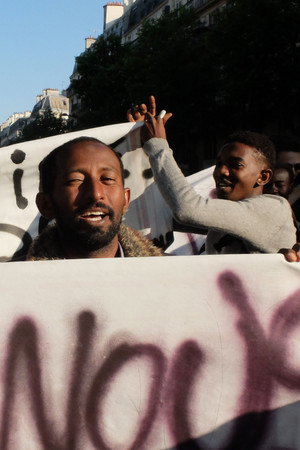
Bariz Street Camp Days
La Chapelle neighbourhood, Paris. Hundreds of exiled people from East Africa survive on the streets, chased violently by the police, yet seeking to defend their rights as asylum seekers. Some months later, having finally obtained their rightful housing, two Sudanese young men return to the sites where they first landed and talk about their arrival in Paris during this agitation.
2020
Refuge(e)
Refuge(e) traces the incredible journey of two refugees, Alpha and Zeferino. Each fled violent threats to their lives in their home countries and presented themselves at the US border asking for political asylum, only to be incarcerated in a for-profit prison for months on end without having committed any crime. Thousands more like them can't tell their stories.
2019
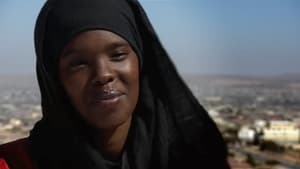
Escape from the World's Most Dangerous Place
Successful model Samira Hashi makes an emotional return to Somalia, one of the most dangerous places in the world and the place she was born. Civil war broke out in 1991, 10 days after Samira's birth, but two years later her family managed to flee the country and she grew up in the UK.Now, as Samira and the war both turn 21, she's going back for the first time to visit the people and places she left behind. The contrast with her safe and glamorous life in London could not be starker as she experiences firsthand the war's effect on a generation of young people growing up in conflict.
2012
Rosans, Bitter Honey
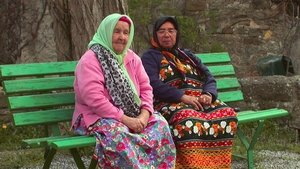
In 1963, Rosans, a village in the Hautes-Alpes region depopulated by the rural exodus, welcomed Harkis (military soldiers) forced to leave Algeria for supporting France during the Algerian War. Around thirty families settled in a camp below Rosans. Nearly half a century after their arrival, first- and second-generation Harkis and native Rosanais recount their experiences of this culture clash, often painful, sometimes happy. Language barriers, religious differences, living in barracks for 14 years, and unemployment were all obstacles to overcome in order to be accepted and then achieve mutual enrichment. Enriched with archive footage to explain the historical context of the time, the film seeks above all to express feelings and unspoken words.
2011

HALEMEH
In the Gaza refugee camp of Jerash, Palestinians face the critical issue of lacking identification documents. This situation undermines their rights and hinders access to essential services and opportunities.
2003

Band of Exile
Here in Toronto, four young Somali refugees are finishing high school. What did they bring with them? What did they find in Canada? Their testimonies, about us and about themselves, interspersed with newsreel footage and sequences of a theatrical creation in which they put all their soul, make them immediately endearing and overturn many prejudices held against refugees. A film that makes you want to get to know them better.
1994

An Oppressed People Is Always Right
In May 1974, the Israeli Air Force carried out an extermination operation against the Palestinian refugee camp Nabatiyeh. With this as a starting point, it is reviewed how the last 50 years of Zionist colonization of Palestine have partly led to the establishment of the state of Israel, partly to the expulsion of a people, the Palestinians, from their land. The film shows scenes of daily life in Palestinian refugee camps. We hear various of the inhabitants talk about their desire to return to their country, and we follow how the resistance movement works to free women from their traditional backward role. At the same time, the emergence of the armed resistance struggle is analysed, and the significance of the latest military technological developments for guerilla wars in the 3rd world is explained.
1976

Chief Rabbi's Emergency Council
Poignant postwar appeal for Britain’s Jewry to support orphaned Jewish children rescued from Europe.
1947

Notices from Yonas
A cell phone was the only thing that kept Yonas, an Eritrean refugee, connected to Jérôme, the French journalist who wanted to tell his story. They met in Libya in 2019, in the abyss of a detention center. Yonas managed to escape and attempted several times to cross the Mediterranean. Like many others who jump from one hell to another, Yonas's only option was to flee forward, and what lay before him was a small boat. Yonas's News chronicles the epic journey in which his life was at stake, summarized in the WhatsApp and voice messages, photos, and videos he was able to exchange with Jérôme. Jérôme Tubiana, journalist, researcher, and member of Doctors Without Borders, has visited Libya five times between 2018 and 2020.