Watch Nous irons jusqu'au bout (les Kaolins de Plemet) (1973) Online Free
Chronicle of the 9-week strike by the kaolin workers of Plémet. The film emphasizes the particular nature of such a strike in a rural commune and in a sector of the old Breton proletariat: that of subsoil mining, almost entirely liquidated after the closure of the Hennebont forges.
More Like This
The Day Iceland Stood Still
When 90% of Iceland’s women walked off the job and out of their homes one morning in 1975, they brought their country to its knees and catapulted Iceland to the forefront of today's global fight for gender equality. Unexpectedly funny, laced with evocative animation and powerfully told by the women who lived it – this is the true story of 12 hours that launched a revolution.
2025

Hotel Chocolat at Christmas
In the lead-up to the festive bonanza, an exclusive look inside the chocolate-maker's inventing room, and its 'chocolate imaginarium' too. Prepare for special choc drinks and cranberry treats.
2024

8/1 – A Democracia Resiste
Unpublished images and exclusive testimonies from the main figures in power who tell how they faced the coup threat of January 8, 2023, a recent trauma in the country's history and revealing something that still remains hidden.
2024

Ecos de huelga
2021

Making of: Pierce Fire Trucks
2019
Vigo 1972
‘VIGO 1972’ narrates the events which took place in Vigo in September 1972, when the firing of five Citröen auto workers resulted in the largest general strike in the history of Galicia — with over thirty thousand workers — all of this during the Franco dictatorship in Spain.
2017
Ho Chi Minh Kim Chi
The sights and sounds of a kimchi factory in Vietnam.
2016
Song of Armorica
A poetic drama, spoken in the Breton language and set in a Breton fishing community, telling of the impossible love between a waifish fisherman and a highborn lady-of-the-manor.
2016

Les 16 de Basse-Pointe
2009
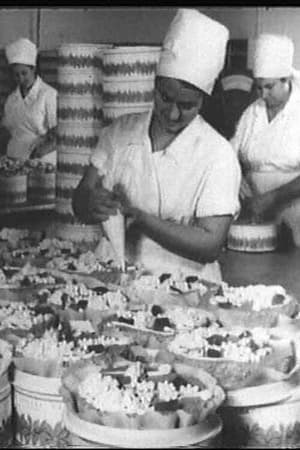
Charlie Marx and the Chocolate Factory
Charlie Marx and the Chocolate Factory started as an investigation of the link between politics and chocolate, at the Karl Marx Confectionary Factory in Kiev, Ukraine. Since access to the factory was denied, the project had to be re-considered, re-invented or re-enacted. Mostly made of archival footage and re-enacted performances based on the company's website, the film merges what was left of the initial idea with what has been collected and realized instead. It borrows from the genres of video art, 'Man on the street' interview, direct address, corporate film, essay, and music video, without legitimately belonging to any of them. The film unravels as a reflection on its own failure, and yet keeps on investigating what has always been at stake: the shift from public to private property (and from analog to digital technology), dialectics of permanence and change, language as a mirror of ideology, and post-Soviet oligarchy culture.
2009
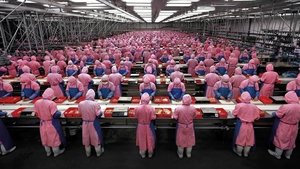
Manufactured Landscapes
MANUFACTURED LANDSCAPES is the striking new documentary on the world and work of renowned artist Edward Burtynsky. Internationally acclaimed for his large-scale photographs of “manufactured landscapes”—quarries, recycling yards, factories, mines and dams—Burtynsky creates stunningly beautiful art from civilization’s materials and debris.
2006
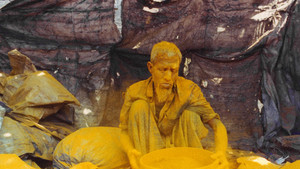
Megacities
Megacities is a documentary about the slums of five different metropolitan cities.
1998
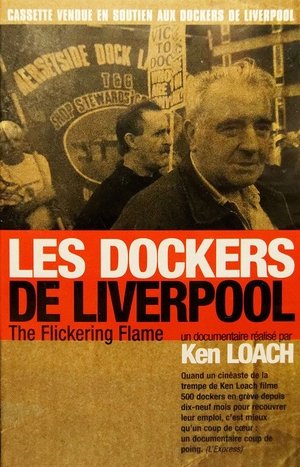
The Flickering Flame
Documentary following dockers of Liverpool sacked in a labour dispute and their supporters’ group, Women of the Waterfront, as they receive support from around the world and seek solidarity at the TUC conference.
1996
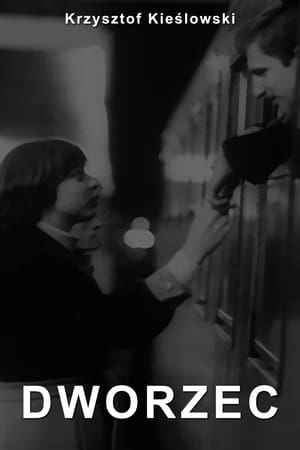
Railway Station
Warsaw's Central Railway Station. 'Someone has fallen asleep, someone's waiting for somebody else. Maybe they'll come, maybe they won't. The film is about people looking for something.
1980
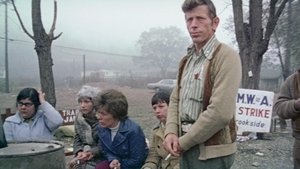
Harlan County U.S.A.
This film documents the coal miners' strike against the Brookside Mine of the Eastover Mining Company in Harlan County, Kentucky in June, 1973. Eastover's refusal to sign a contract (when the miners joined with the United Mine Workers of America) led to the strike, which lasted more than a year and included violent battles between gun-toting company thugs/scabs and the picketing miners and their supportive women-folk. Director Barbara Kopple puts the strike into perspective by giving us some background on the historical plight of the miners and some history of the UMWA. Preserved by the Academy Film Archive in partnership with New York Women in Film & Television in 2004.
1977
I Am a Truck
Worldy renowned for his masterpiece The Housemaid (1960), Kim Ki-young debuts with his first short film I Am a Truck (1953), which was sponsored by UN and made a year after the armistice of the Korean War. This film is a fascinating glimpse into the mind of a soon-to-be powerful auteur and influential filmmaker in the post-war Korean cinema, if not the whole history of Korean cinema.
1953
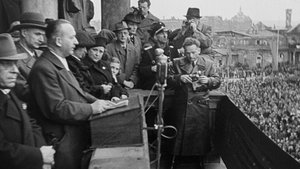
Unity SPD – KPD
Documentary about the merging of the Communist Party of Germany and the Socialist Unity Party of Germany in the Soviet occupation zone, a merger that would lead to the creation of the Socialist Unity Party that would rule the soon-to-be-created East Germany until 1989.
1946
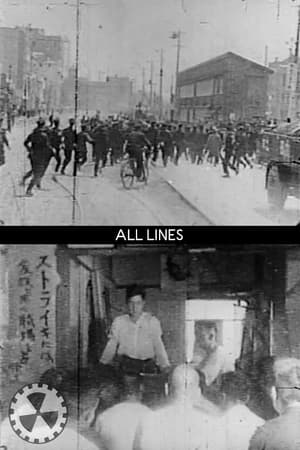
All Lines
This was a news film with elements of reenactment. From December 1927 to 1932, 2,000 bus and train drivers were fired, provoking a strike. This film was edited out of footage shot from that strike over a long period.
1932
Atlas
The concept of machine-made knit was known as early as the 1850s, but it was only during the 1920s that the quality of the material had improved. When the plant known as "Atlas" was introduced in 1931, the shop windows drew a lot of attention, and Aho & Soldan was ordered to make a promotional film. In this well-paced film, we see the jersey production step by step.
1931
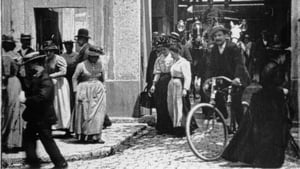
Workers Leaving the Lumière Factory
Working men and women leave through the main gate of the Lumière factory in Lyon, France. Filmed on 22 March 1895, it is often referred to as the first real motion picture ever made, although Louis Le Prince's 1888 Roundhay Garden Scene pre-dated it by seven years. Three separate versions of this film exist, which differ from one another in numerous ways. The first version features a carriage drawn by one horse, while in the second version the carriage is drawn by two horses, and there is no carriage at all in the third version. The clothing style is also different between the three versions, demonstrating the different seasons in which each was filmed. This film was made in the 35 mm format with an aspect ratio of 1.33:1, and at a speed of 16 frames per second. At that rate, the 17 meters of film length provided a duration of 46 seconds, holding a total of 800 frames.
1895