Watch Nazis on Drugs: Hitler and the Blitzkrieg (2019) Online Free
For all its talk of racial, spiritual, and physical purity, the self-anointed “Master Race” harbored a secret…theirs was an axis of drug addicts. This two-hour special explores the origin, impact, and lasting effects of the state-sponsored drug use that helped build—and eventually burned—the Third Reich. Incredible new sources of information, including a detailed journal maintained by Hitler’s personal physician, reveal the extent of not just his, but the entire Nazi Party’s reliance on drugs to power their war effort.
More Like This
Bullets And Blueberries
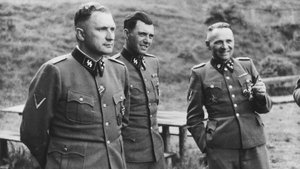
The Holocaust began with the indiscriminate mass shootings by the Einsatzgruppen in the bloodlands of Eastern Europe and was perfected in the gas chambers at Auschwitz. “Bullets And Blueberries” explores the motives, methods and madness of the perpetrators, using never-before-seen images captured by the killers themselves — images that fully capture the banality of evil.
2025

The Final Days of Adolf Hitler
2024

The Nazi Pug: Joke or Hate?
Markus Meechan is a criminal. Guilty of posting a YouTube video judged “grossly offensive” and containing menacing, anti-Semitic and racist material. He claims the video was a joke. Others claim, Markus is a Nazi. But what does the prosecution of a YouTube comedian mean for freedom of expression – is a censorious state overstepping the mark? Or are there some things you just shouldn’t joke about?
2019

Hitler's Battle Against the Press
As early as 1920, the journalists of the "Münchener Post" recognized the danger posed by Adolf Hitler. Consistently and boldly they wrote about National Socialism. The brave journalists and their newspaper are almost forgotten today. A single book has been published about them - in Brazil.
2018

Whitney: Can I Be Me
The life and tragic death of Whitney Houston.
2017

The Aryans
THE ARYANS is Mo Asumang's personal journey into the madness of racism during which she meets German neo-Nazis, the US leading racist, the notorious Tom Metzger and Ku Klux Klan members in the alarming twilight of the Midwest. In The ARYANS Mo questions the completely wrong interpretation of "Aryanism" - a phenomenon of the tall, blond and blue-eyed master race.
2014

Max Manus: Man of War
Max Manus is a Norwegian 2008 biographic war film based on the real events of the life of resistance fighter Max Manus (1914–96), after his contribution in the Winter War against the Soviet Union. The story follows Manus through the outbreak of World War II in Norway until peacetime in 1945.
2008

Zeitgeist: The Movie
A documentary examining possible historical and modern conspiracies surrounding Christianity, the 9/11 terrorist attacks, and the Federal Reserve bank.
2007

Factory Girl
In the mid-1960s, wealthy debutant Edie Sedgwick meets artist Andy Warhol. She joins Warhol's famous Factory and becomes his muse. Although she seems to have it all, Edie cannot have the love she craves from Andy, and she has an affair with a charismatic musician, who pushes her to seek independence from the artist and the milieu.
2006
2 or 3 Things I Know About Him
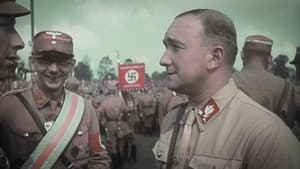
What would your family reminiscences about dad sound like if he had been an early supporter of Hitler’s, a leader of the notorious SA and the Third Reich’s minister in charge of Slovakia, including its Final Solution? Executed as a war criminal in 1947, Hanns Ludin left behind a grieving widow and six young children, the youngest of whom became a filmmaker. It's a fascinating, maddening, sometimes even humorous look at what the director calls "a typical German story." (Film Forum)
2005
Sophie Scholl: The Final Days
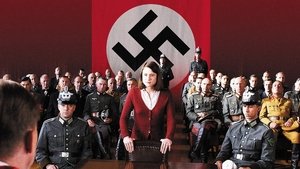
In 1943, as Hitler continues to wage war across Europe, a group of college students mount an underground resistance movement in Munich. Dedicated expressly to the downfall of the monolithic Third Reich war machine, they call themselves the White Rose. One of its few female members, Sophie Scholl is captured during a dangerous mission to distribute pamphlets on campus with her brother Hans. Unwavering in her convictions and loyalty to the White Rose, her cross-examination by the Gestapo quickly escalates into a searing test of wills as Scholl delivers a passionate call to freedom and personal responsibility.
2005
Downfall
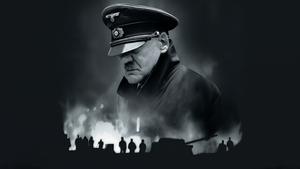
In April of 1945, Germany stands at the brink of defeat with the Russian Army closing in from the east and the Allied Expeditionary Force attacking from the west. In Berlin, capital of the Third Reich, Adolf Hitler proclaims that Germany will still achieve victory and orders his generals and advisers to fight to the last man. When the end finally does come, and Hitler lies dead by his own hand, what is left of his military must find a way to end the killing that is the Battle of Berlin, and lay down their arms in surrender.
2004

Conspiracy
At the Wannsee Conference on January 20, 1942, senior Nazi officials meet to determine the manner in which the so-called "Final Solution to the Jewish Question" can be best implemented.
2001

Aimée & Jaguar
In 1943, while the Allies are bombing Berlin and the Gestapo is purging the capital of Jews, a dangerous love affair blossoms between two women – one a Jewish member of the underground, the other an exemplar of Nazi motherhood.
1999

Basquiat
The brief life of Jean Michel Basquiat, a world renowned New York street artist struggling with fame, drugs and his identity.
1996
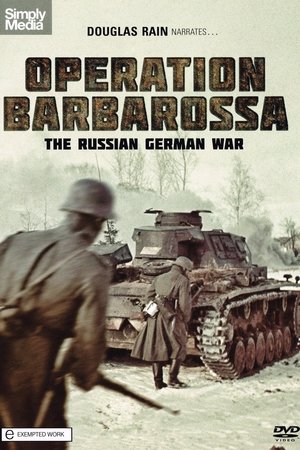
The Russian German War
This is a rare look at one of the worst horror stories in the long infamous history of warfare. This series features captured German and Russian film footage, much of which has never been seen before. For decades the Cold War prevented us from looking closely at what really happened between the Russians and the Germans on the Eastern Front during World War II. More than a struggle between nations, it pitted maniacal tyrant against maniacal tyrant, evil ideology against evil ideology. The lives of tens of millions of human beings were consumed by its raging hatreds and appalling indignities. One in every ten Russians died. One in every four Poles died. Whole divisions of Italians, Romanians, Hungarians disappeared with barely a trace. An average of 17,800 people died on every single day and this, the war on the Russian German Front, lasted for 1,400 days. This series features captured German and Russian film footage, much of which has never been seen before.
1995
Schtonk!
Schtonk! is a farce of the actual events of 1983, when Germany's Stern magazine published, with great fanfare, 60 volumes of the alleged diaries of Adolf Hitler – which two weeks later turned out to be entirely fake. Fritz Knobel (based on real-life forger Konrad Kujau) supports himself by faking and selling Nazi memorabilia. When Knobel writes and sells a volume of Hitler's (nonexistent) diaries, he thinks it's just another job. When sleazy journalist Hermann Willié learns of the diaries, however, he quickly realizes their potential value... and Knobel is quickly in over his head. As the pressure builds and Knobel is forced to deliver more and more volumes of the fake diaries, he finds himself acting increasingly like the man whose life he is rewriting. The film is a romping and hilarious satire, poking fun not only at the events and characters involved in the hoax (who are only thinly disguised in the film), but at the discomfort Germany has with its difficult past.
1992
Ordered to Love
Revealing story about the mysterious Nazi organization "Lebensborn," which was intended to serve the SS in pursuing population policy and racial hygiene goals by systematically producing "hereditarily valuable" children. The film depicts an anti-Hitler Knight's Cross recipient with false papers who becomes a witness and victim of relevant events in a Lebensborn home, where 30 enthusiastic BDM girls and a number of SS hooligans and frontline soldiers have just moved in to "give the Führer a child."
1961
The Bridge
A group of German boys are ordered to protect a small bridge in their home village during the waning months of the second world war. Truckloads of defeated, cynical Wehrmacht soldiers flee the approaching American troops, but the boys, full of enthusiasm for the "blood and honor" Nazi ideology, stay to defend the useless bridge. The film is based on a West German anti-war novel of the same name, written by Gregor Dorfmeister.
1959
Junge Deutsche im Mai
Every year, the most beautiful, best and proudest representatives of German youth meet in Dresden to take to the streets together.