Watch Lago Escondido- Soberanía en juego (2024) Online Free
Loading Cinehub...
A group of Argentines try to reach Lago Escondido, in the south of their own country, where the British billionaire Joe Lewis has created a fiefdom of twelve thousand hectares that functions as a parallel state. This documentary narrates the Seventh March to Lago Escondido in 2023, with a camera that records the events directly, but also investigates dark geopolitical interests, business/judicial lobbies and the complicity of some sectors of Argentine politics with foreign interests.
More Like This
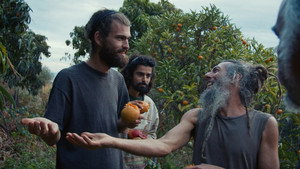
Sintrópica- Semillas de cambio
Jaime Otero, a passionate Galician farmer, and his companions Sérgio and Diogo, embark on an odyssey across the Iberian Peninsula, carrying with them the revolutionary philosophy of syntropic farming. This practice is inspired by the forest to produce food while regenerating ecosystems. Their adventure takes them through regions as diverse as Galicia to the sea of plastics in Almería, confronting us with the severe environmental crisis that conventional agricultural practices are leading us towards. The collection and dispersal of seeds becomes the main tool for regeneration and the backbone of this road movie,in which countless people who are also looking for a paradigm shift are immersed in. . Full of passion and hope, these three pioneers invite us to relearn and to look at nature with new eyes. Ultimately, they show us that our ability to transform our current reality will require a steady and collective effort.
2024

The Route of the Conquerors
In times of global ecological crisis, Costa Rica seems to be an oasis for its rich biodiversity. Nacho traces a route to learn about agroecological projects, discovering what the indigenous communities call "good living" Could this be the solution?
2024
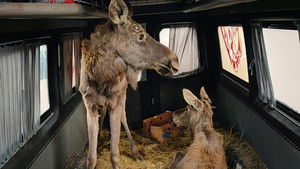
Checkpoint Zoo
Checkpoint Zoo documents a daring rescue led by a heroic team of zookeepers and volunteers, who risked their lives to save thousands of animals trapped in a zoo behind enemy lines in the Russian Invasion of Ukraine.
2024
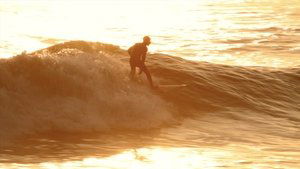
CATANAS POINT - A Surf Documentary
"CATANAS POINT - A Surf Documentary" portrays the reality of the sport of surfing in Angola and compares it with what surfing was like in Brazil from the 1980s to the present day.
2023

De La Mar
The inhabitants of the Humboldt Archipelago have a strong connection to their territory and the sea, which will become the main driving force to defend the nature and biodiversity of the area against the threat posed by the installation of the Dominga mining project and the Cruz Grande mega port.
2022
Mira-futuro
2022
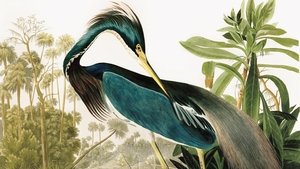
Birds of America
In the first half of the 19th century, the French ornithologist Jean-Jacques Audubon travelled to America to depict birdlife along the Mississippi River. Audubon was also a gifted painter. His life’s work in the form of the classic book ‘Birds of America’ is an invaluable documentation of both extinct species and an entire world of imagination. During the same period, early industrialisation and the expulsion of indigenous peoples was in full swing. The gorgeous film traces Audubon’s path around the South today. The displaced people’s descendants welcome us and retell history, while the deserted vistas of heavy industry stretch across the horizon. The magnificent, broad images in Jacques Loeuille’s atmospheric, modern adventure reminds us at the same time how little - and yet how much - is left of the nature that Audubon travelled around in. His paintings of the colourful birdlife of the South still belong to the most beautiful things you can imagine.
2022
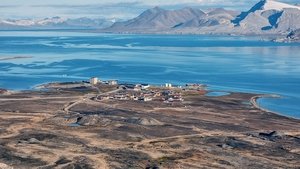
Der Wind - Motor des Klimawandels
2022
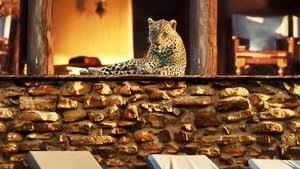
The Year Earth Changed
Never-before-seen footage shows how our living in lockdown opened the door for nature to bounce back and thrive. Across the seas, skies, and lands, Earth found its rhythm when we came to a stop.
2021
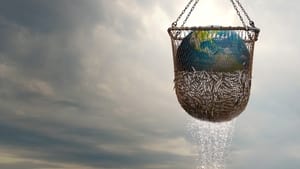
Seaspiracy
Passionate about ocean life, a filmmaker sets out to document the harm that humans do to marine species — and uncovers an alarming global conspiracy.
2021
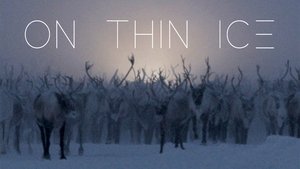
On Thin Ice
Climate change has reached the indigenous Nenets people in the north of Siberia. The nomads' herds of reindeer move on thin ice. The warming in the Russian Arctic is becoming dramatically visible. Huge craters open in the thawing permafrost and expose dangerous viruses and bacteria. Forest floors dry out and the taiga catches on fire. The pack ice off the coast is melting and depriving polar bears of their habitat so that they approach human settlements in their desperation. The changes in the nature of the Arctic Circle combine with the measurements of researchers and observations of the indigenous people to form a disturbing overall picture: In the Russian Arctic, Pandora's box has been opened! The film team had the chance to shoot in regions that were been restricted areas for decades. The documentary shows in impressive and depressing images already existing effects, phenomena and ominous interlinkages of global warming.
2020
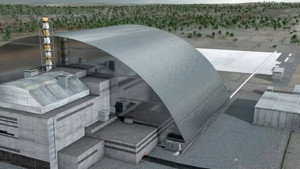
Inside Chernobyl's Mega Tomb
Documentary which follows the construction of a trailblazing 36,000-tonne steel structure to entomb the ruins of the nuclear power plant destroyed in the 1986 Chernobyl disaster.
2016
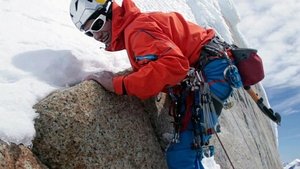
Cerro Torre: A Snowball's Chance in Hell
Movie about David Lama climbing the Patagonian mountain Cerro Torre for the first time free, a mountain that has been dubbed the most difficult to climb in the world.
2013

The Great Famine
When a devastating famine descended on Soviet Russia in 1921, it was the worst natural disaster in Europe since the Black Plague in the Middle Ages. Examine Herbert Hoover’s American Relief Administration—an operation hailed for its efficiency, grit and generosity. By the summer of 1922, American kitchens were feeding nearly 11 million Soviet citizens a day.
2011

To the Limit
At the Limit is a documentary about extreme climbing. In this sports documentary, Pepe Danquart shows brothers Thomas and Alexander Huber climbing in Patagonia and on the granite rock "El Capitan" in Yosemite Valley (USA). A key part of the film is their attempt at a speed ascent of the 1,000-meter-high route "The Nose," in which the two athletes aim to break the then speed record of 2:48:30 hours, set by Hans Florine and Yuji Hirayama in September 2002.
2007
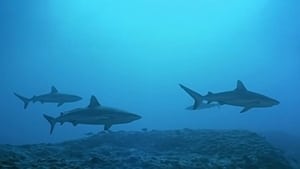
Atlantis
Atlantis is filmmaker Luc Besson's celebration of the beauty and wonder of the world beneath the sea, expanding upon themes touched on in his film The Big Blue. Combining stunning underwater cinematography and a hypnotic score by Eric Serra, Besson's singular vision defies dialogue or narrative structure to explore ocean life as you've never seen it before. Following the colossal success of The Big Blue, Luc Besson crisscrossed the world's seas and oceans to film the beauty and diversity of marine life: from the giant octopuses of Vancouver to the manta rays of the Pacific (New Caledonia), and the grey sharks of Tahiti. A film with no actors or sets other than the underwater world. A breathtaking view of marine species: sharks, dolphins, manatees, octopuses. An exploration of the seabed in the Bahamas, the Galapagos, Vancouver, and Tahiti.
1991
Koyaanisqatsi
Takes us to locations all around the US and shows us the heavy toll that modern technology is having on humans and the earth. The visual tone poem contains neither dialogue nor a vocalized narration: its tone is set by the juxtaposition of images and the exceptional music by Philip Glass.
1983
A Town Without Flies
A teaching film for social studies, which was developed as a new educational subject in 1947. At an elementary school in Hokkaido, children have started a fly extermination campaign to improve school hygiene. In order to eliminate the causes of flies, the entire town is working to improve the sanitary environment. The short was filmed with the cooperation of Mizukaido Elementary School in Joso City and is the first film in the "Social Studies Teaching Film System" by Iwanami Film Productions.
1950
The Plague Monkeys
Recounts the chilling events leading up to the emergence of the deadly Ebola virus. Shot on location in Africa, Europe and North America, and features interviews with Ebola survivors.
The Galápagos Finches
Documentary about finches of the Galápagos Islands.
1971