Watch Hugo Pratt, trait pour trait (2016) Online Free
Loading Cinehub...
Several key words emerge from Hugo Pratt's work, inseparable from his life: travel, adventure, erudition, esotericism, mystery, poetry, melancholy... and of course, Corto Maltese, his hero and alter ego, who established him as one of the greatest names in comic books. Born in Italy in 1927 and dying in Switzerland sixty-eight years later, Hugo Pratt, born without an H and with only one T, grew up in the shadow of a fascist father who took him at a very young age to Ethiopia, which was occupied by Mussolini's forces. The teenager developed a fascination for the wide-open spaces of Africa, soon followed by an irresistible attraction to the Indian world. This was the starting point for a life of travel, success, conquests, rare failures, and marked by his veneration for the American cartoonist Milton Caniff, his absolute master.
Cast
Hugo Pratt, Lambert Wilson
More Like This

The ABCs of Book Banning
In recent years, more than 2,500 books have been removed from school districts around the US, labeled as banned, restricted, or challenged, and made unavailable to millions of students. By no accident, the themes targeted are the usual scapegoats of the American Right—LGBTQ+ issues, Black History, and women’s empowerment—impeding the power of future generations to develop their own thoughts and opinions on critical social issues. By weaving together a lyrical montage of young readers and authors, THE ABCs OF BOOK BANNING reveals the voices of the impacted parties, and inspires hope for the future through the profound insights of inquisitive youthful minds.
2024
The Great American Mud Wrestle
For one-night-only blood was spilled in the mud.
2018
The Road Forward
The Road Forward is an electrifying musical documentary that connects a pivotal moment in Canada’s civil rights history—the beginnings of Indian Nationalism in the 1930s—with the powerful momentum of First Nations activism today. Interviews and musical sequences describe how a tiny movement, the Native Brotherhood and Sisterhood, grew to become a successful voice for change across the country. Visually stunning, The Road Forward seamlessly connects past and present through superbly produced story-songs with soaring vocals, blues, rock, and traditional beats.
2017
Two Headed Cow
Eighteen years in the making, two-headed cow started off as a black and white film that followed Dexter Romweber and his drummer Crow on a rock and roll tour along the same route as General Sherman. The film was not finished due to many circumstances, but the filmmakers were able to resume the film seventeen years later. After major TV appearances, a stint on a major label, bouts of depression and drug addiction, the film took on a different tone and poignancy.
2006
H.P. Lovecraft - Ipotesi di un viaggio in Italia
A documentary about the possible ties between H.P.LOVECRAFT and the Polesine region (Italy), stimulated by the casual discovery of a mysterious manuscript attributed to the great American horror writer died in 1937.
2004

Björk: Minuscule
This documentary offers a behind-the-scenes look at Björk and her touring entourage for the 2001 Vespertine tour. It includes interviews with harpist Zeena Parkins, the Inuit choir from Greenland, electronic duo Matmos, and an ongoing conversation with Björk herself about her recordings and her tours. The documentary is interspersed with live footage of songs from the tour shot by Ragnheidur Gestsdóttir, which themselves correspond to the performances chosen for the Vespertine Live album.
2002
Visconti: La verdad del melodrama
2001
There is No Death For Me
It is a documentary story about five legends of russian cinema: Nonna Mordyukova, Tatyana Okunevskaya, Tatyana Samoylova, Lidiya Smirnova and Vera Vasileva. These wonderful women tell about their lifes and careers in hour interview.
2000
Hands on a Hardbody: The Documentary
Filmmaker S.R. Bindler profiles Texas contestants trying to win a truck by keeping one hand on it longer than everyone else.
1997
Cindy Sherman: Nobody's Here But Me
New York based artist, Cindy Sherman, is famous for her photographs of women in which she is not only the photographer, but also the subject. She has contributed her own footage to the programme by recording her studio and herself at work with her Hi-8 video camera. It reveals a range of unexpected sources from visceral horror to medical catalogues and exploitation movies, and explores her real interests and enthusiasms. She shows an intuitive and often humorous approach to her work, and reflects on the themes of her work since the late 1970s. She talks about her pivotal series known as the `Sex Pictures' in which she addresses the theme of sexuality in the light of AIDS and the arts censorship debate in the United States.
1994
Joseph Cornell: Worlds in a Box
This is a 1991 documentary film about the legendary artist and filmmaker, Joseph Cornell, who made those magnificent and strange collage boxes. He was also one of our great experimental filmmakers and once apparently made Salvador Dali extremely jealous at a screening of his masterpiece, Rose Hobart. In this film we get to hear people like Susan Sontag, Stan Brakhage, and Tony Curtis talk about their friendships with the artist. It turns out that Curtis was quite a collector and he seemed to have a very deep understanding of what Cornell was doing in his work.
1991
Nico: In Memoriam
"Not a documentary but the the ruins of an attempted documentary." - Grashina Gabelmann Nico’s solo concert in West Berlin 1986. She’s high, giggly, not entirely there but her voice is still haunting and raspy and her presence still the one of a star. We see short clips of an interview held the same year in a hotel – an interview Gaul found somewhere, where he can not remember. We see footage borrowed from Andy Warhol’s estate. Footage of factory parties and screen tests.
1989
Unsere MiG
Short film about the MiG fighter jets of the NVA
1986
Cinéastes de notre temps : Norman McLaren
1972
Hitler an der Macht
Short film about Hitler's rise to power in 1933
1960
Gateways to the Mind
The film presents how the human body recognizes and becomes aware of its surroundings. The various information pathways to the brain such as sight, sound, smell, taste and touch are explored in a accurate but simple manner via human impression and cartoon characters!
1958
Die Forelle
Short film about trouts
1946
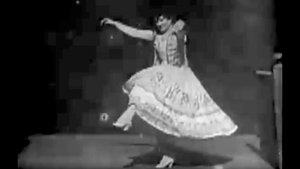
Carmencita
The first woman to appear in front of an Edison motion picture camera and possibly the first woman to appear in a motion picture within the United States. In the film, Carmencita is recorded going through a routine she had been performing at Koster & Bial's in New York since February 1890.
1894
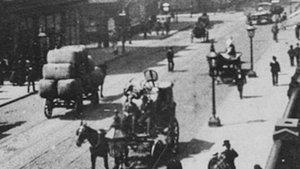
Traffic Crossing Leeds Bridge
A film by Louis Aimé Augustin Le Prince, shot in late October 1888, showing pedestrians and carriages crossing Leeds Bridge.
1888
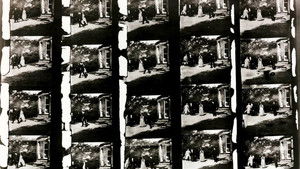
Roundhay Garden Scene
The earliest surviving motion-picture film, and believed to be one of the very first moving images ever created, was shot by Louis Aimé Augustin Le Prince using the LPCCP Type-1 MkII single-lens camera. It was taken on paper-based photographic film in the garden of Oakwood Grange, the Whitley family house in Roundhay, Leeds, West Riding of Yorkshire (UK), on 14 October 1888. The film shows Adolphe Le Prince (Le Prince’s son), Mrs. Sarah Whitley (Le Prince’s mother-in-law), Joseph Whitley, and Miss Harriet Hartley walking around in circles, laughing to themselves, and staying within the area framed by the camera. Roundhay Garden Scene is often associated with a recording speed of around 12 frames per second and runs for about 2 to 3 seconds.
1888