Watch Entre Terre et Ciel (1961) Online Free
This is Gaston Rebuffat's fourth film, in which, with several close friends, he discovers the sublime landscapes of the Alps. “Mont-Blanc is beautiful. I climbed it several times depending on the time, the color of the sky and the shape of the cornices and ridges. Because of the weather and also because of this feeling of altitude, Mont-Blanc provides great pleasure. For the guide, Mont Blanc is his garden, but the garden becomes more beautiful when shown to a friend. Personally, I really like the bivouacs; only there one penetrates a little the mystery of the altitude. That's why I immediately accepted when Tazieff expressed the desire to spend the night at the top of Mont Blanc in an igloo. The film won the Grand Prix at the Trento Film Festival in 1961.
Cast
Gaston Rébuffat, Maurice Baquet, Haroun Tazieff, Paul Beylier, Pierre Cretton, Christian Mollier, Jean-François Reymond
More Like This
Camp Courage
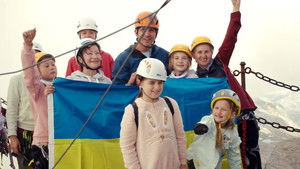
Made refugees by the war in Ukraine, Olga and her granddaughter Milana travel to a summer camp in the Austrian Alps to test the limits of their own bravery, and to strengthen their growing bond.
2023
Seven for Jack
Documentary on career criminal Jack Black during an episode of burglary in Victoria BC. Locations around Victoria and Vancouver are explored in present day, with narration from Black's autobiography.
2022
Berg
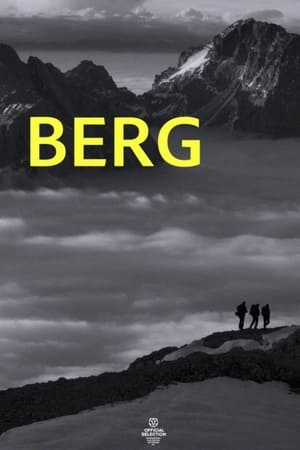
A journey at high altitude seen through the eyes of three mysteriously connected hikers. After their coincidental meeting we follow these three on their personal odysseys. The levels of concentration they exhibit in trying to avoid mistakes makes their experience of the overwhelming landscape even more intense.
2021

BLACKFOX: Age of the Ninja
The era when Samurai and Ninja existed in Japan. Rikka Isurugi was born and raised in a Ninja clan secluded from society. She soon meets Miya, a girl with a mysterious power, who is found lost in the mountains. As Rikka is concerned that someone is pursuing Miya, she also asks the head the of Isurugi Ninja Clan for permission to avenger her father's death. Soon Rikka faces danger with the attack of the Negoro group but…
2019
Illuminated: The True Story of the Illuminati
The true historical account of the Illuminati, exposing the actual rituals of the secret society, and answering the age-old question of whether or not the order still exists.
2019
Pyhä
2017
Killerslope
Mountain climbers achieve fame, despite the many deadly accidents. The image is partly created by the climbers themselves. But because of the difficult circumstances at these great heights, it is practically impossible to find out if all these incredible stories are actually true. In April 2014, Dutch climbers start an expedition the sixth highest mountain in the world. Investigative journalist Geertjan Lassche closely follows the group. How ruthless do you need to be? And are these mountain climbers really as arrogant as they seem to be? The closer the group gets to the top, the more we learn about all kinds of universal dilemmas. And then, even the mountain itself turns against the climbers.
2014
Jurek
This documentary follows the feats of high-altitude climber Jerzy Kukuczka and his ascent to higher heights before his death in 1989.
2014
The Greatest Knight - William the Marshal
The fascinating story of knighthood, told through the extraordinary life and times of William Marshal, whom many consider the world's greatest knight. From Europe's medieval castles to the holy city of Jerusalem, presenter Thomas Asbridge explores William's incredible life, revealing a rip-roaring adventure story in the spirit of King Arthur's Knights of the Round Table. In a career that spanned half a century, this English soldier and statesman served some of Christendom's greatest leaders, from Eleanor of Aquitaine to Richard the Lionheart. Marshal fought in battles across Europe, survived court intrigue and exile, put his seal to the Magna Carta and proved to be the best friend a king could have, remaining loyal to those he served through disaster and victory. Then at the age of 70, despite all the odds, he saved England from a French invasion.
2014
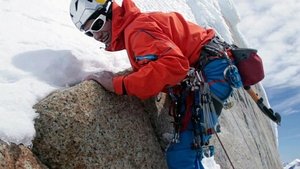
Cerro Torre: A Snowball's Chance in Hell
Movie about David Lama climbing the Patagonian mountain Cerro Torre for the first time free, a mountain that has been dubbed the most difficult to climb in the world.
2013
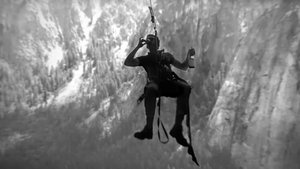
Warren Harding - Recollections of the First Ascent of El Capitan in Yosemity Valley
On November 12, 1958, nearly a year and a half after planting his first piton, Warren Harding climbed to the summit of El Capitan, the legendary face of Yosemite, which he became the first to climb via the equally legendary Nose route. An extraordinary undertaking closer to a heavy Himalayan expedition than to rock climbing. Climbing mainly on weekends in the fall and spring with companions whose level of skill was of little importance to him, Warren Harding spent a total of 47 days (spread over 17 months) on the face. 675 pitons (including 125 expansion pitons) and several thousand hammer blows were necessary to build his legend, despite the displeasure of the "Christians of the valley," as he somewhat sardonically nicknamed Royal Robbins and his cronies, who swear by style.
2011
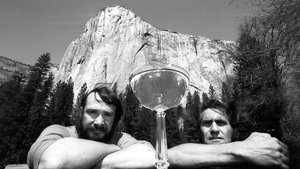
Warren Harding - Recollections of the Wall of the Early Morning Light
In 1970, Warren Harding and Dean Caldwell set out to climb Early Morning Light, better known as Dawn Wall, in Yosemite National Park. Arguably the most controversial climb in the park's history, due to multiple storms and a rescue attempt by the Yosemite Service. The climb thrust the event into the media spotlight, creating a controversy within the local climbing community. In this short documentary, Warren Harding himself recounts the climb.
2011
Crouching Tiger, Hidden Dragon
Two warriors in pursuit of a stolen sword and a notorious fugitive are led to an impetuous, physically-skilled, teenage nobleman's daughter, who is at a crossroads in her life.
2000
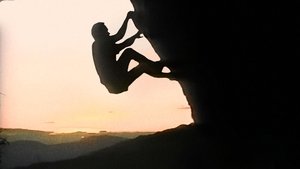
Moving Over Stone
Writer and mountain guide Doug Robinson explains the sport of climbing, focusing on the climbing movement, with several leading climbers providing examples on challenging routes across the United States.
1988
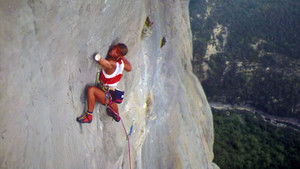
Opera Vertical
Vertical Opera is a documentary film directed by Jean-Paul Janssen, with climbers Patrick Edlinger and Jean-Paul Lemercier in the Gorges du Verdon. The film opens with a training sequence of Patrick Edlinger then he links the routes with Jean-Paul Lemercier "L'Ange en décongelation" (7a), in which he falls voluntarily to demonstrate the usefulness of the rope, then "Le Septième Saut" (7b+). Finally, the final scene, an anthology, consists of a close-up of Edlinger who climbs free solo and barefoot the route "Débiloff", still in the Verdon, above hundreds of meters of void, all to lyrical music. It is "Wie Furchtsam Wankten Meine Schritte", the aria for alto voice from Johann Sebastian Bach's cantata BWV 33, music not unrelated to the subject of the documentary: "How faltering and fearful my steps were".
1984

The Backstage Wall
Behind the scenes of the filming of a film on climbing a cliff by Patrick Berhault and Georges Unia on the parishes of the route "La Tête de Chien" in Monaco. Director Laurent Chevallier explains the difficulties of filming at height, the kind of shots that are suitable and the specifications of equipment suitable for filming on a cliff.
1983
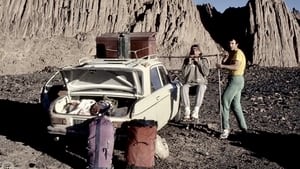
Oversand
Oversand is one of the first films about free climbing, the third film in a series of three with "Overdon" and "Over-Ice". Directed by Jean-Paul Janssen, the film was shot in 35mm in Algeria, in the Sahara Desert, in the Tamanrasset region, on the walls of the majestic peaks of the Atakor massif, central sub-region of Hoggar, mountainous heart of Hoggar, a volcanic plateau of almost circular shape, whose average altitude is 2000 meters, and which culminates at Mount Tahat (2918m), the highest point in Algeria. The Atakor is distinguished by its spectacular volcanic peaks, its needles, and its rugged landscapes, resulting from the erosion of ancient volcanic chimneys, which make it the most emblematic summits of the Hoggar, such as the Assekrem, the Ilamane, or the Tizouyag, where climbers Patrick Edlinger, Patrick Bérhault, Bernard Gorgeon, Hugues Jaillet, Jacques Perrier, Stéphane Troussier and Odette Schoënleb evolve under the watchful eye of the Tuareg caravans.
1981
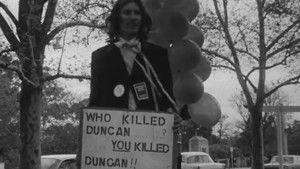
Pride & Snide
A contrast between two kinds of attitudes to gay liberation in Adelaide.
1976
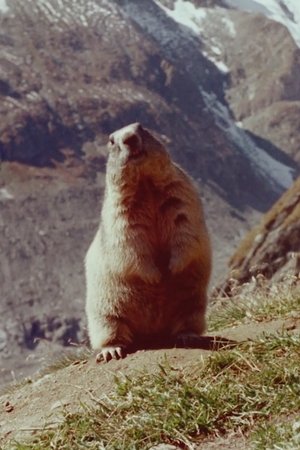
Marmot
A wildlife documentary about marmot.
1966
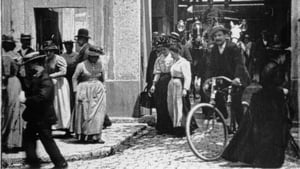
Workers Leaving the Lumière Factory
Working men and women leave through the main gate of the Lumière factory in Lyon, France. Filmed on 22 March 1895, it is often referred to as the first real motion picture ever made, although Louis Le Prince's 1888 Roundhay Garden Scene pre-dated it by seven years. Three separate versions of this film exist, which differ from one another in numerous ways. The first version features a carriage drawn by one horse, while in the second version the carriage is drawn by two horses, and there is no carriage at all in the third version. The clothing style is also different between the three versions, demonstrating the different seasons in which each was filmed. This film was made in the 35 mm format with an aspect ratio of 1.33:1, and at a speed of 16 frames per second. At that rate, the 17 meters of film length provided a duration of 46 seconds, holding a total of 800 frames.
1895