Watch Cinema Againts Power (2017) Online Free
There was an undeclared war for nearly half a century in Bulgaria between the then government and the majority of democratic-minded filmmakers during the Communist regime. Paradoxically, most of the banned or censored out movies were made by members of the Communist Party, believers in their party's ideas and justice. The Communist Party aesthetics against the freedom to tell truth.
Cast
Anri Kulev, Ingeborg Bratoeva, Deyan Statulov, Ivan Nitchev
More Like This
Germán Araújo
In Germán Araujo, director Aldo Novick revives the memory of a journalist who defied censorship during one of Uruguay's darkest periods. Through previously unseen archival footage, testimonies, and music, the film honors the courage of those who reported the truth when it was risky. This powerful documentary is shaping up to be one of the most important Uruguayan film releases of the year.
2025
To Be Destroyed
A 30-minute documentary on book banning and censorship that follows author Dave Eggers as he investigates why a Rapid City, SD school board wanted to ban his book.
2024
Town Destroyer
Controversy erupts over a New-Deal-era mural of the namesake of San Francisco’s George Washington High School. The thirteen-panel artwork "The Life of Washington" by Victor Arnautoff offers a view of the Founding Father both celebratory and critical, referencing his involvements in slavery and Native American genocide.
2022
Radio Silence
Mexico, March 2015. Carmen Aristegui, incorruptible journalist, has been fired from the radio station where she has worked for years. Supported by more than 18 million listeners, Carmen continues her fight. Her goal: raising awareness and fighting against misinformation. The film tells the story of this quest: difficult and dangerous, but essential to the health of democracy. A story in which resistance becomes a form of survival.
2021
CORONA.FILM - Prologue
As the first part of our investigation, the CORONA.FILM prologue will delve into the science behind the pandemic. Starting at the very beginning, we shine a light on the responses. The aim is not to point the finger; our aim is to tell the whole story in all its complexity, as we believe that justice cannot prevail if only one side of the story is told.
2021
The Cleaners
A deep dive into the hidden industry of digital cleaning, which rids the Internet of unwanted violence, porn and political content.
2018
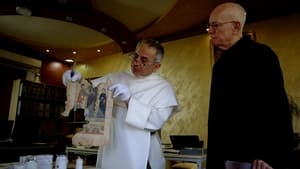
Book Hunters
When chaos reigns, while barbaric and fanatical rulers, both ecclesiastical and secular, systematically burn entire libraries, book hunters, secret heroes of history, travel the world saving and copying texts, threatened by the madness of censors, with the noble purpose of preventing the ultimate loss of human knowledge.
2017
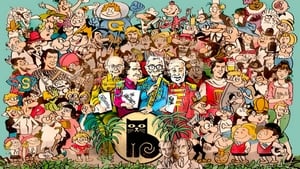
Històries de Bruguera
The history of Bruguera, the most important comic publisher in Spain between the 1940s and the 1980s. How the characters created by great writers and pencilers became Spanish archetypes and how their strips persist nowadays as a portrait of Spain and its people. The daily life of the creators and the founding family, the Brugueras. The world in which hundreds of vivid colorful paper beings lived and still live, in the memory of millions, in the smile of everyone.
2012
Video Nasties: Moral Panic, Censorship & Videotape
A documentary analyzing the furore which so-called "video nasties" caused in Britain during the 1980s.
2010

Cleanflix
When a small Utah-based edited movie company is caught sanitizing Hollywood's copyrighted material, the film industry strikes back with a devastating blow.
2009
In the Lost City
The city of Madrid as it appears in the Spanish films of the 1950s. A small tribute to all those who filmed and portrayed Madrid despite the dictatorship, censorship and the critical situation of industry and society.
2009

This Film Is Not Yet Rated
Kirby Dick's provocative documentary investigates the secretive and inconsistent process by which the Motion Picture Association of America (MPAA) rates films, revealing the organization's underhanded efforts to control culture. Dick questions whether certain studios get preferential treatment and exposes the discrepancies in how the MPAA views sex and violence.
2006
Twentieth Century Fox: The Blockbuster Years
Behind-the-scenes footage, rare screen tests and insightful interviews highlight this engrossing two-hour look at one of Hollywood's greatest dream factories. Such film luminaries as Tom Hanks, William Friedkin, George Lucas, Oliver Stone and Robert Altman discuss their work at the studio. Clips include scenes from Butch Cassidy and the Sundance Kid, Patton, Young Frankenstein, Star Wars, Alien, Big, Home Alone, Die Hard and dozens more.
2003
AFI's 100 Years... 100 Heroes & Villains
The American Film Institute celebrates 100 years of film by recognizing the top 50 film heroes and top 50 film villains of all time.
2003
Walter: The secret life of a victorian pornographer
The story of the sexual memoirs of a Victorian gentleman who revealed himself as Walter. He documented his liaisons in a frank series of journals which ran to eleven volumes and 1.5 million words, titled 'My Secret Life'. Within the journals he documented details of his liaisons, the names of the women, their social standing, and their conversation. For a century, this material was considered obscene, its publication illegal. Today, however, it's seen as a unique insight into Victorian social and sexual mores, providing valuable information on class, gender, marriage, fidelity and morality. This film looks at the dark life of 'Walter', and examines the way his journals have shaped contemporary understanding of Victorian society. The film also examines the mystery that has surrounded this story - who exactly was 'Walter'? The film asks whether he could have been Henry Ashbee, a wealthy London gentleman who was obsessed with sex and attained a pornographic library of over 15,000 volumes.
2000
Boom! Hollywood's Greatest Disaster Movies
Narrated by Bill Mumy (Will Robinson from TV's "Lost in Space"), this documentary spotlights some of the most thrilling scenes the disaster genre has ever produced. From 1970s classics such as Airport and The Towering Inferno to James Cameron's Oscar-winning epic Titanic, no celluloid disaster flick is omitted. Interviews with directors and actors (including Will Smith) and newsreels of real historical disasters are also included.
2000
Censored!
A documentary about the cultural effect of film censorship, focusing on the tumultuous times of the teens and early 1920s in America.
1999
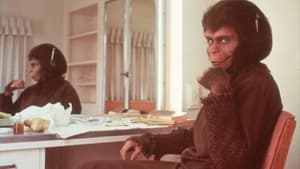
Behind the Planet of the Apes
Roddy McDowall takes you, film by film, from production meetings to make-up sessions, then right onto the movie set to see the actual filming of the science fiction masterpiece. The most comprehensive history of Planet of the Apes ever created, this fascinating 127-minute documentary explores one of the most imaginative and influential series in movie history.
1998
Princess Diana: The Mourning After
In "Diana: The Mourning After" Christopher Hitchens sets out to examine the bogusness of "a nation's grief", tries to uncover the few voices of sanity that cut against the grain of contrived hysteria. His findings suggested that the collective hordes of emotive Dianaphiles sobbing in the streets were not only encouraged but emulated by the media. In the aftermath of Diana's death a three-line whip was enforced on newspapers and on TV, selling the sainthood line wholesale. The suspicion was that journalists, like the public, greeted the death as a chance to wax emotional in print, as a change from the customary knowing cynicism, to wheel out all those portentous phrases they'd been saving up for the big occasion. Sadly, they just seemed to be showboating; the eulogies, laments and tear-soaked platitudes ringing risibly hollow.
1998
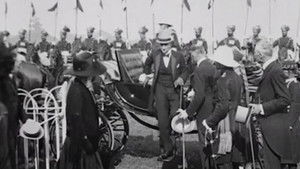
Calcutta Topical No. 2
The race is on - for the Viceroy's Cup.
1925