Watch Chūshingura Urabanashi: Nakazō Kyōran (2000) Online Free
Nakazo is forced by his foster mother, Shun, to practice dance intensively. He is bullied in the Kabuki world, and worries about his future as an actor.
Cast
Ichikawa Ebizo XI, Komaki Kurihara, Masayuki Sakamoto, Masaomi Kondo, Nanako Okochi, Nenji Kobayashi, Ryūzō Hayashi, Ryūnosuke Kaneda, Taisaku Akino, Kazuo Kitamura, Ichikawa Danjūrō XII
More Like This
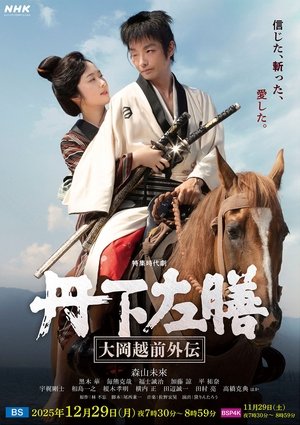
Tange Sazen: The Side Story of Ooka Echizen
The one-eyed swordsman Tange Samanosuke receives a secret order from his lord, Daizen no suke: to steal the cursed twin blades, Kenunmaru and Konryumaru. He risks his life to seize Kenunmaru, losing his right arm in the process. Saved by the fugitive Ofuji, he is reborn as the one-eyed, one-armed warrior-Tange Sazen. Soon, the turmoil reaches Town Magistrate Ooka Tadasuke.
2025

Kokuho
Nagasaki, 1964: Following the death of his Yakuza father, 15-year-old Kikuo is taken under the wings of a famous Kabuki actor. Alongside Shunsuke, the actor’s only son, he decides to dedicate himself to this traditional form of theatre. For decades, the two young men grow and evolve together – and one will become the greatest Japanese master of the art of Kabuki.
2025
Ask This of Rikyu
Sen no Rikyu (Ebizo Ichikawa) is the son of a fish shop owner. Sen no Rikyu then studies tea and eventually becomes one of the primary influences upon the Japanese tea ceremony. With his elegant esthetics, Sen no Rikyu is favored by the most powerful man in Japan Toyotomi Hideyoshi (Nao Omori) and becomes one of his closest advisors. Due to conflicts, Toyotomi Hideyoshi then orders Sen no Rikyu to commit seppuku (suicide). Director Mitsutoshi Tanaka's adaptation of Kenichi Yamamoto's award-winning novel of the same name received the Best Artistic Contribution Award at the 37th Montréal World Film Festival, the Best Director Award at the 2014 Osaka Cinema Festival, the 30th Fumiko Yamaji Cultural Award and the 37th Japan Academy Film Prize in nine categories, including Best Art Direction, Excellent Film and Excellent Actor.
2013
Two Portraits of MIYAGINO
In Edo-era Japan, a ukiyo-e artist languishes in his master’s shadow. Creatively stifled, he finds consolation in the company of a prostitute, and becomes entangled in a love triangle. A mystery emerges involving two portraits and the sudden disappearance of the artist Sharaku. Helmed by Cannes-selected director Tatsuji Yamazaki, the film employs kabuki-inspired sequences and stylised sets.
2010
Kamui
A rebellious ninja in 17th century Japan takes refuge with a fisherman and his family.
2009

Chacha: The Princess of Heaven
Chacha, the woman of the blood of Nobunaga, who loved with Hideyoshi, and feared Tokugawa.
2007
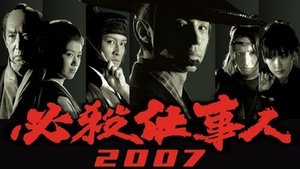
Hissatsu Shigotonin 2007
A violent fire one evening kills a husband and wife couple and burns their Kazusaya rice shop to ashes. Their daughter Sachi manages to make it out alive, but she claims the fire was set by henchmen from the rival Harimaya shop who abducted her sister. After policeman Watanabe Shogoro hears her story, he begins investigating the case, but desperate to avenge her parents' deaths, Sachi later enlists the aid of a mysterious woman who offers to kill Harimaya for a price. Watanabe soon discovers that there is more to this case than meets the eye.
2007
Zatoichi
Blind traveler Zatoichi is a master swordsman and a masseur with a fondness for gambling on dice games. When he arrives in a village torn apart by warring gangs, he sets out to protect the townspeople.
2003
Vengeance for Sale
In a world where vendettas are officially sanctioned, the people sometimes needed help in carrying out their vengeance. Sanada Hiroyuki stars as Sukeroku the Helper, a ‘cool and rambling yakuza’ that has made a business out of helping victims carry out their revenge. When he returns to his hometown to pay a visit to his mother’s grave he meets a deadly ronin who carries a secret which eventually leads him into a vendetta of his own.
2002
Gemini
When his mother's untimely death quickly follows his father's, a doctor begins to believe a killer may be targeting him and his amnesiac wife.
1999
Moonshadow Ninja Scroll: Twenty-One Eyes
A wave of terror is threatening to unseat Shogun Yoshimune. Police stations are erupting into flames, convicts escaping from prison, houses robbed and vandalized, streets teeming with panicked citizens. Is Ijyuin Tanomo, highly-placed official of Owari clan, secretly using deadly ninja to foment riot and rebellion? Narumiya Shinbei, a lone samurai spy adept at ninjutsu must uncover the hidden hand orchestrating these shocking crimes. Shinbei enlists a small band of dedicated ninja to lay siege to the enemy’s stronghold, where his own sister works as an undercover agent. Now, ninja must fight ninja in a last desperate battle to save the shogunate.
1963
While Traveling
In this film, Hibari plays a dual role as brother and sister. The story involves a journey to Hanagasa for an incognito Lord (Kotaro Satomi) to overthrow an attempted usurpation of his domain, while being harassed by vassals of the usurper (Kensaku Hara). There's also a mysterious ronin played by Jushiro Konoe. The songs are seamlessly woven into the narrative and don't overwhelm the action. While the plot is derivative it is good example of its type and quite enjoyable. Note that there are some flashback sequences in black and white.
1962
Tange Sazen: Heavenly Clouds, Earthly Dragon
This movie depicts a familiar samurai Tange Sazen story realistically. Tange loses one of his eyes and arms in an attempt to recover a masterpiece sword for his lord. However, his efforts are not appreciated and he becomes a man of hatred.
1962
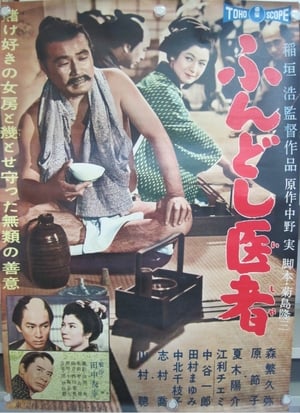
Life of a Country Doctor
A skilled country doctor's talents are such that he can even perform operations as difficult and novel as removing a patient's kidney for the first time in Japan. Unfortunately for him, however, his wife's addiction to gambling is of such a magnitude that he is down to selling his underwear to make money. The image sticks and he becomes known as the 'underwear doctor.' On the other hand, his successful surgery's patient is so grateful he himself wants to become a physician.
1960
The Hidden Fortress
In feudal Japan, during a bloody war between clans, two cowardly and greedy peasants, soldiers of a defeated army, stumble upon a mysterious man who guides them to a fortress hidden in the mountains.
1958
Zangiku monogatari
Based on the novel by Shofu Muramatsu, the film is dedicated to the actors of the renowned Japanese Kabuki theatre. Set in Japan in 1885, the story follows Kikunosuke Onoe, the adopted son of a famous Kabuki actor. Kikunosuke’s father teaches him professional acting skills, preparing him to become his successor and continue the acting dynasty. However, Kikunosuke leaves his family, much to his father’s dismay, to hone his craft outside of Tokyo and moves to Osaka.
1956
Warriors of Ako: Scroll of Heaven, Scroll of Earth
Chronichles the story of the Forty-seven Ronin.
1956
Seven Samurai
A samurai answers a village's request for protection after he falls on hard times. The town needs protection from bandits, so the samurai gathers six others to help him teach the people how to defend themselves, and the villagers provide the soldiers with food.
1954
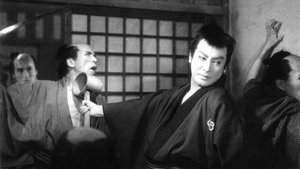
The Man from the Moon
O-Kiyo (Mitsuko Mito), who had escaped from her boss, Shoden, who controlled the Sensoji Temple district, was desperately contemplating suicide when she was rescued by ronin Kojuro Tozawa (Kazuo Hasegawa), who hid her in a dilapidated apartment building. The Shoden clan desperately searched for O-Kiyo, but Kojuro found a huge sum of 50 ryo and ransomed O-Kiyo. Unable to accept this outcome, the enraged Shoden clan attempted to win the favor of constable Jinnosuke Nakayama (Kusuo Abe), seeking to demolish the dilapidated building and transform the area into a pleasure district. However, Kojuro thwarted their plans, bringing joy to the poor residents of the building. After demonstrating his remarkable skills, Kojiro revealed his true identity - he was a prominent hatamoto.
1951

Rashomon
Four people recount different versions of the story of a man's murder and the rape of his wife.
1950