Watch Asia, Workers' Awakening (2013) Online Free
China, Cambodia and Bangladesh have known for two years violent movements of workers' protests. Outsourcing of the subcontractors for a poor country to another are not without consequences. With the awareness of workers and soaring prices, social stability of these countries is no longer guaranteed. The protests and walkouts multiply. Facing the dull anger but rising of these workers, the authorities can not remain inert. This documentary describes the increasing power of a new protest generation of workers, younger, and less docile. To discuss this problem, this film survey examines the question of social relationships in Chinese companies, including Foxconn, the Taiwanese electronics giant, which is the largest employer in China.
More Like This

In the Land of Machines
Every year, many Asian workers arrive in South Korea with dreams of prosperity, only to face exploitation in what is known as the 'City of Machines.' This documentary follows three Nepali workers as they endure harsh realities while reclaiming their dignity through poetry.
2025

Colorless, Odorless
Colorless Odorless follows the work records and archival materials of victims of semiconductor biohazards, tracing the smells and effects of substances that cameras cannot capture. Testimonies of the past overlap with current symptoms, and the disaster repeats itself in other bodies and places.
2025

Blood Money: Inside the Soviet Economy
How did the USSR - a country considered a second-rate industrial power, economically inferior to Germany, the USA and the UK - shape its victory over the armies of Hitler's regime, and secure its place among the winners?
2024

Ascension
The film explores the pursuit of the “Chinese Dream.” Driven by mesmerizing—and sometimes humorous—imagery, this observational documentary presents a contemporary vision of China that prioritizes productivity and innovation above all.
2021

Factory Complex
The drastic economic development in South Korea once surprised the rest of the world. However, behind of it was an oppression the marginalized female laborers had to endure. The film invites us to the lives of the working class women engaged in the textile industry of the 1960s, all the way through the stories of flight attendants, cashiers, and non-regular workers of today. As we encounter the vista of female factory workers in Cambodia that poignantly resembles the labor history of Korea, the form of labor changes its appearance but the essence of the bread-and-butter question remains still.
2015

The True Cost
Film from Andrew Morgan. The True Cost is a documentary film exploring the impact of fashion on people and the planet.
2015

Jinsuk & Me
I have been pretty satisfied with my life before I got on the bus. When I do in June 2011, my whole life turns upside down. I am just a regular passenger at first. Like other people I was sorry, and felt obliged to help and care for other passengers. Then I begin to film these common heroes with my camera. Those who speak about hope, who provide it and get on the bus, Ms. Kim Jin-suk, and other crane laborers who risk their safety while demonstrating for their rights on high. She, while stationed insecurely on high, begins interacting with the world through Twitter and makes friends. Then I realize I really love her. Will we have her back safely?
2012
The War You and I
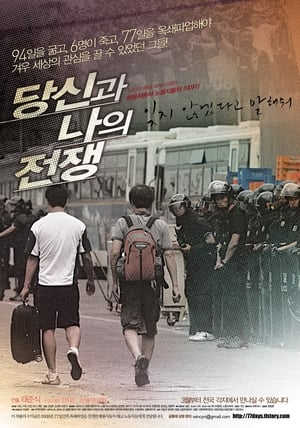
With the unexpected dismissal of 2045 workers, the strike by Ssangyong employees has received the most public support and attention since the IMF. It was an intense period inside and outside the factory.
2010
Aan ons den arbeid
Documentary that shows the changing attitude towards immigrant labor in The Netherlands. The documentary follows three immigrants that arrived in Holland 30 years ago to work in a bakery.
2007
Tie Xi Qu: West of the Tracks
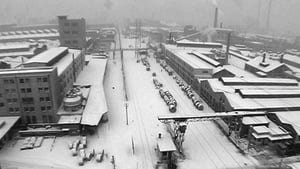
A detailed look at the gradual decline of Shenyang’s industrial Tiexi district, an area that was once a vibrant example of China’s socialist economy. But industry is changing, and the factories of Tiexi are closing. Director Wang Bing introduces us to some of the workers affected by the closures, and to their families.
2004
Money for Bread
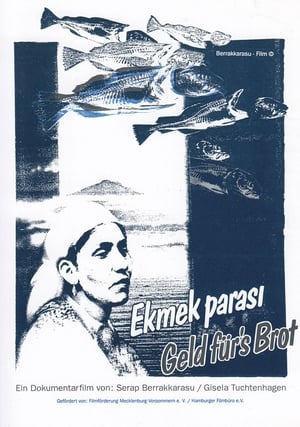
Women from Turkey and Mecklenburg are working together side-by-side at a fish-processing factory in Lübeck. As they work, they share stories about their lives, including their sorrows, griefs, hopes, and dreams, while expressing their longing for home and feelings of being lost in a foreign place.
1994

Doper
Documentary following some stoner friends over the course of roughly a day. Featured here is Bill, a guy who got kicked out of the Marines for doing dope steadily for six years (I'm not gonna do it forever--or maybe I will, who knows?) and Barry, a forklift-driving doper who wins the Employee of the Month plaque while stoned (Live for yourself--live today and then worry about tomorrow when it gets here--that's the way I go).
1987
La fabbrica sospesa
Blue-collar workers, executives, and other people at the Pirelli Bicocca plant talk about the upcoming shutdown of the factory. It's the end for a piece of history of Italian industry and also for a place of memory of workers' struggle: the movie documents the different reactions and scales of awareness determined by class belonging to the functions held in the factory by the interviewees.
1987

Grandin, les raisons d'une victoire
For a year, the women working at the Grandin factory in Montreuil, France occupy the place and lead numerous actions.
1975
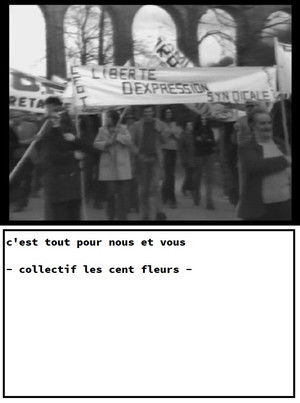
C'est tout pour nous et vous
1974
The Year They Discovered People
In the 1920s, Western Electric Company ordered a series of studies to be conducted at their plant in Cicero, Illinois. At first they wanted to see how lighting affected productivity on the factory floor. Researchers also interviewed employees to hear their ideas and opinions about company policies, management, and other subjects. These were the Hawthorne studies, landmark research in industrial and organizational psychology. In the early 1970s, some of the participants of this study—researchers and workers alike--reunited and reminisced about their involvement.
1974
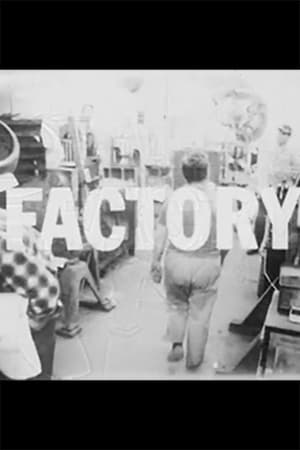
Factory
A cinema verite study of the world of the blue-collar worker and the economic and psychological bind in which he is caught.
1970
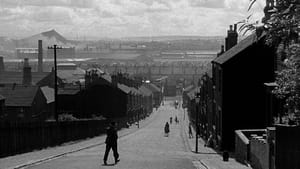
Five Towns
A look at a family living in Stoke-on-Trent in the 1940's and what it's like working in the pottery factories that Stoke is famous for.
1947
7 mill. HK – en film om Burmeister & Wain
1943
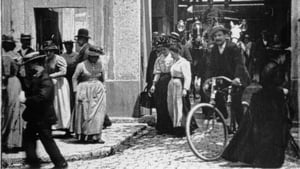
Workers Leaving the Lumière Factory
Working men and women leave through the main gate of the Lumière factory in Lyon, France. Filmed on 22 March 1895, it is often referred to as the first real motion picture ever made, although Louis Le Prince's 1888 Roundhay Garden Scene pre-dated it by seven years. Three separate versions of this film exist, which differ from one another in numerous ways. The first version features a carriage drawn by one horse, while in the second version the carriage is drawn by two horses, and there is no carriage at all in the third version. The clothing style is also different between the three versions, demonstrating the different seasons in which each was filmed. This film was made in the 35 mm format with an aspect ratio of 1.33:1, and at a speed of 16 frames per second. At that rate, the 17 meters of film length provided a duration of 46 seconds, holding a total of 800 frames.
1895