Watch Algiers, the Mecca of Revolutionaries (1962-1974) (2016) Online Free
From the early 1960s to the mid-1970s, independent Algeria provided significant support to anti-colonial movements and revolutionaries worldwide. Successive presidents, Ahmed Ben Bella and then Houari Boumédiène, made Algiers a haven for activists fighting against colonial and racial oppression. Algiers the White became Algiers the Red. The internationalist Che Guevara established his base of operations there for his guerrilla activities in Africa. The African-American leader Eldridge Cleaver made it the international headquarters of the Black Panther Party. During this period, Algiers was known as "The Mecca of Revolutionaries."
Cast
Ahmed Ben Bella, Che Guevara, Nelson Mandela, Houari Boumédiène, Eldridge Cleaver, Patrice Lumumba, Kathleen Cleaver, Miriam Makeba, Fidel Castro, Yasser Arafat, Johnny Makatini, M'Hamed Yazid
More Like This
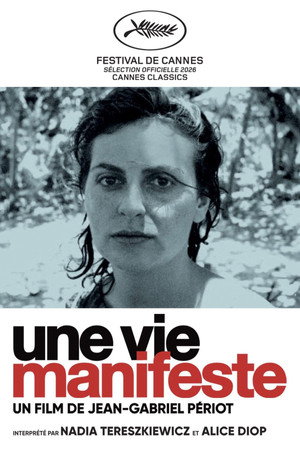
A Life, A Manifesto
The life of Michèle Firk — a trailblazing French journalist, film critic, aspiring director and communist activist involved in various liberation struggles in the second half of the 20th century — as told by narrator Alice Diop, modern day French director.
2026

Algeria, Special Weapons Sections
This documentary by director Claire Billet and historian Christophe Lafaye details the massive and systematic use of chemical weapons during the Algerian War. Algerian fighters and civilians, sheltering in caves, were gassed by "special weapons sections" of the French army. The gas identified on military documents is CN2D, whose widespread use forced insurgents to flee "treated" sites, at the risk of dying there. The method is reminiscent of the "enfumades" used by the French expeditionary force during the conquest of Algeria in the 19th century. Between 8,000 and 10,000 such operations are believed to have taken place on Algerian soil between 1956 and 1962. This historical aspect is little known due to the difficulty of accessing archives, many of which are still classified, raising questions about memory, historical truth, and justice.
2025

Portugal: Carnations Against Dictatorship
In Portugal, during the night of April 24-25, 1974, a peaceful uprising put an end to the last government of the Estado Novo, the authoritarian regime established in 1933 by dictator António de Oliveira Salazar (1889-1970), paving the way for full democracy: a chronicle of the Carnation Revolution.
2024

In the Footsteps of Frantz Fanon
Who was Frantz Fanon, the author of Wretched of the Earth and Black Skin, White Masks, this Pan-African thinker and psychiatrist engaged in anti-colonialist struggles? Born in Martinique, Frantz Fanon was not yet 20 years old when he landed, weapons in hand, on the beaches of Provence in August 1944 with thousands of soldiers from "Free France", most of whom had come from Africa, to free the country from Nazi occupation. He became a psychiatrist and ten years later joined the Algerians in their fight for independence. Died at the age of 36, he left behind a major work on the relationships of domination between the colonized and the colonizers, on the roots of racism and the emergence of a thought of a Third World in search of freedom. 60 years after his death, the film follows in the footsteps of Frantz Fanon, alongside those who knew him, to rediscover this exceptional man.
2021
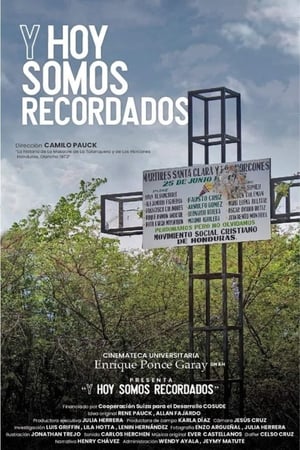
Y hoy somos recordados
2020
Landfall
Hurricane María abated, the news crews packed up and left Puerto Rico, and the interest of the international community turned elsewhere. What happened next?
2020

Kourou et l'épopée spatiale française
2019

Algeria, The Two Soldiers
"Algeria, The Two Soldiers" tells the true story of two young French soldiers during the Algerian War, who were driven in two completely opposite directions by the same keen sense of honor: Noël Favrelière deserted to free a young Algerian Muslim prisoner who was going to be executed, and René Técourt, to continue the fight for French Algeria alongside the OAS ultras. Two emblematic examples, which describe in a direct, carnal way, what happened there.
2017

Hadj Nasreddine Dinet
Étienne Dinet, born March 28, 1861 in Paris, where he died on December 24, 1929, was a French painter and lithographer. Having lived much of his life in Algeria and recognized during his lifetime, he called himself Nasreddine Dinet after converting to Islam.
2016
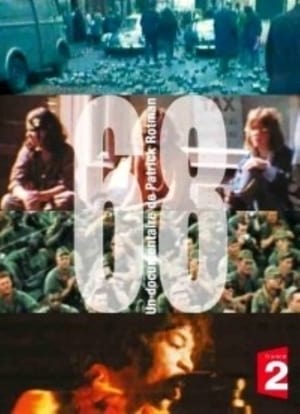
68
From Washington to Saigon, Rome to Mexico, Paris to Prague, a wave of protests shook the world. 68 looks back at the looks back at the Vietnam War, the Prague Spring and the Soviet Invasion, the Paris riots, Dubcek, Che Guevara, De Gaulle, Cohn-Bendrik and more. A dive into the chaos of a turbulent year, featuring fantastic colour footage and the music of Jimi Hendrix, Janis Joplin, Jim Morrisson and Bob Dylan.
2012

My boy, look at the stars
February 28 is Deniz Gezmiş's birthday… He would have been 75 years old today; but it only lived for 25 years, and in those 25 years, it had an impact that spanned 75 years. When you have a 25-year-old son, one feels better, what was done to him...
2012
Silent Stories
Two women and two men tell their stories of exile caused by being lesbian, transgender, bisexual and gay.
2011
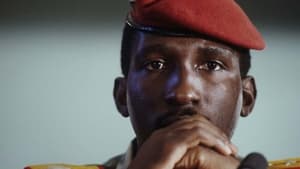
Thomas Sankara: The Upright Man
Thomas Sankara, former president of Burkina Faso, was known as "the African Che", and became famous in Africa due to his innovative ideas, his devastating humor, his spirit and his altruism. More than a classic biography, this film sheds light on the impact that this man and his politic made on Burkina Faso and Africa in general.
2006

Regards D'en Face - Alger
It is with the architect Jean-Jacques Deluz, that we visit Algiers, "his city" since 1960 and that he left only two years during the worst moments of terrorism. From the Casbah, in the 19th century center, including the cities of Fernand Pouillon and Bab El Oued to arrive at the new city of Maelma which he built today. Tender look, but without concessions at the same time architectural promenade and meetings with actors of art and culture: Djamel Allam, the singer Kabyle, Djamel Amrani, the poet, friend of Jean Sennac, Mohamed Ben Gettaf, Dramaturge and director of the theater of Algiers, Souad Delmi-Bourras, young designer Boudjemàa Kareche, director of the Algerian cinema, Amine Kouider, conductor, who relaunches the opera in Algeria, the painter Malek Salah, and others. A look at Algeria and the Algerians, far from the clichés of certain media, the bias being to seek signs of hope rather than "blood and tears".
2003
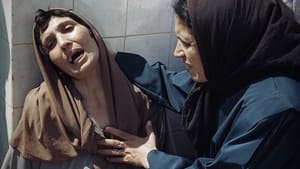
Algeria's Bloody Years
Documentary series in two parts: 1. A people without a voice (80'), 2. A land in mourning (78'). Part 1: A people without a voice: October 88, the Algerian Republic is faltering, the film goes back to the sources of this tragedy and explains how the face to face between the Islamists and those in power began. The interruption of the legislative elections of December 91, followed shortly after the assassination of President Boudiaf in June 92, plunged Algeria into chaos. Part 2: A land in mourning: the cycle of violence that leads to massacres and the economic and geopolitical underside of the war. More than 100,000 deaths, an incredible degree of barbarity, massacres, apparently incomprehensible... Behind the official window of power and its artificial political scene, hides a shadow power.
2002
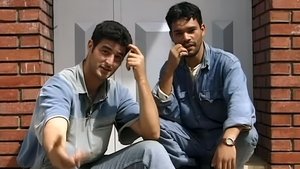
Algeria, Life Goes On
In a small town in northern Algeria during the 1990s, at the height of the dark decade that tore the country apart, three unemployed young men navigate the daily lives of life, caught between endless boredom and the anticipation of the improbable, between humor and despair. This documentary bears witness to an era from which Algeria has managed to recover, once again facing alone attempts at external destabilization, the devaluation of its local currency by the World Bank, and the interference and pressure of international financial lobbies.
1998
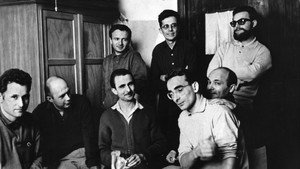
Brothers in Arms
From 1954 to 1962, during the Algerian War, French citizens provided concrete assistance to the FLN in France: sheltering refugees, forging documents, facilitating border crossings, and transporting funds. Whether committed to the ideals of the Republic or driven by Third Worldist revolutionaries, they sought to build a bridge of friendship between nations. They paid for their commitment with imprisonment and exile. Four veterans of the Jeanson network recall this period. Today, they are no longer seen as traitors or heroes, but as witnesses recounting "their" war... Silent for 30 years, the "Jeanson network" now bears witness to this history.
1992
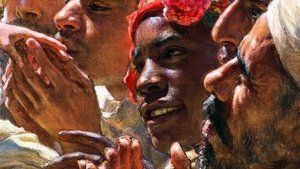
نصر الدين ديني
Étienne Dinet (إتيان دينيه), born March 28, 1861 in Paris, where he died on December 24, 1929, was a French painter and lithographer. He was one of the leading representatives of Orientalist painting at the turn of the 19th and 20th centuries. Obtaining a scholarship in 1884, Dinet undertook his first trip to southern Algeria in the region of Bou-Saâda, the Naili culture having a profound impact on him, as he would return there many times until he settled in his first Algerian studio in Biskra in 1900. In 1905, he bought a house in Bou-Saâda to spend three-quarters of the year there. In 1907, on his advice, the Villa Abd-el-Tif was created in Algiers, modeled on the Villa Medici in Rome. Having lived much of his life in Algeria, he called himself Nasreddine Dinet (نصر الدين ديني) after converting to Islam. On January 12, 1930, he was buried in the Bou-Saâda cemetery, where a museum that houses many of his works bears his name.
1977
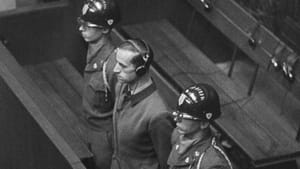
The Memory of Justice
This exceptional, disturbing, and thought-provoking two-part documentary compares the atrocities committed by the Nazis as revealed during the Nuremberg trials to those committed by the French in Algeria and those done by the Americans in Vietnam. The four-hour epic questions the right of any country to pass self-righteous moral judgements upon the actions of another country.
1976
El milagro de la tierra morena
A documentary made by Cuban journalists about the Portuguese revolution in 1974 that overthrew the dictatorship of Salazar
1974