Watch Aida (2001) Online Free
Verdi’s grand opera “Aida” is given an intimate treatment in Busetto, Italy, in 2001, in a staging with young singers, all coached by the legendary tenor Carlo Bergonzi and staged by Franco Zeffirelli. The result is an astonishing musical and dramatic piece of theater, proving that with the right mix of ingredients, an opera can be staged in a small theater and still achieve a thrilling and moving effect.
Cast
Adina Aaron, Kate Aldrich, Scott Piper
More Like This
Giacomo Puccini: Turandot
The opera Turandot by Giacomo Puccini from the Arena di Verona (2024), with desings by late Franco Zeffirelli. Turandot is sung by Ecaterina Semenchuk.
2024
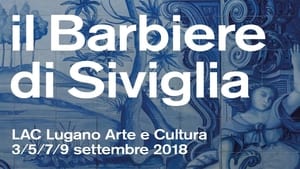
Rossini: Il Barbiere di Siviglia
Part of the celebrations for the 150th anniversary of the death of the Pesaro composer, Il Barbiere di Siviglia staged in Lugano, is the result of a virtuous collaboration that involved Swiss Radio and Television, LuganoInScena and LuganoMusica. The musical part was entrusted to Maestro Diego Fasolis who, together with his Barocchisti ensemble, was involved in the project from the very beginning. Internationally renowned soloists such as Edgardo Rocha (who embodies the Count of Almaviva), Riccardo Novaro (Bartolo), Lucia Cirillo (Rosina), Giorgio Caoduro (Figaro), Ugo Guagliardo (Basilio) and Alessandra Palomba (Berta) performed on stage.
2018
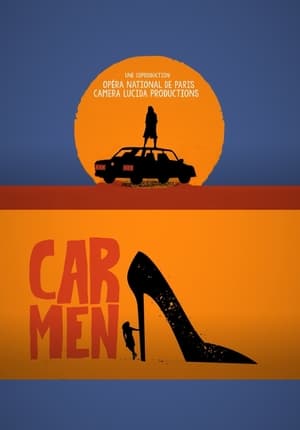
Carmen - Opéra National de Paris
The first words uttered by Carmen mark one of the greatest entrances in the history of opera and express all that need be said: “Love is a rebellious bird that no one can tame…” With a devilish sway of the hips and a hint of Andalusian flair, the beautiful cigar-maker sets her sights on a soldier: Don José. Fate will do the rest.
2017
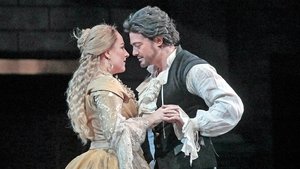
The Metropolitan Opera: Roméo et Juliette
Diana Damrau and Vittorio Grigolo are opera’s classic lovers in Gounod’s lush Shakespeare adaptation. Director Bartlett Sher’s “brilliant and inspired new production … is a revelation” (Huffington Post), and has already won acclaim for its vivid 18th-century milieu and stunning costumes during runs at Salzburg and La Scala. Emmanuel Villaume conducts the sumptuous score.
2017
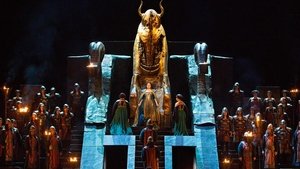
Verdi: Nabucco
The legendary Plácido Domingo brings another new baritone role to the Met under the baton of his longtime collaborator James Levine. Liudmyla Monastyrska is Abigaille, the warrior woman determined to rule empires, and Jamie Barton is the heroic Fenena. Dmitri Belosselskiy is the stentorian voice of the oppressed Hebrew people.
2017

Royal Opera House: Così fan tutte
Semyon Bychkov conducts a cast of young, up-and-coming talent including American soprano Corinne Winters in a new production of Mozart’s opera on the nature of love.
2016
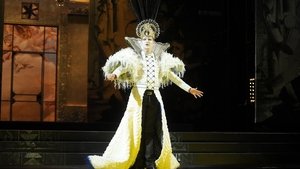
Artaserse
Live broadcast of the opera performance held on November 10, 2012 at the Opéra national de Lorraine in Nancy, performed by five world-class countertenors.
2012
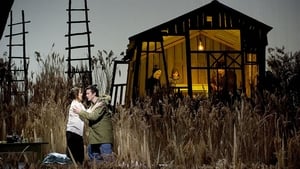
The Legend of the Invisible City of Kitezh
Opera lies at the heart of Rimsky-Korsakov's colourful idiom, but performances are few and far between; this realisation of his penultimate and grandest stage work is a very rare and special experience. Kitezh is known as "the Russian Parsifal", which encapsulates its mystical flavour and steady unfolding of a legend of redemption
2012
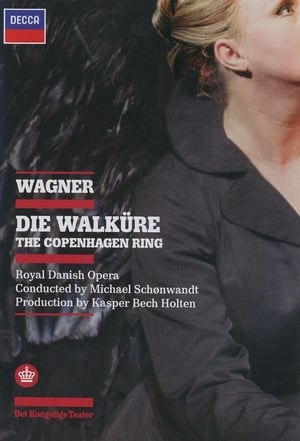
Die Walküre
Die Walküre (The Valkyrie), WWV 86B, is an opera in three acts by Richard Wagner with a German libretto by the composer. It is the second of the four operas that form Wagner's cycle Der Ring des Nibelungen (The Ring of the Nibelung). The story of the opera is based on the Norse mythology told in the Volsunga Saga and the Poetic Edda.[1][2] In Norse mythology, a valkyrie is one in a group of female figures who decide which soldiers die in battle and which live. Die Walküre's best-known excerpt is the "Ride of the Valkyries". DVD release June 2009.
2006

Egypt: Rediscovering a Lost World
Dramatization of the great discoveries of ancient Egypt, from the exploration of tombs in the early 1800s, to the unraveling of the Rosetta Stone to translate the ancient language on the tombs, to the discovery of Tutankhamun's tomb.
2005
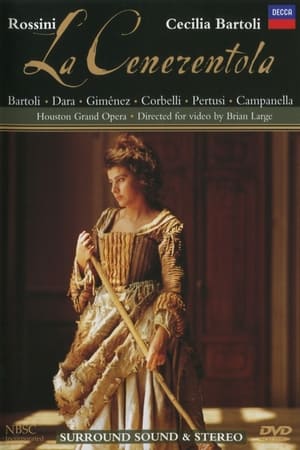
Rossini: La Cenerentola
La Cenerentola, ossia La bontà in trionfo (Cinderella, or Goodness Triumphant) is an operatic dramma giocoso in two acts by Gioachino Rossini. The libretto was written by Jacopo Ferretti, based on the fairy tale Cendrillon by Charles Perrault. The opera was first performed in Rome's Teatro Valle on 25 January 1817.---- IMDB id refers to Great Performances: Season 24, Episode 12 La Cenerentola (3 Apr. 1996) from Houston Grand Opera so release date is misleading.
2001
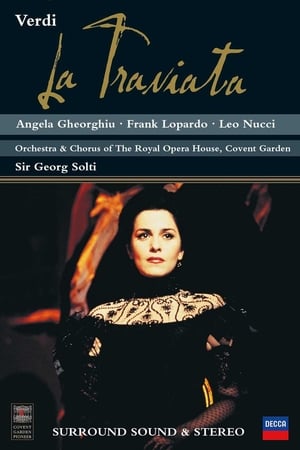
La Traviata
La traviata (Italian: [la traˈviaːta], "The Fallen Woman"[1][2]) is an opera in three acts by Giuseppe Verdi set to an Italian libretto by Francesco Maria Piave. It is based on La dame aux Camélias (1852), a play adapted from the novel by Alexandre Dumas, fils. The opera was originally entitled Violetta, after the main character. It was first performed on 6 March 1853 at the La Fenice opera house in Venice. Piave and Verdi wanted to follow Dumas in giving the opera a contemporary setting, but the authorities at La Fenice insisted that it be set in the past, "c. 1700". It was not until the 1880s that the composer and librettist's original wishes were carried out and "realistic" productions were staged.[3]
2001

Joseph: King of Dreams
In this animated retelling of the story from the Bible's Book of Genesis, Joseph's gift of dream interpretation and his brilliantly colored coat inspires jealousy in his brothers.
2000
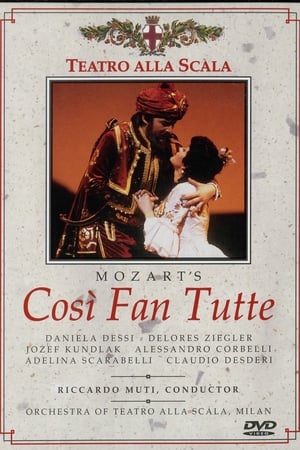
Cosi Fan Tutte
Officers Ferrando and Guglielmo are certain that their lovers Dorabella and Fiordiligi are faithful to them, but the cynical Don Alfonso challenges them to a bet that the women will be unfaithful given the chance. The officers thus pretend to go off to war, and return in disguise as Albanian strangers, to woo Dorabella and Fiordiligi incognito. The ladies are initially frosty, but soon warm to their new suitors, spurred on by their maid Despina. Performed at the La Scala Theatre in Milan.
1989
Brouk Pytlík
1989
Die Nacht aus Blei
A surreal movie by peter Weigl starring Michael Biehn and Lubomir Kafka.
1985
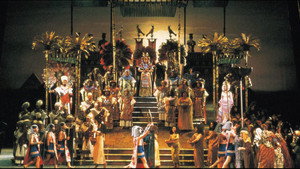
Aida - San Francisco Opera
An Egyptian military commander, Radamès, struggles to choose between his love for the enslaved Ethiopian princess Aida, and his loyalty to the Pharaoh. To complicate the story further, the Pharaoh's daughter Amneris is in love with Radamès, although he does not return her feelings.
1981
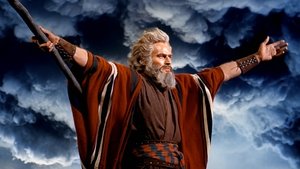
The Ten Commandments
Escaping death, a Hebrew infant is raised in a royal household to become a prince. Upon discovery of his true heritage, Moses embarks on a personal quest to reclaim his destiny as the leader and liberator of the Hebrew people.
1956
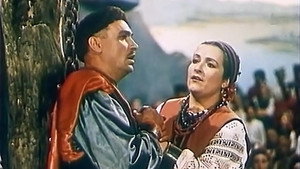
A Cossack Beyond the Danube
A Ukrainian comic opera with spoken dialogue in three acts with music and libretto by the composer Semen Hulak-Artemovsky (1813–1873). The orchestration has subsequently been rewritten by composers such as Reinhold Glière and Heorhiy Maiboroda. This is one of the best-known Ukrainian comic operas depicting national themes.
1953
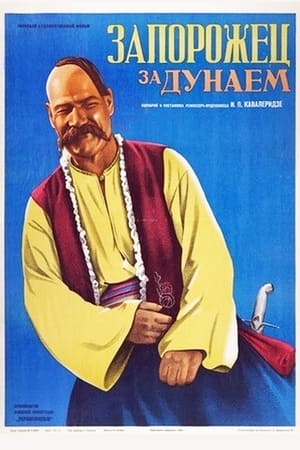
Cossacks Beyond the Danube
Adapted from the opera written by the composer Semen Hulak-Artemovsky.
1937