Loading Cinehub...
Ankoku Butoh is a style of avant-garde dance that established itself in the counter culture experimental arts scene of post WWII Japan. The dance form is thought to have been founded by Tatsumi Hijikata, who both created and performed in butoh pieces from the late 1950’s - through the early 1970’s. In butoh, the style of movement is extremely stylized and deliberate, vacillating between slow and sharp, expressing feelings of dread, sexualization, violence, calmness, birth and “creatureness” among other things. This performance of Summer Storm was originally recorded in 1973 at Westside Auditorium, Kyoto University, Japan, and was Hijikata’s last public performance before his death in 1986 with Butoh of Dark Spirit School. Video version produced in 2003.
Tatsumi Hijikata, Yoko Ashikawa, Kobayashi Saga, Nimura Momoko, Katsura Mana, Koichi Tamano, Kôichi Satô, Yukio Waguri, Ikko Amamiya, Ryuichi Tachibana, Hanae Naoto, Hiroshi Ono
This documentary will explore the Afro-Caribbean dance, ‘whining’ alongside the practice of twerking to analyze respectability politics, pressures to accommodate whiteness, and gendered criticism of sexual expression within the Black diaspora. Using archival footage of West African dance, expert opinion from dancing and gender studies professors, and the active participation of partygoers in a dance experiment, Watkins will paint the picture of the defiance, autonomy, and ancestral veneration intrinsic to these traditional movement styles.
2025

Moving Together is a celebratory love letter to music and dance that brims with kinetic life and energy. This documentary explores the intricate collaboration between dancers and musicians, moving seamlessly between Flamenco, Modern, and New Orleans Second Line.
2023

A love story, portraying the dilemmas and inevitable consequences of ambition. It is a film about a woman's fight for independence, a woman trying to succeed with her own art in the extremely competitive world of dance.
2017

The senior year of a girls’ high school step team in inner-city Baltimore is documented, as they try to become the first in their families to attend college. The girls strive to make their dancing a success against the backdrop of social unrest in their troubled city.
2017

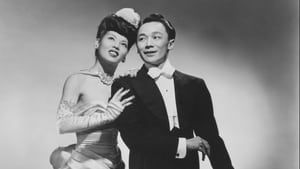
Swinging and twirling Dorothy Toy Fong the legendary tap dancer is still exciting at 99 years old. Award-winning reporter Rick Quan traces Fong’s journey as a famous duo with Paul Wing and exciting run with her Oriental Showgirl group. Fong’s wondrous spirit dances off the screen and into your heart.
2017

A documentary following the conscious evolution of electronic music culture and the spiritual movement that has awakened within.
2011

With the coveted glitter ball trophy once again up for grabs, how will series winner Chris Hollins fare against other celebrity favourites - including Austin Healey, Kelly Brook, Mark Ramprakash, Ali Bastian, and Natalie Cassidy? As they take to the stage alongside their professional partners including; Kristina Rihanoff, James and Ola Jordan, Brian Fortuna, Natalie Lowe and Ian Waite, in brand new breathtaking outfits and daring routines. They will need to impress judges; Len Goodman, Bruno Tonioli, Craig Revel Horwood and Arlene Philips. Who as always, are ready with quips, banter and razor-sharp observations!
2010

Documentary that reconstructs the professional life of the dancer through the thread of his own voice. A work that travels to the fundamental landscapes of the personal history of Gades with unpublished documents and the testimony of those who shared with him many pages of the book of his life and the history of Spanish dance in recent decades.
2007

Profile of famed dance director Busby Berkeley's career, in particular "The Gang's All Here"
2007

A documentary film that highlights two street derived dance styles, Clowning and Krumping, that came out of the low income neighborhoods of L.A.. Director David LaChapelle interviews each dance crew about how their unique dances evolved. A new and positive activity away from the drugs, guns, and gangs that ruled their neighborhood. A raw film about a growing sub-culture movements in America.
2005

The film presents thirteen rhythms of flamenco, each with song, guitar, and dance: the up-tempo bularías, a brooding farruca, an anguished martinete, and a satiric fandango de huelva. There are tangos, a taranta, alegrías, siguiriyas, soleás, a guajira of patrician women, a petenera about a sentence to death, villancicos, and a final rumba.
1995

Portrait of Lester Horton, a Los Angeles-based dancer, choreographer and teacher who trained many world-reknowned dancers and built the first American theater devoted permanently to dance. Former students and friends, including Bella Lewitzky, Alvin Ailey, and Carmen de Lavallade, help create a picture of Horton through interviews. Includes numerous dance excerpts.
1993

This documentary pierces the mystery and mystique of a dance movement adored by the West and largely ignored by the Japanese. It uses archival and modern footage of leading Butoh performers and interviews Butoh specialists to throw light on the essential Butoh themes of darkness, violence and eroticism to get to the core of the nature of Butoh.
1991
Pina Bausch created and performed Café Müller for her dance company Tanztheater Wuppertal. The dance was inspired by and based on her childhood memories of watching her father work at his café in Germany during and immediately following World War II. In this silent style featurette, Bausch shows a restaurant after closing, in which the ghosts of the departed customers stumble blindly into walls and onto chairs but fail to find one another.
1985
This short documentary describes the process and inspiration behind the creation and performance of a new Cuban ballet based on Afro-Cuban traditions and beliefs.
1964

Anma (The Masseurs) is a representative and historical work by the creator of Butoh dance, Tatsumi Hijikata in his early period in the 1960s. The film is realized not only as a dance document but also as a Cine-Dance, a term made by Iimura, that is meant to be a choreography of film. The filmmaker "performed" with a camera on the stage in front of the audience. With the main performers: Tatsumi Hijikata and Kazuo Ohno, the film has the highlights such as Butohs of a soldier by Hijikata & a mad woman by Ohno. There is a story of the mad woman, first outcast and ignored, at the end joins to the community through her dance. Inserted descriptions of Anma (The Masseurs) are made for the film by the filmmaker, but were not in the original Butoh. The film, the only document taken of the performance, must be seen for the understanding of Hijikata Butoh and the foundation of Butoh.
1963

A filmed version of Aaron Copland's most famous ballet, with its original star, who also choreographed.
1959
Brenda Way, founder and artistic director of ODC, is a recipient of the San Francisco Foundation Community Awards "for creating a community hub through dance. She built the largest, most comprehensive contemporary dance center in the nation, and through it she inspires dancers and audiences, cultivates artists, and engages the community. Brenda is a choreographer, writer, and community activist who strengthens our region's cultural connections." - San Francisco Foundation

A testimony to the performance of ritual dances. Although they were performed only during the so-called “unbaptized days”, the 12 days between Christmas and Epiphany in the Orthodox Christianity, these dances are associated by some researchers with the Roman rosaries, the cult of the dead. Ritual clothing and the use of wooden swords to disperse the demons are important props in the dances that are believed to protect the folks from temptations and demons until they are baptized.
1957

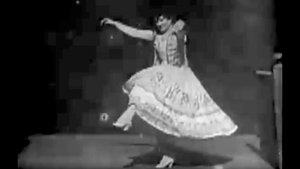
The first woman to appear in front of an Edison motion picture camera and possibly the first woman to appear in a motion picture within the United States. In the film, Carmencita is recorded going through a routine she had been performing at Koster & Bial's in New York since February 1890.
1894