Watch A Brilliant Madness (2002) Online Free
The life of the Nobel Prize-winning mathematician and schizophrenic John Nash — the inspiration for the feature film A Beautiful Mind — is a powerful exploration of how genius and madness can become intertwined.
Cast
Liev Schreiber
More Like This
An Island of the Mind
A homeless man with schizophrenia slowly embraces antipsychotic medication under Hawaii's only willing psychiatrist and a court mandate, while a man in recovery offers rare insight into mental illness as he fights to reclaim stability.
2025

Billy
Billy is a film buff who films himself non-stop. During a film shoot, he meets Lawrence Côté-Collins and the two become friends. One night, he assaults her. Years later, in prison for the deaths of two people, Billy is diagnosed with schizophrenia. With the help of the filmmaker, his only remaining relationship apart from his family, his personal archives become an invaluable resource for understanding his illness. A formal deconstruction of schizophrenia through a remarkably open-minded gaze.
2024
A Trip to Infinity
Does infinity exist? Can we experience the Infinite? In an animated film (created by artists from 10 countries) the world's most cutting-edge scientists and mathematicians go in search of the infinite and its mind-bending implications for the universe. Eminent mathematicians, particle physicists and cosmologists dive into infinity and its mind-bending implications for the universe.
2022
Drunk on Too Much Life
The filmmakers' 21-year-old daughter journeys from locked-down psych wards and diagnostic labels toward expansive worlds of creativity, connection, and greater meaning. Featuring insights from trauma experts and others, the film challenges the widespread idea that mental illness should be understood purely in biological terms, revealing the myriad ways that madness has meaning beyond brain chemistry.
2021

Johannes Kepler - Storming the Heavens
Nowadays we associate Johannes Kepler with his famous laws of planetary motion. But the history of his discoveries is a drama of Shakespearian proportions - full of intrigue, passion, depravity and corruption.
2020
Schizophrenia: The Voices in My Head
A documentary tracking the daily lives, struggles and triumphs of some young Irish people living with schizophrenia. They speak openly about what it's like to live with such a severe mental health disorder and struggle with delusional thoughts and the internal voices that are so associated with schizophrenia.
2017

The Blood Is at the Doorstep
After Dontre Hamilton, a black, unarmed man diagnosed with schizophrenia, was shot 14 times and killed by police in Milwaukee, his family embarks on a quest for answers, justice and reform as the investigation unfolds.
2017
They Heard Voices
THEY HEARD VOICES is a documentary film exploring the Hearing Voices Movement, chronic psychosis, and the schizophrenia label. The film is a series of wide-ranging interviews with voice hearers, medical historians, anthropologists and psychiatrists from Britain and America, presenting different people’s views. Is schizophrenia hard science or an arbitrary, catch-all term with no real meaning? What does it mean for those experiencing psychosis?
2016

Eliyahu Rips: The Burning
In April 1969 Ilya (Eliyahu) Rips, then a young student of mathematics, tried to burn himself in a public square in Riga, Latvia protesting against the Soviet invasion of Czechoslovakia. He was stopped and eventually sent to a psychiatric hospital for two years. Thanks to international pressure from the mathematical community in 1972 he was allowed to emigrate to Israel. Now he is considered one of the most brilliant mathematicians in the world. At the same time, for most people familiar with his name, Rips is first of all associated with the development of the so called Bible Code – a mathematical program allegedly helping to decipher hidden messages encoded in Torah – the Five Books of Moses. He is attacked by both the scientific and religious community, yet his research continues.
2016
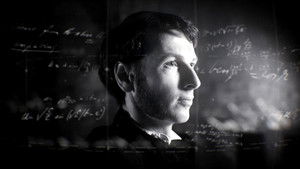
The Genius of George Boole
Narrated by Oscar-winning actor Jeremy Irons, The Genius of George Boole assembles academics and industry leaders from across the globe to explore the life and importance of one of the world’s greatest unsung heroes.
2015
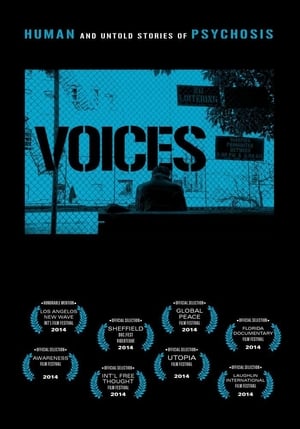
Voices
Voices is an award-winning documentary that features the stark and intimate portraits of three very different individuals and their struggle with severe mental illness in America. The stories of Sharon, Thomas and Aaron illuminate the challenges, realities, and often complex emotions and choices that surround people with psychotic mental illness and those who love them.
2013
Born Schizophrenic: Jani's Next Chapter
Jani is one of the youngest children ever diagnosed with schizophrenia. At age 9, she's seen great improvements and some setbacks. But now her parent's attention turns toward her brother, Bodhi. At age 4, is he showing signs of schizophrenia too?
2012
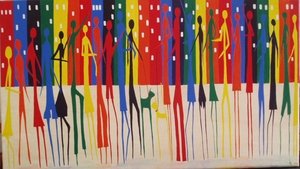
Painting with 14 Personalities
British artist Kim Noble talks about the reality of living with dissociative identity disorder and shows us the artwork created by 14 of her personalities. "I'm Patricia, I don't like being called Kim, but I have got used to it now."
2012
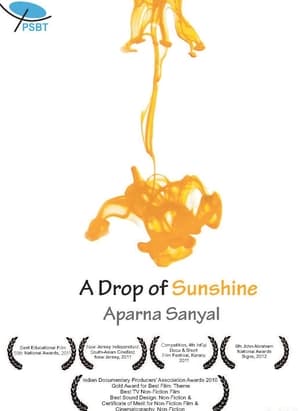
A Drop of Sunshine
Schizophrenia. It may be one word, but it immediately conjures up multiple connotations. Mad. Incurable. Violent. Suicidal. Chemical imbalances. Crazy. A lifelong condition. Inevitable dependency on Medicines. Dark. Terrible. 'A Drop of Sunshine' challenges these notions. It questions the mainstream view of the condition and seeks alternate ways of recovering from it. Through the powerful story of its young and gutsy protagonist, Reshma Valiappan, it seeks to give viewers a new vocabulary to address the stigmatized mental illness. The film proposes that the only treatment method that can work in Schizophrenia is one where the so-called 'patient' is encouraged and empowered to become an equal partner in the process of healing.
2011

Clouds Are Not Spheres
Until recently geometry was 'cold', incapable of describing the irregular shape of a cloud, the slope of a mountain or the beauty of the human body. With fractal geometry, Benoit Mandelbrot gave us a language for our natural world. In this captivating documentary, the man himself explains this groundbreaking discovery.
2010
Executing the Insane: The Case of Scott Panetti
Scott Panetti was tried for the capital murder of his parents-in-law on September 8, 1992 in Gillespie County, Texas. He was subsequently sentenced to death on September 22, 1995. Panetti has an extensive history of mental illness, including schizophrenia, manic depression, auditory hallucinations and paranoia. Panetti was hospitalized, both voluntarily and involuntarily for mental illness fourteen times in six different hospitals before his arrest for capital murder in 1992. Following his conviction, Panetti’s former wife, and daughter of the victims, Sonja Alvarado, filed a petition stating that Panetti never should have been tried for the crimes as he was suffering from paranoid delusions at the time of the killings.
2007
This Beggar's Description
It's a sensitive, moving doc chronicling the life of Tétrault's brother Philip , a Montreal poet, musician and diagnosed paranoid schizophrenic. A promising athlete as a child, Philip began experiencing mood swings in his early 20s. His extended family, including his daughter, share their conflicted feelings love, guilt, shame, anger with the camera. They want to make sure he's safe, but how much can they take?
2006
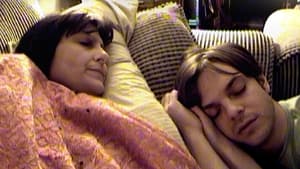
Tarnation
Filmmaker Jonathan Caouette's documentary on growing up with his schizophrenic mother -- a mixture of snapshots, Super-8, answering machine messages, video diaries, early short films, and more -- culled from 19 years of his life.
2003

Monkeys Like Becky
The first part of this documentary deals with the Portuguese neurologist António Egas Moniz, Nobel Prize for Medicine in 1949, one of the first surgeons to apply the technique called lobotomy for the treatment of schizophrenia. The second part deals with the everyday life of people with schizophrenia today: behavior and relationships, and treatment for the disease.
1999
Into Madness
Initially airing on HBO's "America Undercover" series, this riveting documentary focuses on three families shattered by the psychiatric disorder of schizophrenia. Subjects "Bob," "Missy" and "Steven" have lived for over a decade with schizophrenia. The film documents the difficult day-to-day existence of both those afflicted with this order and the families searching for answers to their loved ones' suffering. This film also shows the varied and variably successful treatment methods for each of the subjects—one is placed in a group home, one is placed in an institution, and one is cared for at home. The documentary was critically acclaimed for its compassionate treatment of mental illness.
1989